There is no topic in the domain world where the advice online splits more violently than "buying a domain for SEO." Search it and you'll find, side by side, a page promising that aged domains are an instant-authority shortcut that'll rocket you up the rankings — and, right next to it, a page warning that touching an expired domain is a guaranteed penalty. Both are selling you something. Both are wrong.
After 25 years buying, selling, and building on domains, here's the honest version: a domain can absolutely help your SEO, but almost never for the reason the shortcut-sellers claim. The value isn't in the age. It's in whether the name is relevant, whether its history is clean, and whether you're building something real on it. Get those three right and a domain is a genuine SEO asset. Get them wrong and you've bought a liability with a countdown timer.
This guide walks the whole thing straight down the middle: the three legitimate ways to buy a domain for SEO, what a 301 redirect actually does and doesn't preserve, how to read a domain's history before you pay a cent, and where Google's 2024 rules draw the line that most "aged domain" listings quietly step over.
Does buying an aged domain actually help SEO?
Let's kill the biggest myth first, because everything downstream depends on it. Google does not use domain age as a ranking factor. This isn't a hot take — Google's own search advocates have said flatly that domain age "helps nothing," and it appears nowhere in Google's ranking documentation.
So why do older domains so often sit at the top of the results? Because age is a proxy, not a cause. A domain that's been around ten years has usually had ten years to publish content, earn links, and build the trust and topical authority that Google genuinely rewards. The age didn't rank it. The signals it accumulated during that age did. A decade-old domain with no real content and no relevant links has nothing SEO cares about — and it will lose to a one-year-old site run by someone who clearly knows the subject.
That single distinction reframes the entire purchase. You are never buying "age." You are buying — or failing to buy — clean, relevant authority. Which means the only question that matters when you evaluate a domain for SEO is: what did this name actually accumulate, and is any of it worth inheriting?
The three legitimate ways to buy a domain for SEO
There are exactly three plays here that a real business can run without looking over its shoulder. Everything outside these three drifts toward the spam side of Google's rulebook.
1. Buy a clean keyword or brandable domain and build on it
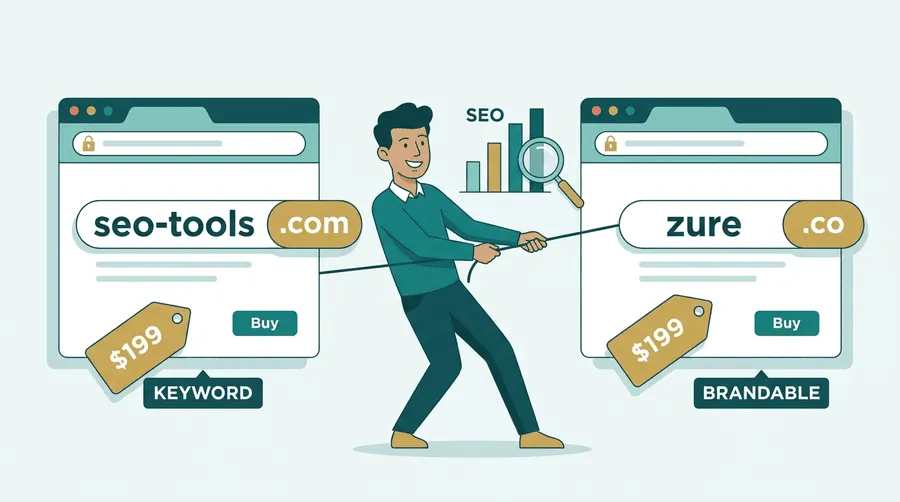
This is the boring answer that also happens to be the best one. A domain whose name is relevant to your topic — a clear keyword match, or a strong brandable that you'll make relevant through content — gives you keyword signal, memorable branding, and a completely fresh, penalty-free start. There's no history to vet because you're the one making the history. It's the play with all of the upside and none of the risk, and it's where the overwhelming majority of founders should be shopping. We break down the trade-off between exact-match and brandable names in keyword domains vs. brandable domains for SEO.
2. Redirect a genuinely relevant domain you legitimately acquired
This is the M&A play, executed at small scale. You buy a domain that has real, on-topic history — a defunct competitor, a project you're consolidating, an old brand of your own — and 301-redirect it to your main site so its relevant authority consolidates. Done with genuine relevance, this is completely normal; it's the same mechanism behind every corporate acquisition. The keyword there is relevant. More on the mechanics below.
3. Register defensively around your brand
Buying the plural, the common typo, the matching alternate TLD, or the .com of your alt-TLD brand isn't a ranking play — it's a protection play. It stops branded traffic and link equity from leaking to a squatter and keeps competitors from parking on a near-match of your name. It's cheap insurance, and on a fixed-price marketplace it's often trivially affordable.
Here's a live snapshot of the kind of clean, keyword-relevant names that fit plays #1 and #3 — every one vetted for a clean history and $199 or less:
What a 301 redirect actually does (and doesn't) preserve
The 301 redirect is the single most misunderstood tool in this whole conversation, so let's be precise. A 301 is a permanent redirect — it tells search engines "this address has moved here for good, transfer the credit." And Google is explicit that this works: in its official guidance on moving a site, Google states plainly that "'301' and other permanent redirects don't cause a loss in PageRank." You can read the full guidance in Google's site-move documentation.
So the mechanism is real. Two things determine whether it works for you:
- Relevance governs how much transfers. A redirect from a topically related source consolidates strongly. A redirect from an unrelated one gets discounted — Google can and does treat a wildly off-topic redirect as passing little or no value, because the content and audience don't line up. A defunct fashion blog pointed at a B2B software site is a weak signal at best and a red flag at worst.
- Redirect in one hop, and use a 301, not a 302. Chains (A → B → C) leak equity at every step; redirect straight from the acquired domain to the final destination. And a 302 is a temporary redirect — Google doesn't consolidate signals through it reliably, so for a permanent move you always want the 301.
If you're running the redirect play as part of a rebrand or migration, the mechanics of doing it cleanly overlap heavily with the checklist in when to rebrand your startup, and the actual name-transfer step is covered in the complete domain transfer guide.
The line you can't cross: Google's expired domain abuse policy
Here's the part the aged-domain marketplaces don't put in their sales copy. In 2024 Google added expired domain abuse to its spam policies as a named, targeted violation. The definition is worth quoting exactly:
"Expired domain abuse is where an expired domain name is purchased and repurposed primarily to manipulate search rankings by hosting content that provides little to no value to users."
Google's own examples make the boundary vivid: affiliate content on a site that used to belong to a government agency; commercial medical products on what was a nonprofit medical charity; casino content on a former elementary school's domain. In each case the buyer wasn't acquiring a relevant asset — they were harvesting a stranger's leftover authority for an unrelated purpose. That's the abuse. And the enforcement has teeth: sites caught by this policy have lost the overwhelming majority of their traffic effectively overnight. You can read the current policy in full on Google Search Central's spam policies page.
The practical test I use is a plain-English one: could you explain this redirect or acquisition to a smart friend who knows nothing about SEO, and have it sound like a normal business decision rather than a trick? "We bought the domain of a competitor we absorbed" passes. "We bought a dead yoga studio's domain to funnel its links into our crypto site" does not. If the only reason a domain is interesting is its leftover link juice, you're on the wrong side of the line.
How to vet a domain's history before you pay
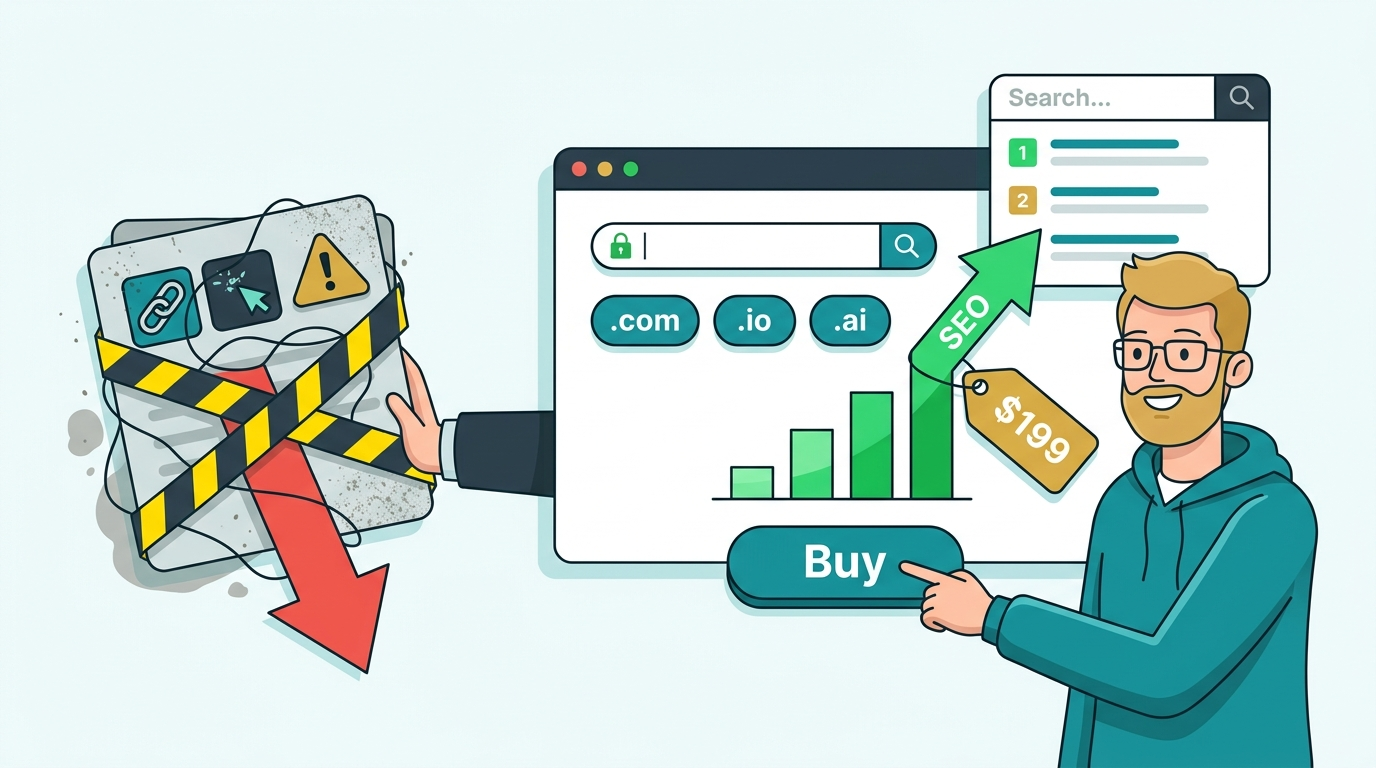
If you are buying a domain with history — play #2 — the vetting is not optional. Because a domain's baggage, including past penalties, can follow it to you, a cheap aged domain with a bad past is more expensive than a clean domain at full price. Run these checks before money changes hands:
| Check | Tool | What you're looking for | Red flag |
|---|---|---|---|
| Content history | Wayback Machine | Real, on-topic pages over the years | Parked pages, foreign-language spam, gambling/adult, sudden topic switches |
| Backlink profile | Ahrefs / Majestic | Natural, relevant, varied links | Thousands of identical anchors, link-farm footprints, irrelevant sources |
| Index status | site:domain.com in Google |
Currently or recently indexed cleanly | Deindexed entirely, or indexed with spam pages |
| Penalty history | Search Console + manual review | No sign of manual actions | Traffic that collapsed and never recovered |
| Topical fit | Your own judgment | History matches your niche | A domain "in a related territory" that really isn't |
The Wayback Machine check is the one people skip and the one that catches the most. Spend ten minutes clicking through a domain's captured snapshots and its real history reveals itself fast — you'll see whether it was a genuine business, a churn-and-burn spam site, or a domain that changed identity three times. If the archive shows anything you wouldn't want your brand associated with, no price makes it worth it.
For a fuller picture of how history, backlinks, and comparables actually factor into what a name is worth, see domain valuation explained.
Aged domain vs. clean domain: which should you actually buy?
Put the two options side by side and the honest trade-off becomes obvious for most buyers.
| Factor | Aged domain with history | Clean, relevant domain |
|---|---|---|
| Upfront authority | Possibly some — if history is clean and relevant | None; you build it |
| Risk | Inherits penalties, spam links, abuse-policy exposure | Effectively zero |
| Vetting effort | High — hours of Wayback, backlink, penalty checks | Minimal |
| Best case | On-topic links consolidate via a clean 301 | Fast, safe ranking on genuine content |
| Worst case | Penalty follows you; traffic tanks | You have to earn rankings (as everyone does) |
| Right for | Experienced operators running a relevant M&A-style redirect | Almost every founder and business |
The uncomfortable truth the shortcut-sellers won't tell you: for the vast majority of buyers, the clean domain wins. The aged-domain play has a real but narrow use case, demands expertise to execute without blowing up, and carries downside that a fresh domain simply doesn't have. Unless you know exactly what you're doing and the history is genuinely relevant and genuinely clean, the safe play is also the smart one.
This is exactly why buying from a marketplace that pre-screens every listing for clean WHOIS history and clear meaning removes most of the risk from the equation — you get the SEO-friendly qualities of a relevant, memorable name without gambling on someone else's past. Here's a current set of clean, brandable names that give you a penalty-free foundation to build on, each $199 or less:
Prefer to browse by intent? Explore the curated keyword collection for exact-match relevance or the brandable collection for names you'll make relevant through content — every one vetted for clean history and $199 or less.
A simple decision framework
Strip away the noise and buying a domain for SEO comes down to four questions, in order:
- Do I need someone else's history at all? If you're building fresh content and brand, no — buy a clean, relevant domain (play #1) and stop here. This is the right answer for most people.
- If I do want history, is it genuinely relevant to my topic? If not, walk away. Irrelevant history is the fast lane to the expired-domain-abuse policy.
- Is the history clean? Run all five vetting checks. One serious red flag kills the deal regardless of price.
- Can I explain the acquisition to a non-SEO person without it sounding like a trick? If yes, proceed with a single-hop 301. If no, you already have your answer.
Run those four honestly and you'll never buy a domain that comes back to bite you — and you'll skip the entire category of expensive mistakes that make "buying domains for SEO" sound scary in the first place.
The bottom line
Buying a domain for SEO is neither a magic shortcut nor a minefield — it's a decision with clear right and wrong moves. The wrong move is chasing "age" and leftover link juice on an unrelated domain, which is precisely what Google's expired-domain-abuse policy is built to punish. The right move is almost always simpler and cheaper: buy a clean, relevant, memorable domain with no baggage, redirect only genuinely related history in one honest hop, and build real authority on top. Age was never the asset. Relevance and a clean history are.
Ready to start on solid ground? Browse the curated keyword and brandable catalog — every name AI quality-vetted for a clean history and clear meaning, every one $199 or less, and ready to transfer within 72 hours. Or ground your strategy first with our pillar guides on keyword domains and brandable domains.