Every "best domain extension" guide on the internet tells you the same thing: .com is "High" trust, .io is "Medium-High," some new TLD is "Growing." None of them show their work. You're handed a vibe dressed up as a verdict, with no data, no methodology, and — most damaging — no acknowledgment that trust depends entirely on who is looking at the URL.
I've spent 20+ years buying, selling, and writing about domains, watching real buyers react to real extensions, and the single most expensive mistake founders make is assuming there's one universal trust ranking. There isn't. A senior backend engineer and your aunt do not judge .io the same way. A fintech compliance officer and a teenage early-adopter do not read .xyz the same way. The extension that builds instant credibility with one audience can quietly cost you conversions with another.
So this is the ranking I wish existed: tiered, segmented by audience, and backed by current 2026 data — registration figures, phishing-perception research, and deliverability signals — instead of hand-waving. By the end you'll know exactly which extension your specific product should wear, which ones to avoid, and how to lock a credible name for $199 or less instead of overpaying a broker for the letters after the dot.
How we ranked TLD trust (the methodology nobody else shows)
Before the rankings, here's the method — because a trust ranking without one is just an opinion.
Three forces actually move how much a human trusts an extension:
- Familiarity and scale. The more registrations and the longer the track record, the more "real" an extension feels. The internet crossed 392.5 million domain registrations across all TLDs in Q1 2026, with .com and .net alone accounting for 176.1 million of them, according to Verisign's Domain Name Industry Brief. Ubiquity breeds trust —
.comis the ending people assume when they can't remember the real one. - Spam and phishing association. When a meaningful share of an extension's domains get used for abuse, every domain on that extension inherits the suspicion. The APWG Phishing Activity Trends Report logged 1,003,924 phishing attacks in a single quarter, with payment and banking targets making up 30.9% of them — and mailbox providers respond by filtering hardest on the extensions abusers favor.
- Audience-specific signaling. A
.devtells a developer "built by one of us." That same.devtells a non-technical consumer almost nothing. Trust is contextual, so the ranking below is split by audience rather than flattened into a single misleading score.
We combined those three forces into four trust tiers, then noted where each extension's score changes depending on who's judging it. That second part is the whole point.
The 2026 TLD trust tiers (the table everyone else gets wrong)
Here is the core ranking. "Consumer," "Developer," and "Enterprise" are the three audiences whose trust most often decides a purchase, a signup, or a click.
| Extension | Consumer trust | Developer trust | Enterprise trust | One-line read |
|---|---|---|---|---|
| .com | Highest | High | Highest | The universal default; safest everywhere |
| .org | High | High | High | "Mission / institution" signal |
| .ai | Medium-High | High | High | "Serious AI product," now mainstream in tech |
| .io | Medium | Highest | High | "Developer tooling / B2B platform" |
| .app | Medium-High | High | Medium-High | "An application you open," HTTPS-secured |
| .dev | Low-Medium | Highest | Medium | "Built by and for developers" |
| .co | Medium | Medium-High | Medium | Clean .com alternative; mild ambiguity |
| .net | Medium-High | Medium | Medium | Legacy-trustworthy, slightly dated |
| .xyz / .online | Low-Medium | Medium | Low-Medium | Cheap, mixed reputation; name carries it |
| Free ccTLDs (.tk/.ml/.ga) | Very Low | Very Low | Very Low | Avoid — spam-saturated, heavily filtered |
The pattern that no single-score ranking can capture jumps out immediately: .io and .dev are top-tier for developers but middling for consumers, while .com is the only extension that's elite across all three audiences. That gap is the entire reason "what's the best TLD?" has no universal answer.
Why .com still wins — and exactly when it doesn't
Let's be honest about the leader. .com is the most trusted extension in 2026 for the same reason it was in 2006: it's the default the entire internet was trained on. When someone half-remembers your brand, their fingers type .com. When a non-technical visitor sees yourbrand.com, they read "established company." That reflex is worth real money in consumer conversion, and no amount of "new TLDs are fine now" commentary erases it.
But the .com advantage has a precise boundary, and crossing it costs founders dearly:
- It's a consumer advantage, not a universal one. To a developer evaluating an API, a sharp
.ioor.devreads as more credible than a clumsy.com. The trust premium is audience-specific. - A bad
.combeats a good one nowhere.getyourapphq.comdoes not out-trust a cleanyourapp.io. Length, spelling friction, and hyphens destroy the very trust the.comwas supposed to buy. We break this down in keyword domains vs. brandable domains for SEO. - The price reflex is the real trap. Founders assume the
.comtrust premium requires a five-figure aftermarket check. It doesn't. The mistake is overpaying a broker for the extension when a clean name on the right TLD — including plenty of.coms — sits at a fixed, transparent price.
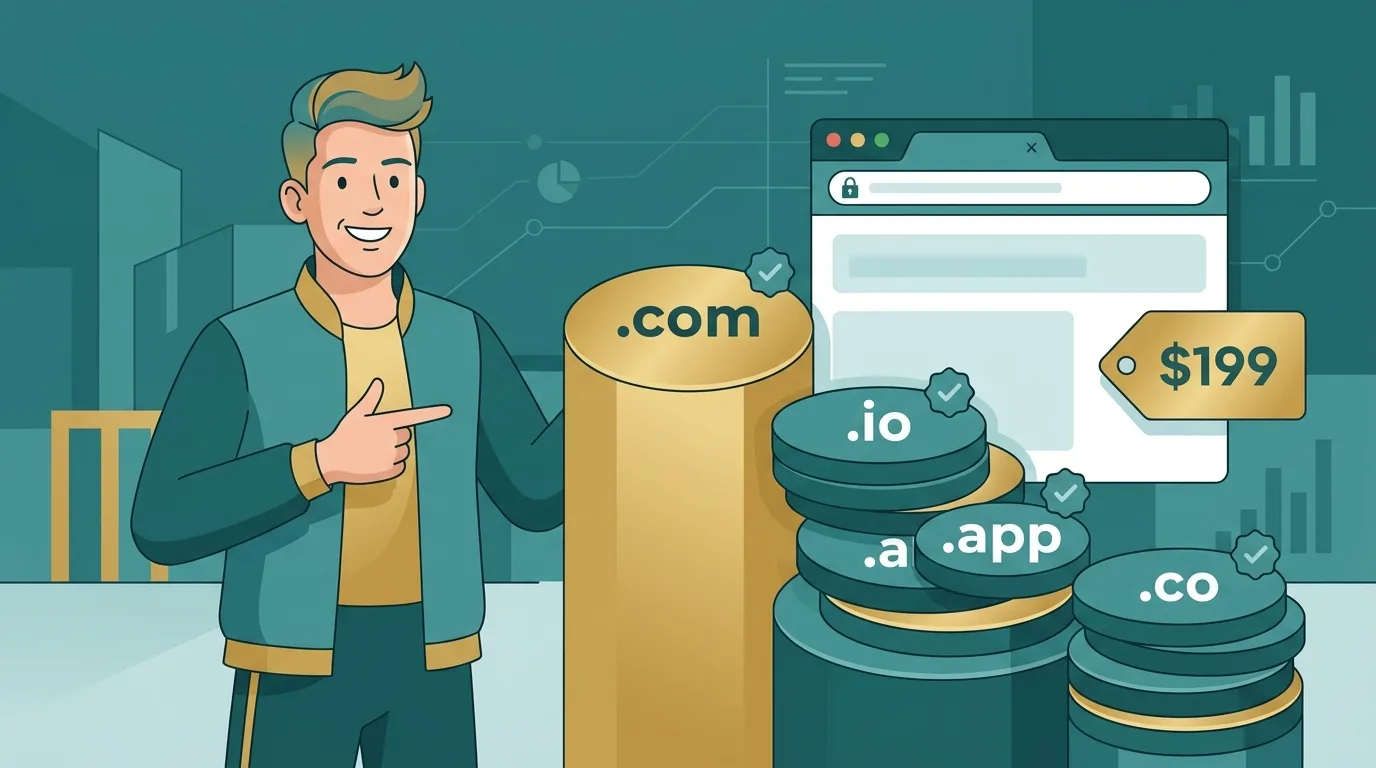
The takeaway: default to .com for mainstream consumer brands when a clean one is within reach, but never torture a name into a worse .com when a better extension fits your audience. For the full economics of getting a strong .com affordably, see how to get a premium domain for under $500.
The developer tier: why .io, .dev, and .app outrank .com for technical audiences
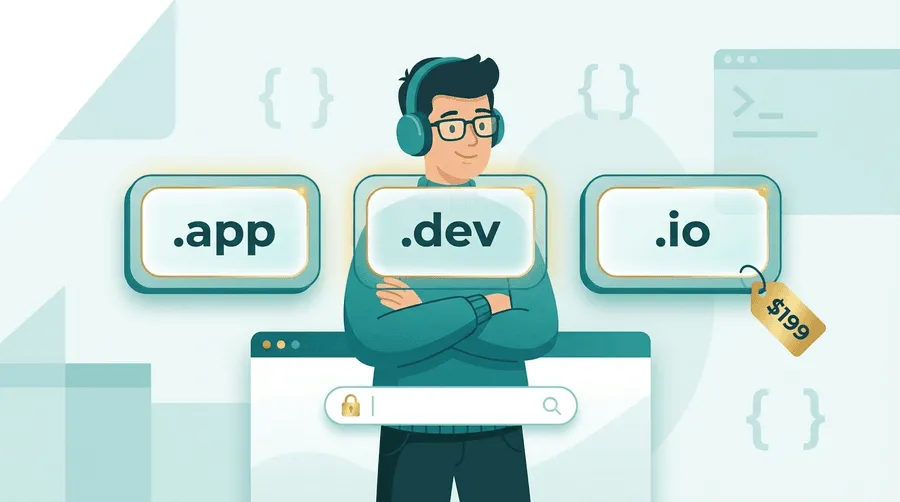
Flip the audience and the ranking reorders. For developers, the extension is a credential. .io carries the longest track record in developer culture — it reads as "input/output" and has become shorthand for APIs, CLIs, and serious B2B tooling. .dev, operated by Google Registry, says "built by a builder." .app says "this is the application," and because both .app and .dev are HSTS-preloaded, they're HTTPS-only by default — a security posture technical buyers actively respect.
These names also solve a problem .com can't: availability. The short, clean, one- and two-word names that vanished from .com a decade ago are frequently still open on the developer TLDs.
If you're shipping something for engineers, the deeper trade-offs — HTTPS enforcement, renewal-cost differences, and the ccTLD footnote on .io — are worth understanding before you pick. We cover all three head-to-head in .app vs .dev vs .io for indie developers. The short version: for a technical audience, a great developer-TLD name doesn't just match a .com — it often beats one.
The .ai question: credible extension or expensive bubble?
No extension's trust trajectory has moved faster. .ai crossed one million registrations in January 2026 and has been growing at roughly 1% per week, propelled by the AI startup wave. Two years ago .ai read as "niche technical ccTLD." In 2026 it reads as "this company is serious about AI" — it has crossed from improvised to intentional in the eyes of both developers and enterprise buyers.
That said, trust and price are different conversations. The surge has pushed .ai aftermarket prices high and its registry renewals run well above a typical .com, so the danger isn't credibility — it's overpaying for the halo. The move is to get the .ai trust signal without the speculative markup.
The qualities to look for are the same ones that make any .ai credible: short, pronounceable, obviously brandable, and genuinely tied to an AI or data product rather than bolted on for hype. For the full breakdown of finding affordable .ai names and avoiding the renewal-cost trap, see .ai domains for startups: what's still affordable in 2026.
The phishing-perception problem: which TLDs quietly cost you trust
Here's the part the cheerful "all TLDs are fine now!" guides skip. Some extensions actively subtract trust, and the damage is measurable in places founders don't think to look — chiefly the spam folder.
The mechanism is reputation by association. When an extension is cheap enough and lightly-verified enough that abusers flock to it, mailbox providers and security tools start filtering every domain on that extension more aggressively. The classic offenders are the free country-code TLDs — .tk, .ml, .ga, .cf — which became so saturated with phishing and spam that many email systems flag or block them outright. With over a million phishing attacks logged in a single quarter by the APWG, filters have no incentive to give a spam-heavy extension the benefit of the doubt.
A few practical rules fall out of this:
- Avoid free and ultra-cheap, low-verification extensions for anything you'll send email from. The deliverability hit is real and largely invisible until your signups stop arriving.
- The TLD is not a Google ranking factor. Google treats new gTLDs like any other extension, so
.ai,.app, and.corank exactly as well as.com. The penalty is human and inbox-based, not algorithmic. - Reputation is inherited, so curation matters. A clean-history name on a respected extension protects you; a random cheap registration on a tainted one fights you from day one. This is why trust-sensitive sectors like finance lean conservative — see domain names for fintech startups.
Which extension should you pick? A decision framework by use case
Skip the generic ranking and match the extension to what you're actually building:
If you're building a mainstream consumer brand
Lead with .com. The universal-default trust reflex is worth most here, and a clean .com removes friction with non-technical buyers. If the exact .com is compromised or absurdly priced, a strong .co or a great brandable on another extension beats a tortured .com — but try for the .com first.
If you're building a developer tool, API, or B2B platform
Lead with .io or .dev, and treat .com as optional. Your audience reads these as credentials, availability is far better, and a crisp technical-TLD name signals "built by people who get it."
If you're building an AI or data product
.ai now carries real signal — but only buy it at a sane price, and make sure the name would stand on its own without the hype. A great brandable on .com or .io can serve an AI product just as well without the renewal premium.
If you're an agency, studio, or freelancer
Credibility and email professionalism matter most; .com, .co, and .studio/.agency-style names all work if the name reads established. We cover the suffix patterns and the personal-name-vs-brand decision in domain names for agencies and freelancers.
Whatever tier you land in, the winning move is the same: pick the extension your audience trusts, then buy the best name available on it at a transparent price.
You can browse the full curated catalog of featured domains across every trustworthy extension, or narrow straight to handpicked brandable names — every listing AI-vetted for clean history and trademark conflicts, and every one $199 or less.
Trust is the name and the extension — not the extension alone
The biggest myth in domain naming is that trust lives in the dot. It doesn't. Trust is a product of the extension your audience expects and the quality of the word in front of it. The 2026 data confirms .com is still the universal default and that a handful of spam-saturated extensions genuinely cost you credibility — but it also confirms that .io, .dev, .app, and .ai are fully trusted by the audiences that matter to them, often more than a worse .com would be.
So stop hunting for the single "most trusted" extension. Identify who you need to trust you, pick the tier that matches, and then spend your energy on getting a short, clean, defensible name rather than overpaying for letters after a dot. On a fixed-price marketplace, that name — on whatever extension your audience trusts — is a single transparent checkout at $199 or less, vetted for clean history and ready to transfer within 72 hours.
Ready to pick yours? Start with the featured catalog across every credible extension, or sharpen the style of name first with our guides to brandable domains and keyword domains.