Here is the uncomfortable truth I learned in 20+ years buying, selling, and writing about domains: the price of a premium domain has very little to do with what it is worth — and everything to do with who is selling it.
I have watched founders pay $20,000 for names that would have sold for $2,000 a year earlier, simply because their startup gained visibility and the seller knew it. I have also watched patient, well-informed builders walk away with genuinely premium names for under $200.
This guide is the playbook I wish every founder had before opening a "Make an Offer" form — including what premium domains actually are, why prices balloon, where the affordable options hide, and what to do the moment after you buy.
What Is a Premium Domain, and Why Does It Cost So Much?
Before you can find a cheap premium domain, you need to understand what "premium" actually means — because the word gets used in two very different ways that carry completely different cost implications.
Type 1: Aftermarket (Resale) Premium Domains
These are domain names that someone already registered and is now selling at a markup. The word "premium" here is informal — it just means the name is considered high quality, typically because it is short, memorable, brandable, or contains a valuable keyword.
Example: launch.io is registered, not available to hand-register. The owner has it listed on Sedo for $12,000. There is nothing official about that price — it is a seller's ask, set speculatively.
Aftermarket premium domains have standard renewal fees once you own them (you pay whatever your registrar charges for that TLD going forward). The premium is a one-time purchase cost.
Type 2: Registry Premium Domains
These are domain names where the registry itself (the organization that controls the TLD) has designated certain names as premium and assigned special pricing. When you see a .co, .io, or new TLD name in a registrar's search results with an inflated "registration fee" — often $50–$5,000+ just to register — that is a registry premium.
The key difference: with a registry premium domain, the elevated cost does not stop at purchase. Renewal fees and transfer fees are also higher than standard registration prices, sometimes indefinitely. You can end up paying hundreds of dollars per year to hold a registry-premium name.
Practical rule: before you pay a high registration price for a "new" domain, check whether it is a registry premium — and if so, check the renewal price at the same registrar. Surprises at renewal are one of the most common rookie mistakes in this market.
Do You Pay for a Premium Domain Once, or Every Year?
This is the single most misunderstood part of premium domain pricing, so let's make it unambiguous: an aftermarket premium domain is a one-time purchase, not a subscription. You pay the seller's price once to acquire the name, and after that you only pay your registrar's standard annual renewal — typically $10–$20/year for a .com. The four- or five-figure sticker you see on a broker listing is the acquisition cost, paid a single time.
The exception is a registry premium name (Type 2 above), where the registry sets an elevated price that repeats every renewal. That is why the "is this a one-time fee?" question matters so much: on the aftermarket, yes; on a registry premium, no.
| What you're buying | Upfront cost | Recurring cost |
|---|---|---|
| Aftermarket premium (resale) | One-time acquisition price | Standard renewal (~$10–$20/yr) |
| Registry premium | Elevated registration | Elevated renewal, often indefinitely |
| Fixed-price name on 199.domains | One time, $199 or less | Standard renewal (~$10–$20/yr) |
So when a name is listed at $199 or less on a fixed-price marketplace, that is what you pay once — you own the name outright and renew it at ordinary rates thereafter. Always confirm the renewal price before you buy, because a low headline price on a registry-premium name can quietly cost you more over three years than a higher one-time acquisition would. For the full five-year cost comparison across every buying route, see how much a premium domain really costs.
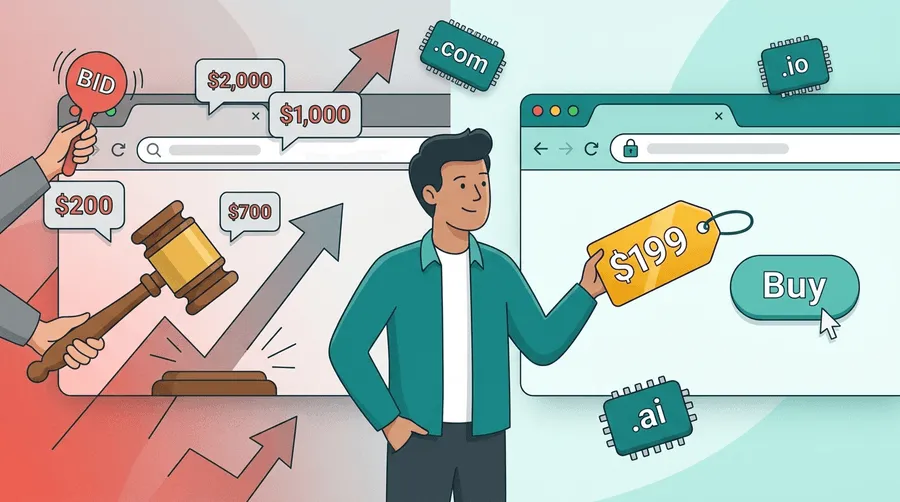
Why Premium Domains Cost $2,000 to $50,000 on the Aftermarket
When you search for a name and see a four- or five-figure price tag, you are not looking at a market price. You are looking at a negotiation anchor. Three forces inflate it:
1. Speculative pricing with no floor disclosure
Sellers on traditional marketplaces price for the best-case buyer — a funded startup that must have the name. The founder of Resend documented this perfectly: the asking price for resend.com was $39,999, and he ultimately closed it for $25,000 through weeks of parallel negotiations. The "price" is never the price.
2. Broker and marketplace commissions
Commission-based platforms typically take 15% to 25% of the sale. Sellers know this and bake it into the listing. When you pay $10,000 for a domain, a meaningful slice never touches the domain's value — it covers the middleman.
3. Visibility-based repricing
Domain prices rise as you grow. The moment your project hits Product Hunt or a funding announcement goes out, the owner of your dream domain knows your budget just expanded. This is why experienced founders secure names before launch, not after.
Real Scenario: "I Found This Domain on GoDaddy for $1,790 — What Should I Do?"
This is the exact situation that sends founders to Reddit at midnight. Here is the decision tree:
Step 1 — Is it a registry premium or an aftermarket listing?
Look at the renewal price alongside the registration price. If GoDaddy shows $1,790 to register, $1,790 to renew, it is a registry premium — budget accordingly or walk away. If the renewal is $12–$15/year, it is aftermarket.
Step 2 — Search for the same name on other platforms. The same aftermarket domain can be listed at wildly different prices on different platforms. Search for it on Sedo, Afternic, and Dan.com — you may find a lower ask or a "make an offer" form where $800 gets accepted.
Step 3 — Check whether the owner has had it a long time. Use WHOIS (without privacy protection) or check the Wayback Machine to see how long the domain has been held and whether it was ever developed. A domain parked for 8 years with no development is a sign the owner has forgotten about it — opportunity for negotiation.
Step 4 — Consider whether the exact name is necessary.
If launch.io is $1,790, check whether launch.app, launch.dev, or a brandable variation like launchio.co exists and is affordable. For most early-stage startups, a clean name on a modern TLD beats a compromised .com at ten times the price.
Step 5 — If it is aftermarket and you want it, make an offer. Open negotiations at 30–40% of the asking price. Use the negotiation approach in the section below.
The Four Routes to a Premium Domain Under $500
Route 1: Fixed-Price Curated Marketplaces (Fastest, Zero Negotiation)
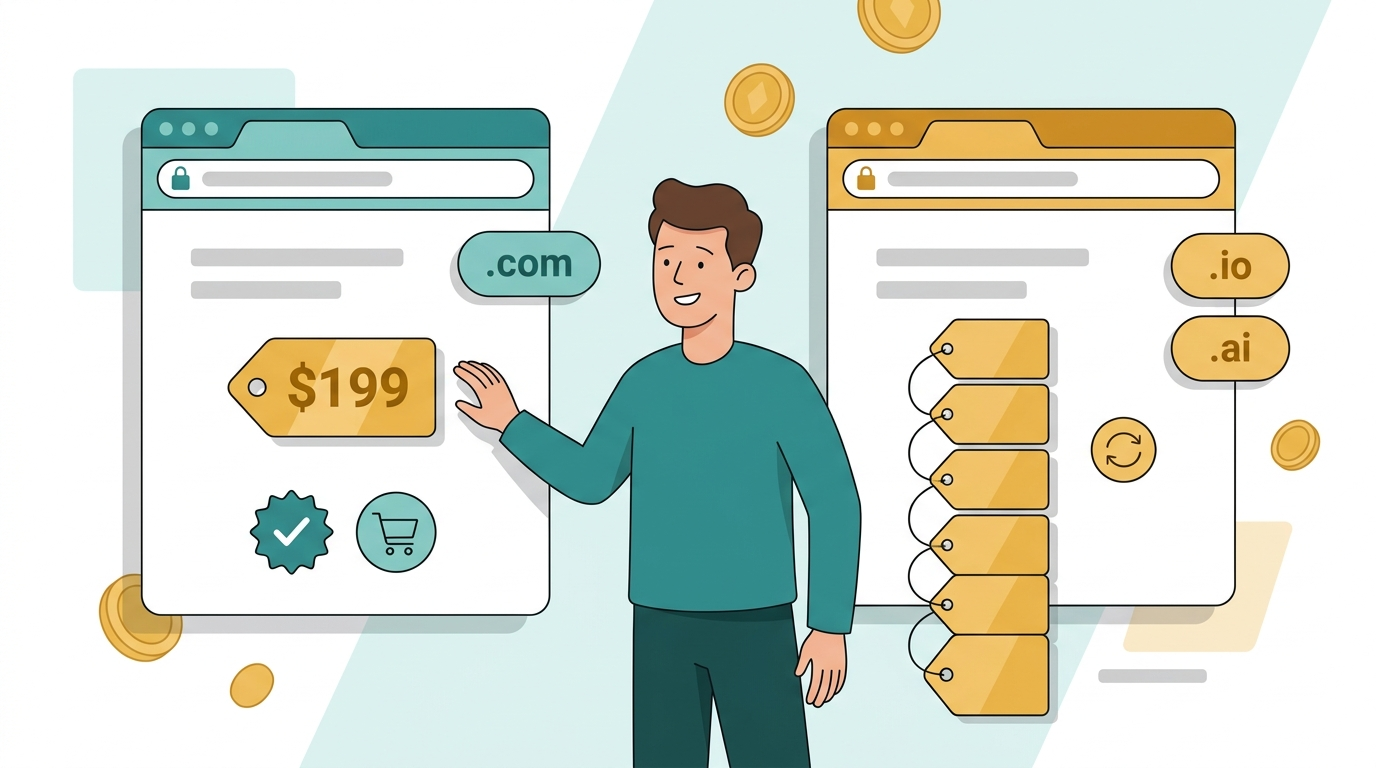
A newer model removes the negotiation layer entirely: curated catalogs where every domain carries one transparent price, shown up front. Our marketplace at 199.domains lists 1,300+ handpicked brandable and keyword domains, each priced individually at $199 or less — checkout via Stripe, transfer initiated within 72 hours, full refund if the transfer fails.
The economics work because fixed-price models trade margin for volume and skip the commission stack. Every name in the catalog has been vetted for clean history and trademark conflicts before listing.
Start with featured picks or browse recently added domains.
Route 2: Expired Domain Auctions (Cheapest, Most Research Required)
Every day, thousands of registered domains expire because owners stop renewing. Hidden among the junk are genuinely premium names — solid brandables frequently sell between $50 and $500 at auction.
Where to look:
- GoDaddy Auctions — the largest drop-catching service
- DropCatch — specialist in premium drop catches
- NamePros — community forum with private seller listings, often under asking
- ExpiredDomains.net — aggregates dropping domains with filter tools
The research you must do before bidding:
- Check the Wayback Machine — past spam, adult content, or link farms follow the domain
- Pull the backlink profile in Ahrefs or Semrush — toxic anchors hurt you from day one
- Search USPTO TESS — a live trademark on the term can force a forced transfer
- Confirm no ICANN transfer lock (see the post-purchase section)
The time investment is significant — plan 30–90 minutes per serious candidate, and expect to evaluate many before winning one.
Route 3: Exact-Match Names on Modern TLDs (Best Value Arbitrage)
This is the single biggest pricing arbitrage in naming today. The .com of your ideal name may cost $15,000 on the aftermarket, while the identical word on .app, .dev, .io, .ai, or .co costs a fraction — and in many cases registers new.
Industry data shows roughly a third of funded startups now launch on a non-.com TLD as their primary domain — a share that has more than doubled in four years. For developer tools, SaaS, and apps especially, names on .app or .dev often carry more niche credibility than a compromised .com would.
The key is matching the TLD to your audience — a point we cover in depth in domain names for indie developers: .app vs .dev vs .io and the best domain names for SaaS startups in 2026.
Route 4: Direct Negotiation (When You Must Have a Specific Name)
If you need one specific registered domain, direct negotiation is your path — and most buyers give away their leverage in the very first email. (For the deeper negotiation playbook, see 10 lessons on how domain brokers really work.) Here is how to negotiate without leaving money on the table:
1. Never reveal your company identity. Use a personal email address and inquire as an individual. The moment a seller knows you are a funded startup, the floor rises.
2. Run parallel negotiations on 2–3 alternatives. Real alternatives give you genuine walk-away power. "I am also looking at a couple of others" is not a bluff if it is true.
3. Open at 20–30% of ask. This is not insulting in the domain market — it is the expected starting move. A $5,000 listing: open at $1,200–$1,500.
4. Set a hard internal deadline. Naming is a notorious founder time-sink. Give yourself two weeks maximum, then take your best alternative.
5. Use licensed escrow. For any deal over $500, use Escrow.com or your registrar's built-in transfer protection. Confirm the process aligns with ICANN's transfer policy.
Negotiation Email Template
Copy and adapt this for a cold outreach to a domain owner:
Subject: Interested in [domain.com]
Hi,
I came across [domain.com] and wanted to reach out directly. I am an individual working on a project and exploring whether this name might be available.
Would you consider an offer of $[20–30% of ask or a reasonable opening]? I can move quickly with Escrow.com to make the process straightforward for both of us.
If this is not the right range, I would welcome knowing your best price. Either way, I appreciate you taking a moment to respond.
Best, [First name only]
Keep it short, non-corporate, and offer a concrete number. Vague "what's your best price?" openers invite the seller to repeat their ask.
What the Market Actually Looks Like: Where Domains Sell and for How Much
Understanding the full marketplace landscape helps you know where to search and what to expect to pay:
| Platform | Type | Typical Price Range | Commission |
|---|---|---|---|
| 199.domains | Fixed-price curated | $199 or less | None |
| Atom (Squadhelp) | Curated brandable | $1,500–$10,000+ | ~25% |
| BrandBucket | Curated brandable | $1,000–$10,000+ | ~30% |
| Sedo | Open aftermarket | $500–$500,000+ | 10–15% |
| Afternic / GoDaddy | Open aftermarket | $500–$100,000+ | 20% |
| Dan.com | Open aftermarket | $300–$100,000+ | 9% |
| NamePros | Community forum | $50–$5,000 | 0% (direct) |
| GoDaddy Auctions | Drop/expiry auction | $12–$5,000 | 20%+ |
| Direct registration | New/available name | $10–$200 | None |
For the full breakdown on why the price you see is never the price you pay on auction and broker platforms, read our comparison of fixed-price vs. auction domain pricing.
Full Cost Comparison: What You Actually Pay
| Factor | Broker / Make-an-Offer | Expired Auctions | Modern TLD Exact Match | Fixed-Price ($199 or less) |
|---|---|---|---|---|
| Typical total cost | $2,000–$50,000+ | $50–$500 + fees | $10–$500 | $199 or less |
| Commission/fees | 15–25% baked in | Auction + escrow fees | None | None |
| Time to close | 2–8 weeks | Days–weeks of hunting | Instant | Instant checkout |
| History vetting | Your responsibility | Your responsibility | N/A (new) | Done before listing |
| Renewal cost | Standard going forward | Standard going forward | Check for registry premium | Standard going forward |
| Transfer timeline | 1–4 weeks | Varies by registrar | N/A | Under 72 hours |
| Refund if transfer fails | Rare | Platform-dependent | N/A | Yes — 100% |
Due Diligence Checklist Before Buying Any Cheap Domain
A low price is only a bargain if the asset is clean. Run this audit on any aftermarket purchase:
History check
- Wayback Machine: no spam, adult content, phishing, or link farm history
- Google site: search — check what pages Google has indexed
- MozBar or Ahrefs: pull the backlink profile for toxic anchors (casino, pharma, counterfeit)
Trademark check
- USPTO TESS: no live marks on the exact term in your industry class
- EUIPO and WIPO if you operate internationally
- Check for pending applications, not just registered marks
Registry check
- Confirm renewal price at your registrar before buying (especially for
.io,.co,.ai, new TLDs) - Check for registry premium designation — some renewals are 10× the standard rate
Transfer check
- Confirm registration date — domains registered within 60 days are ICANN-locked
- Check domain status at ICANN WHOIS: status must not include "clientTransferProhibited" set by the owner (this differs from standard registrar locks)
- Confirm the seller can provide the EPP/auth code at purchase
On the seller
- Use Escrow.com or registrar-backed transfer protection for any deal over $500
- If using a private seller, verify WHOIS or get a signed letter confirming ownership before payment
What Happens After You Buy: The Transfer Timeline
Many buyers focus entirely on acquisition and are blindsided by the transfer process. Here is exactly what to expect after you complete a purchase:
Day 0 — Purchase and payment You complete checkout (Stripe, Escrow.com, or the platform's payment system). For fixed-price marketplaces, this is instant. For aftermarket deals, payment initiates the process.
Days 0–3 — Transfer initiation The seller (or the marketplace) submits the domain transfer at the losing registrar: the domain is unlocked, any privacy protection is removed, and an EPP/auth code is generated and sent to you.
Days 1–3 — You initiate at your registrar You enter the EPP code at your gaining registrar (Cloudflare, Namecheap, Google Domains, etc.) and submit the transfer request.
Days 3–8 — ICANN transfer window ICANN mandates a 5-day transfer approval window. The losing registrar notifies the registered owner email. Transfers auto-approve after 5 days if not rejected; some registrars allow expedited approval in hours.
Day 8–10 — DNS update Once the transfer completes, you update nameservers and DNS records. Your domain is live at your registrar.
ICANN 60-day lock rule: If a domain was registered or transferred within the last 60 days, it cannot be transferred to a new registrar regardless of what the seller agrees to. Always confirm the domain's registration or last-transfer date before purchasing.
For a full deep-dive on EPP codes, transfer locks, and what to do when a transfer fails, see our complete domain transfer guide.
Is a Cheap Premium Domain Worth It?
The short answer is yes — with a caveat on what "cheap" means.
A vetted, trademark-clean, brandable name on a respected TLD is worth $199. Paying $500 for a clean one-word name at an expired auction is a bargain. Paying $15,000 for a .com when a functionally equivalent .io would have cost $299 is usually a mistake.
The psychology of domain names and why certain names convert better is a topic in its own right — we cover the cognitive science behind processing fluency, phonetic symbolism, and trust signals in SaaS naming psychology. The bottom line is that a $199 name with the right characteristics outperforms a $15,000 name with the wrong ones.
The Bottom Line
The premium domain market runs on opacity: hidden floors, embedded commissions, and prices that scale with your visibility. The counter-strategy is simple — buy before you are visible, buy where prices are transparent, and never pay for the negotiation theater.
Whether you hunt expired auctions, claim an exact match on a modern TLD, or pick a vetted name off a fixed-price shelf, a genuinely premium domain under $500 is not a unicorn in 2026. It is a process.
Browse the curated fixed-price catalog — 1,300+ vetted names, every one priced at $199 or less with the exact price shown up front. Or read our companion guides on brandable domains and keyword domains to find the right style of name for your strategy.