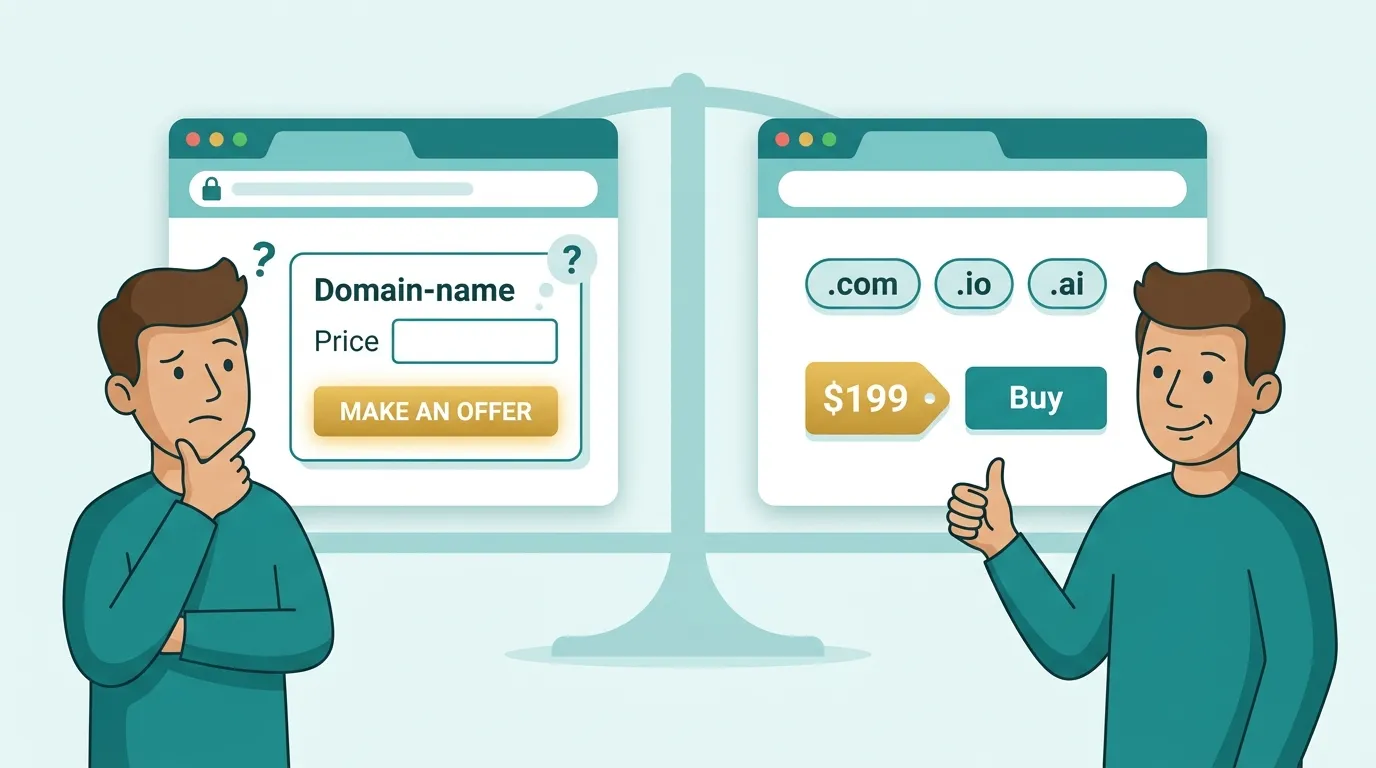
A founder emailed me last month, mid-panic, asking what he should offer for a domain. The listing had no price — just a clean, friendly "Make an Offer" button and a box waiting for a number. He'd been staring at it for a day. Too low and he'd insult the seller; too high and he'd overpay. He had no idea what the name was actually worth, and the listing was carefully designed so he never would.
I've spent 20+ years on the other side of that box, buying, selling, and writing about how these listings are built. So let me tell you what most negotiation guides won't, because they're written from the buyer's chair guessing at the seller's intent: a "Make an Offer" listing is not a courtesy, and it is not a hint that the price is flexible downward. It is a deliberate pricing tactic, built on two well-documented pieces of behavioral economics, and it is engineered to extract the highest number you're willing to say out loud.
This is the guide I wish that founder had read before he opened the form. We'll pull apart exactly why the blank price box works, who actually holds the information, what a domain negotiation really costs you beyond the price tag, and the one antidote that makes the whole game disappear. Every domain I feature here is $199 or less — a number, printed, that means what it says.
Why does a domain say "Make an Offer" instead of showing a price?
Start with the question almost nobody asks: if the seller knows what they want for the domain, why not just print it?
Because a printed price is a ceiling, and an offer box is not.
The moment a seller lists "$3,000," they can never get more than $3,000 from you — and if you'd have happily paid $8,000, they've left $5,000 on the table. A blank offer box has no ceiling. It invites the most motivated buyer in the world to walk up and reveal, in their own words, how much this name is worth to them. The form isn't asking what the domain is worth. It's asking what you are worth, and most buyers answer honestly without realizing they've been asked.
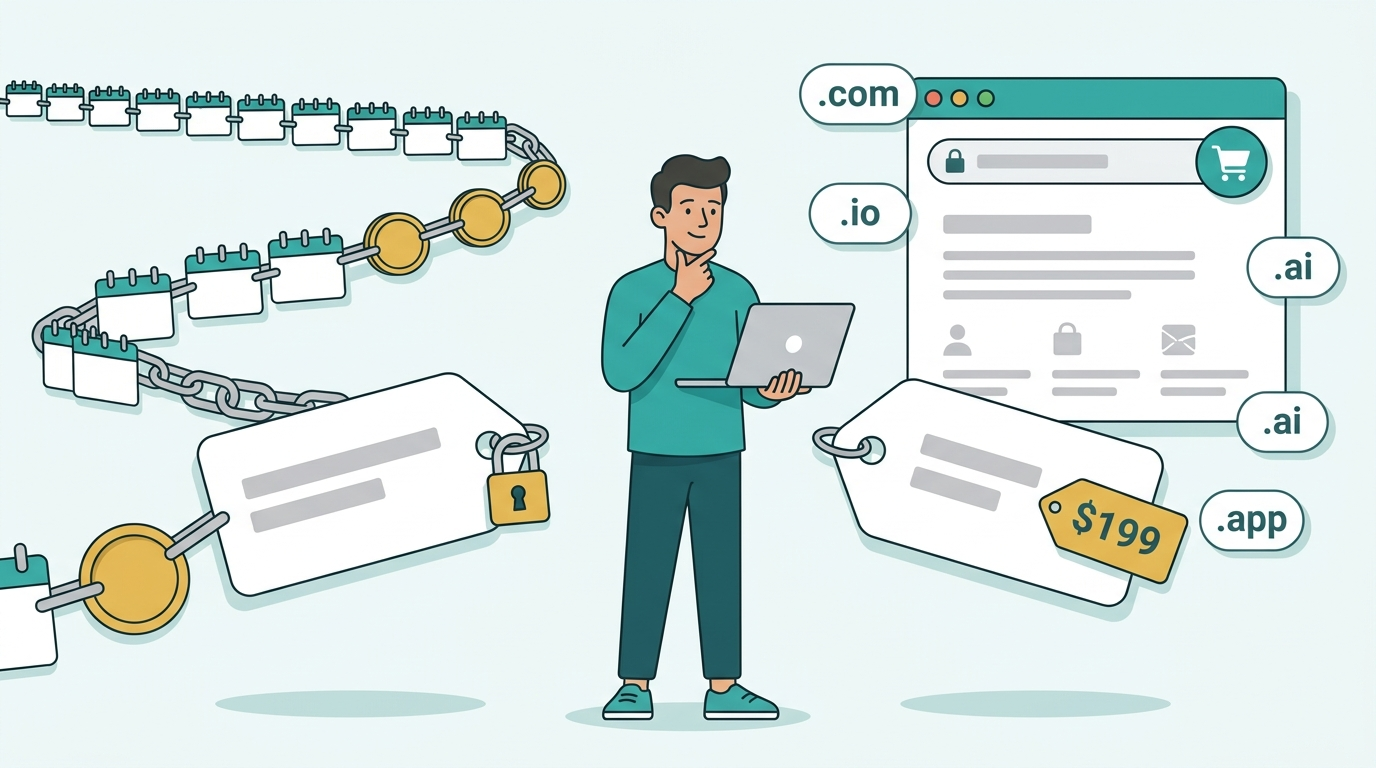
There's a second, quieter mechanism. The instant you fill in that box, you've started something. You've made contact, you've named a number, you're now "in a negotiation." Behavioral economists call the pull that keeps you there the sunk-cost effect: the time and emotional energy you've already spent makes walking away feel like a loss, even when continuing is the worse decision. Two weeks of back-and-forth later, the $1,500 gap between you and the seller feels small relative to everything you've invested — so you close it. That stretch was the plan all along.
Investor's note: When I set a listing to "Make an Offer," I wasn't being flexible. I was running price discovery on your budget at my expense of nothing. The blank box is the single most profitable thing a domain seller can do, which is exactly why so many premium listings use it.
The anchoring trap: how the first number rewrites the whole negotiation
Here's where it gets genuinely sneaky, and where the research is unambiguous.
When you finally type a number into that box, one of two things happens — and both favor the seller. If you anchor low to "leave room," the seller re-anchors hard in the opposite direction, and the midpoint you eventually settle on is far higher than your opening figure. If you anchor high because you're afraid of insulting them, you've just told them your ceiling and handed them the entire surplus.
The underlying force is anchoring bias, one of the most robust findings in all of behavioral economics. As the Harvard Program on Negotiation lays out in its primer on price anchoring, the first number named in a negotiation exerts a disproportionate pull on the final agreement — drawing directly on Daniel Kahneman and Amos Tversky's landmark work showing that even arbitrary, random numbers measurably shift the prices people will subsequently accept. The anchor doesn't have to be fair or even relevant to work. It just has to be first.
Watch it operate in a real, documented case. When the founders of Resend negotiated for their domain, the seller opened at $39,999. That number was the anchor. The buyer countered with a deliberate lowball of $7,999 to test the floor; the seller came back at $35,000; after a few days of back-and-forth they closed at $25,000. Notice the gravity. The final price sat far closer to the seller's $39,999 anchor than to the buyer's $7,999 counter — not because the domain was objectively worth $25,000, but because the negotiation orbited the first big number that got named. That is anchoring doing exactly what it does.
A "Make an Offer" box is anchoring with the safety off. There's no listed price to push back against, so whoever names the first serious number sets the gravity well for everything that follows. And the seller has run this play hundreds of times. You're running it once.
Information asymmetry: the seller knows the floor, you're guessing
Even setting psychology aside, "Make an Offer" negotiations are rigged by something more basic: the two sides do not have the same information.
The seller knows what they paid for the name. They know its renewal cost, its traffic, its prior offers, how long they've held it, and the lowest number they'd actually accept. You know none of that. You know how much you want it — which is the one fact that hurts you most to reveal, and the exact fact the offer box is built to extract.
The negotiation literature is clear-eyed about who this favors. In its analysis of whether to make the first offer, the Harvard Program on Negotiation concludes that the party with better information about the zone of possible agreement should drop the aggressive anchor. In a domain deal, that party is almost always the seller. They've mapped the realistic price range; you're standing outside it in the dark, trying to guess where the edges are. When the better-informed side also gets to shape the anchor, the less-informed side — you — systematically overpays.
This is the part the tactical "5 tips to negotiate a domain" listicles never confront. They hand you scripts for playing the game better. They don't tell you the game itself is built on an information gap you can't close from your seat, no matter how clever your email is.
The cost nobody puts on the invoice: your time
Suppose you play well. You research comps, you anchor smartly, you hold your nerve, and you talk a $4,000 ask down to $2,900. You "won" $1,100.
Now count what it cost you to win it.
Two to three weeks of split attention. A dozen emails drafted and second-guessed. The silent stretch where the seller goes quiet to apply pressure and you refresh your inbox instead of building your product. The escrow setup, the transfer initiation, the days of limbo. For a founder racing to launch, that's not free — it's some of the most expensive time you have, spent on procurement instead of on the thing customers actually pay you for.
I watched founders do this constantly: pour two weeks and real cognitive bandwidth into saving an amount of money that their stalled launch cost them several times over. The negotiation has a price tag that never appears in the final invoice, and for anyone with momentum on the line, it's frequently the largest line item of all.
| What you're really paying | "Make an Offer" listing | Fixed price ($199 or less) |
|---|---|---|
| Headline price | Unknown until you negotiate | Printed up front ($199 or less) |
| Anchoring exposure | High — first big number sets the deal | None — no anchor to fight |
| Information position | Seller knows the floor; you guess | Price is public; symmetric |
| Time to own | Days to weeks of back-and-forth | Instant checkout, transfer in 72h |
| Broker commission baked in | Typically 10–20% (15% common) | None |
| Founder bandwidth cost | Weeks of split attention | Minutes |
| Walk-away clarity | Murky — sunk cost pulls you back | Clean — it fits the budget or it doesn't |
The right-hand column isn't just cheaper. It's legible. You can make the decision in a minute because there's nothing hidden to discover.
The antidote: a price that's just a price
The fix for all of this is almost insultingly simple. Take away the blank box.
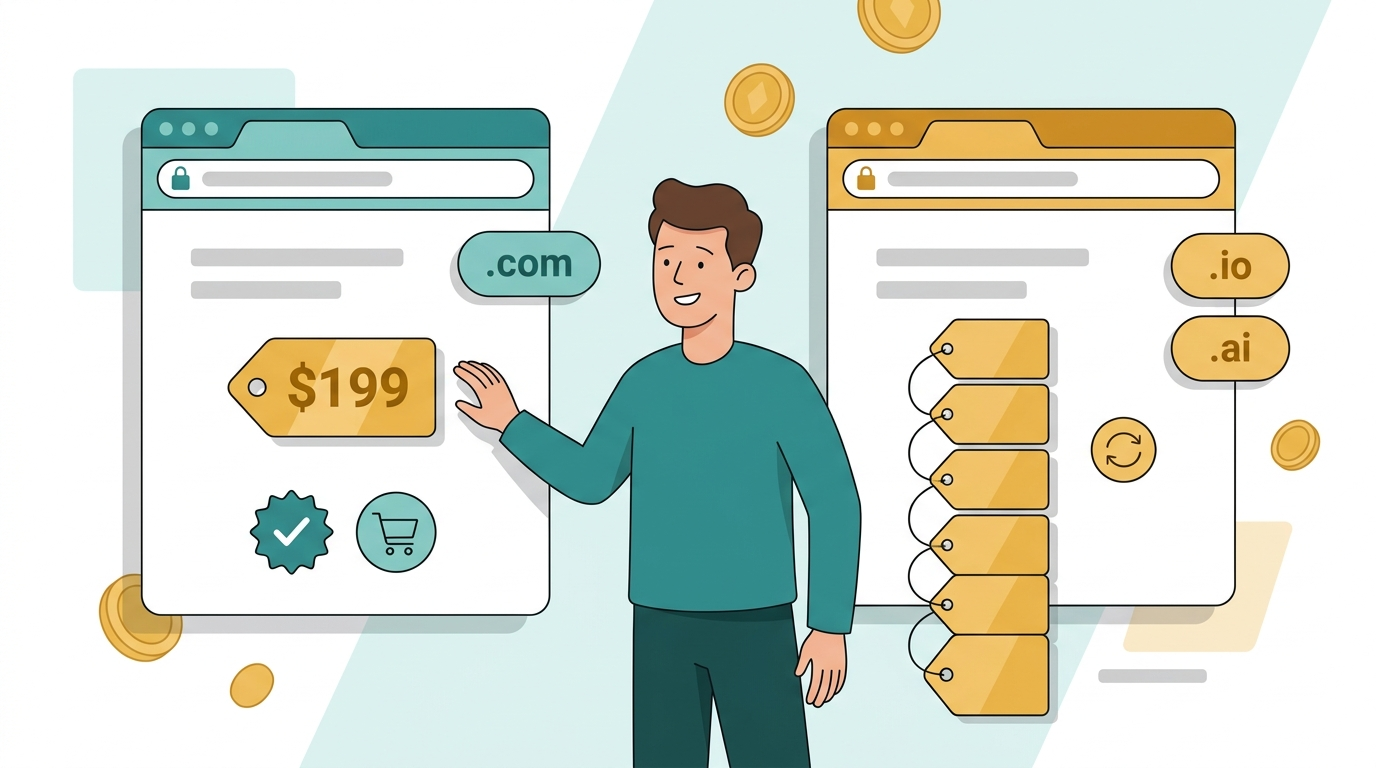
When a domain has a transparent, fixed price, every mechanism we've just dismantled stops working at once. There's no anchor for the seller to set, because the number is already printed and you see it before you ever make contact. There's no information asymmetry, because the one fact that matters — the price — is public. There's no sunk-cost spiral, because there's no negotiation to get trapped inside. There's no commission to inflate the number, and no two-week tax on your attention. You look at the price, you decide if the name is worth it to you, and you either buy it or you don't. That's the entire transaction.
This is the model we built 199.domains around, and it's worth being precise about why fixed pricing can work where the aftermarket can't. We make our margin on volume and on the curation itself — every name is screened for clean history and trademark conflicts before it's listed — rather than on out-negotiating you on a single deal. Every domain in the catalog is $199 or less, printed up front. There is no offer box. For the deeper economics of how this compares to the auction and broker models, I broke it all down in fixed-price vs. auction domains: the real cost of buying premium and how to get a premium domain for under $500 without a broker.
Here's a live sample of the catalog — short, brandable, vetted names, every one a fixed price of $199 or less with no negotiation and no anchor to fight. These pull straight from current inventory, so what you see is genuinely available right now:
What these share isn't luck — it's a printed price. You can evaluate any of them in the time it takes to read the name, because there's nothing hidden behind the number waiting to be negotiated out of you.
When does making an offer actually make sense?
I'm not going to pretend negotiation never has its place — that would be its own kind of dishonesty. There are narrow cases where engaging a "Make an Offer" listing is rational:
- The name is genuinely irreplaceable to you. If a specific exact-match
.comis load-bearing for your brand and nothing else will substitute, you may have no choice but to negotiate for it. Just go in with eyes open about the asymmetry. - You have strong comp data. If you've done real homework on a database like NameBio and you know the realistic range cold, you've narrowed the information gap enough to anchor credibly. This is the one situation where being the better-informed party can flip to your side — and it's worth learning how domains are actually valued before you name a number, so you can tell whether an ask is fair.
- You can truly walk away. The buyers who do best in domain negotiations are the ones who don't need the name. If you have a strong second choice, your willingness to leave is the only real leverage you have — and it only works if it's genuine.
Outside those cases, the "Make an Offer" box is a tax on people who don't know they're being taxed. And notice that two of the three exceptions are really about closing the information gap — which a transparent marketplace hands you for free. For most founders, especially anyone whose name isn't uniquely irreplaceable, the disciplined move isn't to negotiate better. It's to refuse to play a game stacked against you and buy from a catalog where the price is the price. The psychology behind why we overvalue the "perfect" specific name in the first place is its own rabbit hole, one I dug into in the psychology of startup domain names.
For founders who'd rather spend their energy on naming patterns that scale than on haggling, here's a live set of brandable, ready-to-grow names in the same catalog, every one $199 or less:
If you want help choosing which name to lock before you ever worry about price, our guide to the best domain names for SaaS startups in 2026 walks through the patterns that hold up as a company grows.
How to protect yourself if you do negotiate
If your situation lands in one of those narrow exceptions and you're going to engage an offer form anyway, at least walk in with armor:
- Set your walk-away number before you send a single email. Write it down. The whole point of the offer box is to move that number after you're emotionally committed — so commit to it in writing while you're still calm.
- Don't reveal urgency. The fastest way to raise the price is to signal you need the name by Friday. Sellers read desperation instantly, and it re-anchors them upward.
- Anchor first, and anchor with data. If you genuinely know the comps, naming a credible, evidence-backed number first can pull the deal toward you instead of letting the seller's anchor set the gravity. Without comps, you're better off saying as little as possible.
- Price your own time into the deal. Before you start, decide how many days of your attention this name is worth. When you hit that limit, the negotiation is over regardless of where the price landed — your bandwidth is the budget you're actually spending.
- Always use escrow. Never wire money directly to a stranger for a domain. A neutral escrow service protects both sides, and any legitimate seller will expect it.
Every one of these is a defense against a tactic the seller is deploying on purpose. That's worth sitting with for a second: a fair, transparent transaction shouldn't require you to armor up at all.
The bottom line on "Make an Offer" domains
A blank price box looks like an open door. It's a funnel. It's built on anchoring bias and information asymmetry — two forces the research says reliably favor whoever sets the price and knows the floor, and in a domain deal that is almost never you. The few hundred dollars you might save by negotiating well are routinely swallowed by the broker's commission, the seller's anchor, and the quiet weeks of founder attention the whole process devours.
You don't have to play. The antidote to a manipulated price is a transparent one: a number, printed, that means what it says and is there before you ever make contact. That's the entire idea behind a fixed price of $199 or less — no offer, no anchor, no negotiation, no commission, and your launch instead of your inbox. Skip the blank box. Browse the curated catalog of $199 domains, find the name, and spend the two weeks you'd have lost haggling on the thing you actually came to build.