Every founder eventually types a single dictionary word into a registrar search box, hits enter, and watches the same thing happen: taken. Then they try the aftermarket and find a five- or six-figure price tag. The natural conclusion is that affordable one-word domains simply don't exist anymore — that the era of grabbing a clean single word for the price of a nice dinner is over.
That conclusion is half right, and the half it gets wrong is the half that matters. I've spent 20+ years buying and selling domains and writing about the market, and "do affordable one-word names still exist?" is one of the most common questions I get. The honest answer is: the obvious ones don't, but there are still four well-defined pockets where genuinely good one-word and one-word-feeling names trade for under $500 — and most buyers never look in them.
This guide is the map. We'll cover the scarcity math so you understand why the headline prices are what they are, the four places affordability actually hides, a two-minute method to sanity-check any price, and a simple buy-vs-wait decision so you stop refreshing the same sold-out search.
Why Are One-Word .com Domains So Rare and Expensive?
Start with the supply side, because it explains everything else. There are roughly 160 million registered .com domains — .com alone accounts for around 157 million of the world's ~368 million total registrations, according to Verisign's Domain Name Industry Brief. The English language, by contrast, has a working vocabulary in the low tens of thousands of common words. That mismatch was resolved years ago: the common dictionary words were registered in the 1990s and early 2000s, and the desirable ones have essentially never lapsed.
So the supply of available one-word dictionary .coms is, for practical purposes, zero. Tools that crawl the entire .com zone confirm it — searches for newly available one-word .coms return nothing, because there is nothing. What changes hands does so on the aftermarket, where price is set by auction psychology rather than utility.
That's why the numbers look the way they do. Four-letter .coms trade for $50,000 and up. Recognizable one-word .coms sell for six and seven figures — icon.com changed hands for $12 million in 2025, and chat.com reportedly sold for $15.5 million. You are not paying for a better website address than a two-word name would give you. You are paying for scarcity — the social signal of owning a word outright. For a venture-backed company raising on the strength of its brand, that math can pencil out. For a founder, indie developer, or bootstrapper trying to launch, it usually doesn't.
The mistake is letting that headline price convince you the whole category is out of reach. It isn't. You just have to stop hunting in the most-picked-over part of the field.
Where Do Affordable One-Word Domains Actually Hide?
The five-figure names get the headlines, but affordability lives in four specific pockets. Each one gives you a name that reads as a clean single word — which is what your customer's brain actually responds to — without the singular-dictionary-.com tax.
1. Plural forms and grammatical variants
The single biggest blind spot. If router.com is a six-figure name, routers.com or a one-word .app/.io plural is frequently a fraction of the price — and in many product contexts the plural reads better ("we host your routers," "manage all your finals"). Brokers and bots anchor on the singular, which leaves plurals, gerunds (-ing forms), and agent nouns (-er forms) comparatively under-shopped. A plural costs you nothing in recall: a listener who hears "routers dot app" types it correctly every time.
2. Niche and lower-frequency dictionary nouns
The famous one-word .coms are high-frequency words everyone competes for. But the dictionary is deep, and thousands of precise, evocative, lower-frequency nouns — the kind that perfectly describe a narrow product — sit in the aftermarket at sane prices because demand for them is thin. A geologist, a reseller, a final — specific nouns that own a category in a niche cost far less than a generic word that a thousand companies want. The narrower your space, the better this works.
3. Coined and brandable single words
Some of the strongest one-word brands aren't dictionary words at all — they're short, phonetic, invented terms (think of the coined names behind many billion-dollar companies). A coined one-word name is, by definition, available, trademark-clear in its space, and yours alone. The trade-off is that you have to teach the meaning rather than borrow it — but you skip the scarcity tax entirely. We break down how to judge a coined name in our guide to keyword vs. brandable domains for SEO.
4. One-word names on modern TLDs
The cleanest path of all. The single word that's gone on .com is very often wide open on .io, .ai, .app, .co, or .dev. These aren't fringe extensions anymore — there are now over a million registered .io domains and hundreds of thousands of .ai names, and for technical and AI-native audiences they read as more modern than a compromised .com. You get the exact same single word, the same auditory cleanliness, at a tiny fraction of the price. We make the full case for this in one-word domains for startups.
Here is a live snapshot of one-word and short brandable names currently in the catalog — every one $199 or less:
Comparison: Where to Look for an Affordable One-Word Name
Not every pocket fits every project. This table maps the trade-offs so you can pick the lane that matches what you're building.
| Approach | Typical price | Recall quality | Best for | Watch-out |
|---|---|---|---|---|
| Singular dictionary .com | $50,000–$7,000,000+ | Excellent | Funded brands buying scarcity | Almost never under $500 |
| Plural / variant .com | Hundreds to low thousands | Excellent | Products that read better plural | Confirm singular isn't a competitor |
| Niche dictionary noun | Often under $500 (curated) | Very good | Narrow, specific categories | Word must fit the space precisely |
| Coined one-word name | $199 or less (curated) | Good (teach it once) | Unique, trademark-safe brands | You build the meaning |
| One word on .io/.ai/.app/.co | $199 or less (curated) | Very good | Dev, AI, and modern products | Mainstream users still type .com |
The pattern is hard to miss: the moment you step one inch off the singular-dictionary-.com, the price drops by one to four orders of magnitude while the name your customer hears stays just as clean.
How Do I Know If a One-Word Domain Is Fairly Priced?
Once you find a candidate, you need a sanity check — because the aftermarket is built to make every name feel like a steal or a once-in-a-lifetime opportunity, depending on which manipulates you faster. Here's the two-minute version of what I used to do professionally.
Step 1 — Pull comparable sales, not asking prices
Asking prices are fiction until someone pays them. What matters is what comparable names — similar length, similar extension, similar word commonness — actually sold for. Public sales databases let you search this in seconds. A four-letter .com and a niche eight-letter noun live in completely different price universes; comps anchor you to the right one.
Step 2 — Ignore the seller's anchor
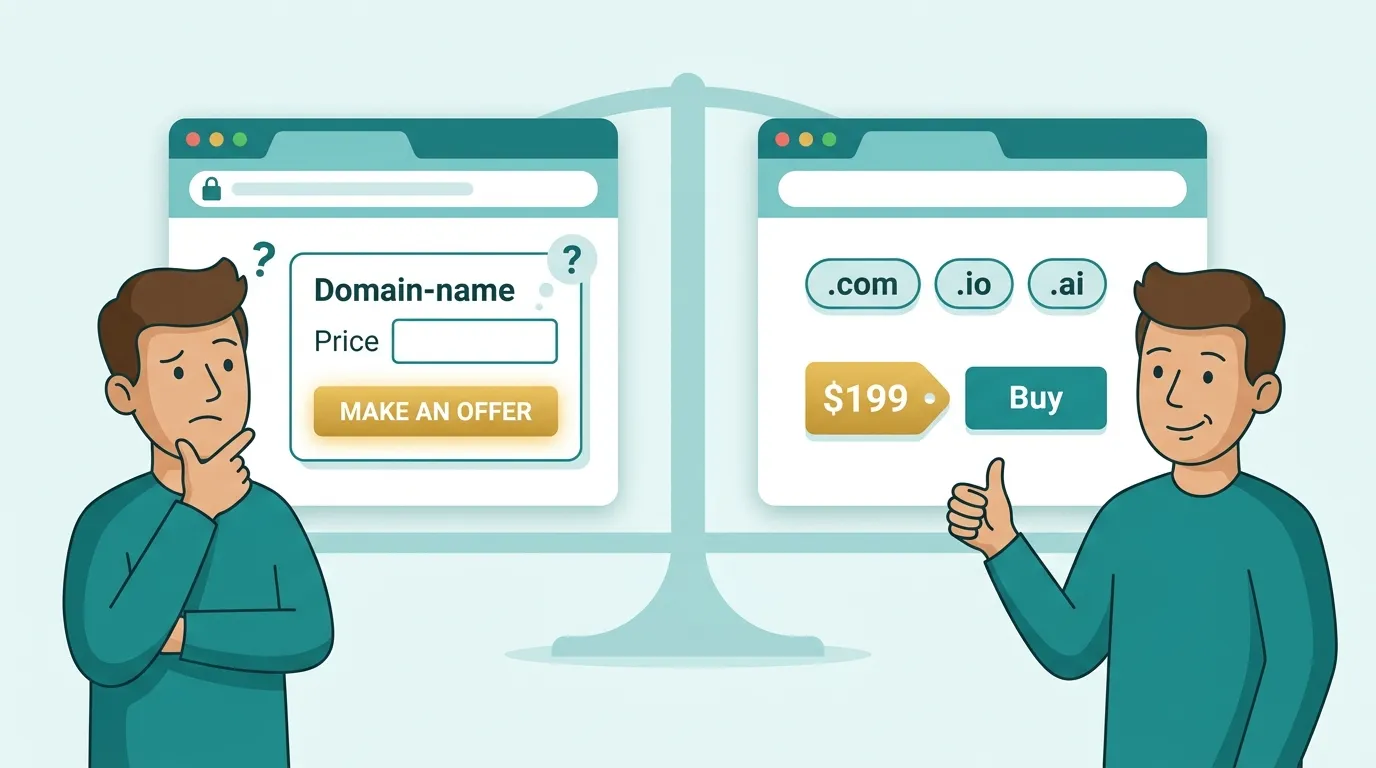
If a listing says "make an offer" or shows a price with a giant strikethrough, treat that number as a negotiation prop, not data. The seller knows their floor and you don't — that information asymmetry is the entire game, and it's why we wrote a whole piece on why 'make an offer' domains cost you more. A transparent fixed price you can see before you commit removes the manipulation; a hidden one invites it.
Step 3 — Run the say-spell-search test
Say the name out loud on an imaginary phone call. Can a listener spell it without you repeating yourself? Search it — does anything confusingly similar already rank? A name that passes all three is worth more to your business than a "better" word that fails one of them, regardless of what the comps say. Recall is the asset; the dictionary status is just a proxy for it.
Step 4 — Compare against the fixed-price floor
This is the shortcut the whole exercise is building toward. If a curated marketplace lists a clean one-word or one-word-feeling name at a fixed, transparent price that sits at or below your comps, the valuation question is already answered — there's nothing to negotiate and no asymmetry to lose to. For the full breakdown of how fixed pricing compares to auctions and brokers, see fixed-price vs. auction domains and how to get a premium domain for under $500.
Featured: Short, Clean Names Worth a Look
The catalog refreshes regularly. Here's a current snapshot of short-form and one-word-style names — the kind that pass the say-spell-search test and skip the scarcity tax — each $199 or less, ready to transfer:
Prefer to browse the whole set yourself? 199.domains now has a dedicated One-Word category filter — explore the premium one-word domain catalog or the curated brandable picks — every name $199 or less, all vetted for clean history.
Buy Now or Wait? A Simple Decision Framework
The last trap is hesitation. Founders sit on a good available name "to keep looking," and one of two things happens: someone else registers it, or they talk themselves into the six-figure singular .com they can't afford. Here's how to break the loop.
Buy now if the name passes the say-spell-search test, fits your space precisely, is available at a fixed, transparent price you can absorb, and you're within a few months of needing it. Good available one-word and short-form names don't sit still — the affordable pockets are affordable precisely because they're not yet picked over, and that's a temporary condition for any specific name you like.
Wait only if you genuinely haven't decided what you're building, or you're holding out for a singular dictionary .com and have a five-figure budget earmarked for it. "Waiting for the perfect word to get cheaper" is not a strategy — scarce assets don't get cheaper, and a name you can act on today beats a name you might afford someday. As we explain in the psychology of startup domain names, the cost of a slightly-less-perfect name you own is almost always lower than the cost of the perfect name you're still chasing.
The deeper point: a one-word name is an appreciating, resellable asset, not a sunk marketing cost. If you buy a clean one for $199 or less and your project pivots, you hold something with a real resale floor. The downside of acting is small and recoverable. The downside of waiting is watching the name get registered by someone faster.
The Bottom Line
Do affordable one-word .com domains still exist? The singular dictionary ones — chair.com, loan.com, the words everyone wants — effectively don't, and chasing them under $500 is a fool's errand. But one-word names that read just as cleanly to your customer absolutely still exist under $500: plurals and variants, niche nouns, coined brandables, and the same words on .io, .ai, .app, and .co. Those are where smart founders shop, and they always have been.
Stop measuring the category by its most expensive members. Run the say-spell-search test, check your comps, ignore the anchors, and when a clean name shows up at a fixed, transparent price, take it. The word your customers remember doesn't care whether it sat in the dictionary — it cares whether they can say it, spell it, and find it.
Ready to skip the scarcity tax? Browse the dedicated One-Word domain category — every short, brandable, vetted name $199 or less, ready to transfer within 72 hours. Or start with our pillar guides on keyword domains and brandable domains to lock in the style of name before you pick the word.