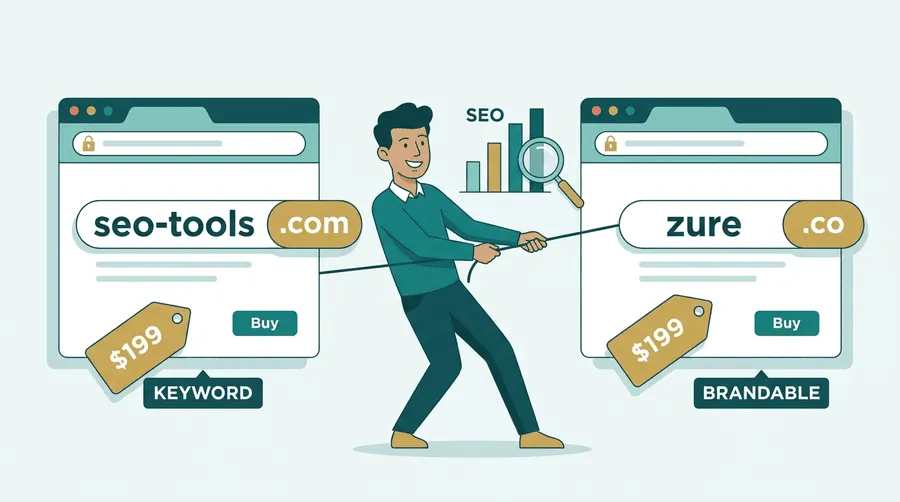
Every week, someone asks me a version of the same question: "Should I buy bestprojectmanagement.com because it's got my keywords in it, or should I grab something short and weird like zure.co?" It's one of the oldest debates in domains, and in 2026 it's still soaked in myths that were already outdated a decade ago.
I've spent 20+ years buying, selling, and writing about domains, and I watched the keyword-domain gold rush peak — and then watched Google quietly end it overnight in the fall of 2012. The marketers who didn't get the memo kept overpaying for exact-match keyword strings long after the SEO advantage evaporated. The ones who did get it pivoted to brandable and partial-match names and built companies you've heard of.
This is the honest, data-backed version of the keyword-vs-brandable question: what actually changed, where each style of name still wins, and a decision matrix to pick the right one without guessing. Every domain I feature here is $199 or less.
What's the Difference Between a Keyword Domain and a Brandable Domain?
Before the strategy, the definitions — because most arguments online conflate them.
A keyword domain (also called an exact-match or EMD when it matches a search phrase precisely) puts the search term directly in the name. denverplumber.com, cheapcarinsurance.com, projectmanagementsoftware.com. The pitch is instant topical relevance: a searcher and a crawler can both tell what the site is about from the URL alone.
A brandable domain is a distinctive, often invented or repurposed word that carries no literal keyword. monday.com, stripe.com, zure.co. The pitch is memorability and ownership: nobody confuses your brand with a category, and you can grow into new products without your name fighting you.
There's also a third, increasingly dominant category — the partial-match domain — which fuses the two: a brandable word with a keyword hint baked in, like seovis (SEO + a coined suffix). Hold that thought; it's where most smart 2026 buyers land.
Do Keyword Domains Still Help SEO in 2026?
Here's the short answer brokers and SEOs agree on: a keyword in your domain is not a direct Google ranking factor in 2026. It hasn't been for over a decade. If you only remember one thing, remember that.
The turning point was Google's Exact Match Domain (EMD) update, which rolled out on September 27–28, 2012. Matt Cutts announced it as a "small upcoming Google algo change [to] reduce low-quality 'exact-match' domains in search results." Per Search Engine Journal's algorithm history, roughly 41 exact-match domains fell out of the top 10 for competitive terms, and notably, non-.com EMDs were hit harder than their .com equivalents. It targeted thin, spammy sites that had been ranking purely on the keyword in the name — not all keyword domains, but the ones leaning on the name instead of the content.
Google's own URL structure guidance reinforces the point. It recommends readable, descriptive URLs "rather than long ID numbers" so that "Google Search (and your users) better understand your site" — but it frames this as a usability and crawlability matter, not a keyword-ranking lever. Readable beats cryptic; keyword-stuffed beats nothing.
So why do keyword domains still command interest? Because they retain indirect advantages:
- Click-through rate (CTR): A name that literally matches what someone searched can earn a few extra clicks in the results page — and CTR is a real engagement signal.
- Anchor text: When people link to a keyword domain, the URL itself often carries the keyword, nudging relevance.
- Faster classification: When your domain semantically matches the topic, Google has slightly less work to do figuring out what your site is about. Studies of local-service SERPs still find a majority of top results use exact- or partial-match domains — not because the name ranks them, but because relevant names correlate with focused, relevant sites.
The catch: every one of those benefits is a tailwind, not an engine. Behind a thin site, a keyword domain ranks nowhere. For the full picture of how search engines weigh names, see our pillar on keyword domains and when they work.
Where Brandable Domains Win for SEO
This is the part the "just buy keywords" crowd never tells you: because Google neutralized the keyword advantage, brandable domains compete on a completely level field — and then pull ahead on the signals that actually compound.
Branded search and type-in traffic
When users search your brand name directly or type your URL into the address bar, that's one of the strongest trust signals a site can send. You can't generate branded search volume for cheapcarinsurance.com — there's no brand to search. A memorable brandable name builds a moat of direct traffic that no keyword string can replicate. We dig into the recall mechanics in the psychology of startup domain names.
Natural, brand-shaped backlinks
Brandable names earn clean branded anchor text — journalists and bloggers write "Stripe," not "the online payments processing platform." That consistency reads as authority. Keyword domains, by contrast, can accumulate over-optimized exact-match anchors that look manipulative to Google's link-spam systems.
AI search and LLM citations
This is the 2026 differentiator. AI answer engines — ChatGPT, Perplexity, Google's AI Overviews — don't scan your domain for keywords. They surface and cite recognized brands they judge credible. A distinctive brandable name is far more likely to be remembered, named, and recommended by an LLM than a generic keyword phrase that reads like a thousand other thin sites. As search shifts from ten blue links to cited answers, brandability becomes an SEO asset, not just a marketing one.
For the deeper case on memorability and naming patterns, our pillar on brandable domains and our guide to one-word domains for startups both go further.
Keyword vs. Brandable: The Head-to-Head Comparison
Here's the trade-off matrix I'd put in front of any founder deciding between the two styles.
| Factor | Keyword domain | Brandable domain |
|---|---|---|
| Direct ranking boost | None since 2012 EMD update | None — level field |
| Click-through (CTR) | Small lift for matching queries | Earned through brand recognition |
| Memorability / recall | Low — blends into the category | High — distinctive and ownable |
| Type-in & branded search | Negligible | Strong, compounding trust signal |
| AI-search citations | Rarely named by LLMs | Far more likely to be cited |
| Anchor-text profile | Risk of over-optimized exact match | Clean branded anchors |
| Trademark protection | Hard — generic terms can't be owned | Strong — coined words are protectable |
| Scalability across products | Locked to one keyword | Grows with the company |
| Best for | Narrow, single-service or local sites | Long-horizon brands and startups |
The pattern is hard to miss: keyword domains offer a few narrow, indirect tailwinds; brandable domains win on nearly every signal that compounds over a brand's lifetime.
When Does a Keyword Domain Actually Make Sense?
I'm not here to tell you keyword domains are useless — that's the opposite mistake. There are real scenarios where a keyword (or partial-match) name is the right call:
- Hyper-local or single-service businesses. If you're a plumber in one city and you'll never expand beyond that service, a clean keyword name can earn CTR on exactly the queries you care about, and you're not trying to build a national brand.
- High-intent landing or microsites that support a larger brand and exist to capture one specific query.
- Partial-match names that get the best of both worlds — a keyword hint inside a brandable, trademark-able word. This is the modern default, and where I steer most buyers.
The failure mode to avoid is the generic exact-match string — bestbluewidgets.com — bought in the belief that the name will rank the site. Since 2012, it won't, and worse, it can read as spammy to both users and Google's quality systems. If relevance matters to you, get it through a partial-match name plus genuinely useful content.
The 2026 Decision Framework: Which Should You Buy?
Skip the agonizing. Run your shortlist through these five questions and the answer usually falls out.
1. Are you building a brand or capturing a query?
If the goal is a company that grows across products and raises money, you want a brandable or partial-match name. If the goal is to rank one focused page for one high-intent term, a keyword name can serve.
2. Can you own it?
You can't trademark "best car insurance." You can trademark a coined word. If legal defensibility matters — and for any funded venture it does — brandable wins. Our guide to the best domain names for SaaS startups covers the naming patterns that stay protectable.
3. Will an AI engine remember it?
Say the name out loud. Would a person — or an LLM summarizing your category — recall and cite it? Distinctive names get named. Generic strings get paraphrased and forgotten.
4. What does it cost to acquire?
Premium generic keyword .coms often command five figures on the aftermarket precisely because of the lingering keyword myth. A clean brandable or partial-match name is frequently available for a fraction of that. On a fixed-price marketplace, a vetted name is a single checkout at $199 or less — see how to get a premium domain for under $500 for why that gap exists.
5. Does the extension fit?
A keyword can carry on a modern TLD (resellers.app, outofmemory.dev), and a brandable shines on .com, .co, or .ai. Match the extension to your audience — our .app vs .dev vs .io comparison breaks down the developer-facing options.
Keyword, Brandable, or Partial-Match: A Quick Reference
| Your situation | Best fit | Why |
|---|---|---|
| Funded startup, long horizon | Brandable / partial-match | Scales, defensible, AI-citable |
| Local single-service business | Keyword / partial-match | CTR on focused intent |
| Side project or MVP | Brandable (short) | Cheap, memorable, upgradeable |
| Microsite supporting a brand | Keyword | Captures one query |
| Anything you'll trademark | Brandable | Generic terms can't be owned |
The Bottom Line for 2026
The keyword-versus-brandable debate was settled, quietly, on a September weekend in 2012 — and most of the internet still hasn't caught up. Google stopped handing out free rankings for keywords in domains, which means the question is no longer "which one ranks better?" (neither does, directly) but "which one builds a brand that earns rankings?"
For the overwhelming majority of founders and builders, that's a brandable or partial-match name: memorable, ownable, AI-citable, and free of the spammy baggage that haunts generic exact-match strings. Keyword domains keep a narrow, legitimate role for focused, single-intent sites — but they are a tactic, not a strategy.
The good news is you don't have to overpay for either. Browse the curated catalog of brandable domains or keyword domains — every listing vetted for clean history and trademark conflicts, every one $199 or less, ready to transfer within 72 hours. Pick the style that matches your ambition, then go build the thing that earns the ranking.