What do the best SaaS startups have in common, before they have a product, a logo, or a single customer?
A name worth building on.
I have spent over two decades buying, selling, and writing about domains, and the pattern is unmistakable: the SaaS companies that scale cleanly almost always started with a name that was short, ownable, and engineered for trust. The ones that struggled often spent their first year apologizing for a name — spelling it out on calls, losing traffic to a competitor's exact-match domain, or quietly planning a rebrand they could not yet afford.
This guide is the data-backed playbook for naming a SaaS startup in 2026: what funded companies actually chose, the five naming patterns that reliably work, how to pick the right TLD, and real domains you can acquire today for $199 or less.
What Funded SaaS Startups Actually Named Themselves
Before reaching for a thesaurus, it helps to know what the companies that raised money actually did.
The single clearest signal in the data is the dominance of the exact brand-match domain — a domain that is the company's name, with no "get," "try," or "app" bolted on. Among Y Combinator-backed startups, roughly 57% own their exact brand-match domain, and a strong majority of funded startups overall still anchor on a .com. The takeaway is not that you must have a .com to raise — plenty of developer-first companies thrive on .io, .dev, and .ai — but that owning your name cleanly matters more than any single extension.
The companies that win their category tend to share three naming traits:
- Their domain is their name. No prefix, no workaround. When you hear the company, you know the URL.
- It survives the phone test. A founder can say it on a podcast and listeners can find it without spelling help.
- It looks like a brand, not a search query. Investors and enterprise buyers read a clean name as a credibility signal.
Harvard Business Review's research on how brand associations drive customer spending reinforces the point: the associations a name triggers — competence, modernity, trust — translate directly into willingness to pay. Your domain is the first brand association a customer ever encounters.
The 5 SaaS Naming Patterns That Work
Nearly every strong SaaS name fits one of five repeatable structures. Knowing them turns naming from a blank-page panic into a filtering exercise.
1. Invented or coined word
A made-up word with no prior meaning — Twilio, Klarna, Vercel. These are the most defensible names because they are trademark-clean and category-agnostic, but they require the most brand-building to fill with meaning.
Best for: venture-scale companies planning to own a category.
2. One-word category claim
A real dictionary word repurposed to claim a concept — Stripe, Notion, Linear. Enormously powerful when you can get one, because the word already carries positive associations. We make the full case for this in one-word domains for startups.
Best for: brands that want instant authority and have budget or timing on their side.
3. Keyword + suffix
A category keyword fused with a clean suffix — Mailchimp, Calendly, Shopify. These telegraph what the product does while staying brandable enough to trademark. The -ify, -ly, and -ize suffixes remain reliable in 2026.
Best for: products where category clarity accelerates adoption.
4. Two clean words
Two short, real words combined — Dropbox, Mailgun, Firebase. The sweet spot is two words under twelve characters total, which is also the fastest-selling length bracket in the domain aftermarket.
Best for: most early-stage SaaS — the highest hit-rate pattern for finding something available.
5. Verb + noun (job-to-be-done)
A name that states the action the product performs — Sendgrid, Lookback, Postmark. These read as confident and functional, especially for developer tools.
Best for: utility products and developer tools where the job is the brand.
Choosing the Right TLD for Your SaaS
The extension is not a footnote — it shapes how your name is perceived, typed, and trusted. Here is how the major SaaS TLDs rank by use case in 2026:
| TLD | Best For | Trust Signal | Watch Out For |
|---|---|---|---|
| .com | Broad, enterprise, consumer SaaS | Highest — universal default | Scarcity and price on short names |
| .io | Developer-first, technical SaaS | Strong in tech circles | Less recognized by non-technical buyers |
| .app | Mobile and web apps | Modern, HTTPS-enforced | Newer, lower type-in recall |
| .ai | AI and ML products | On-trend, premium | Higher renewal costs; relevance fades if you pivot |
| .co | Flexible .com alternative | Good, startup-friendly | Occasionally typed as .com by users |
The honest rule: a brandable .com is still the safest long-term asset, because when a user forgets your extension, their brain and their browser both default to .com. But if the matching .com is unavailable or out of budget, a .io, .app, or .ai that you own cleanly beats a compromised .com with a hyphen or a misspelling every time.
For a developer-first product, the calculus shifts toward .io and .app. For an AI product where the .ai reinforces positioning, the premium can be worth it — just budget for the higher renewal. And remember that you do not need to overpay: see how to get a premium domain for under $500 for the full breakdown.
10 SaaS Domain Structures You Can Buy Today
Theory is cheap. Here are real, available names from the 199.domains catalog, mapped to the patterns above — every one $199 or less:
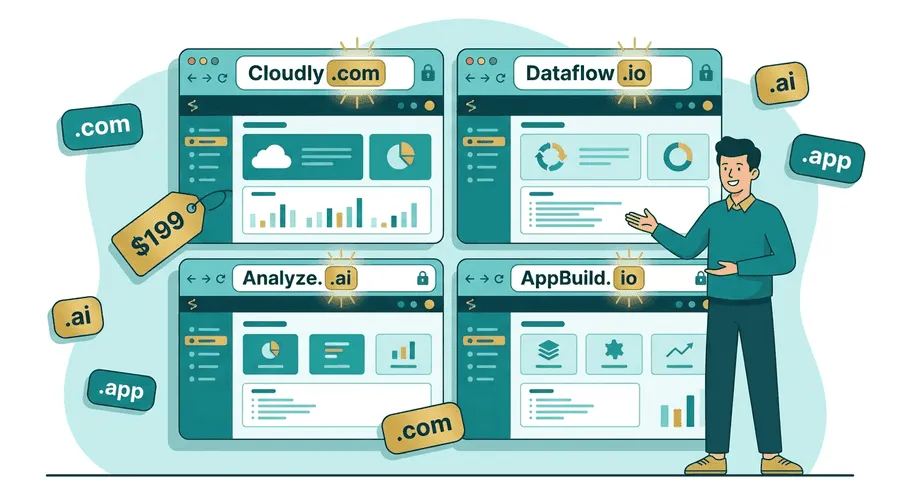
Notice the spread: finals.io and wrestler.io are clean one-word claims; seovis.com and videosbot.com show the keyword-plus-suffix pattern; dailyplanner.io and codesnippets.app are two-word job-to-be-done names; peaq.app and zure.co are coined brandables ready to be filled with meaning. Any of these could anchor a fundable SaaS — and each is $199 or less.
For the deeper strategy behind brandable versus descriptive naming, see our complete guides on brandable domains and keyword domains.
The Naming Mistakes That Quietly Kill Conversion
Most bad SaaS names do not fail loudly. They leak — a little trust here, a little traffic there — until the cumulative cost is a forced rebrand. Avoid these:
-
The "Get/Try" prefix trap.
getmyapp.combecausemyapp.comwas taken means you spend forever sending traffic to someone else's domain. If you must use a workaround, plan to buy the clean version later — it will only get more expensive. -
Hyphens and numbers.
data-flow.ioorcloud4you.comintroduce spelling ambiguity every time the name is spoken. They read as improvised, not established. -
Hard-to-spell coined words. An invented name is only an asset if people can spell it after hearing it. Run the phone test: say it once, see if a friend can type it.
-
Trademark collisions. Falling in love with a name before clearing it is the most expensive mistake on this list. A quick USPTO trademark search in your industry class takes minutes and can save a five-figure rebrand.
-
Over-indexing on keywords. A literal keyword string like
bestcrmsoftware.comlooks like a search query, not a company. Google de-emphasized exact-match domains over a decade ago, and buyers read keyword-stuffed names as low-trust. Aim for keyword-adjacent, not keyword-literal. -
Picking a TLD that fights your audience. A
.devaimed at non-technical small-business owners adds friction; a long.comfor a developer tool that could have been a crisp.iomisses a credibility signal. Match the extension to who is typing it.
The throughline: every one of these mistakes trades a small amount of long-term brand equity for short-term convenience. For more on why the psychology of a name drives real conversion numbers, read SaaS naming psychology: how a domain name drives trust and conversion.
Your SaaS Naming Shortlist: A 5-Step Filter
When you are ready to commit, run every candidate through this filter:
- Say it out loud. If it needs spelling, it loses.
- Match name to pattern. Confirm it fits one of the five structures — coined, one-word, keyword+suffix, two-word, or verb+noun.
- Pick the TLD by audience.
.comfor broad,.io/.appfor technical,.aifor AI-native. - Clear the trademark. A two-minute USPTO search before you fall in love.
- Buy before you build. Good names are one-of-one. Secure it while you have momentum.
External resources worth bookmarking as you decide: Dynadot's startup domain strategy guide and DomainDetails' breakdown of the best TLDs for startups both go deep on extension trade-offs.
A great SaaS name will not guarantee you succeed — but a bad one will tax every customer interaction you ever have. Get it right once, at the start, for $199 or less, and never think about it again.