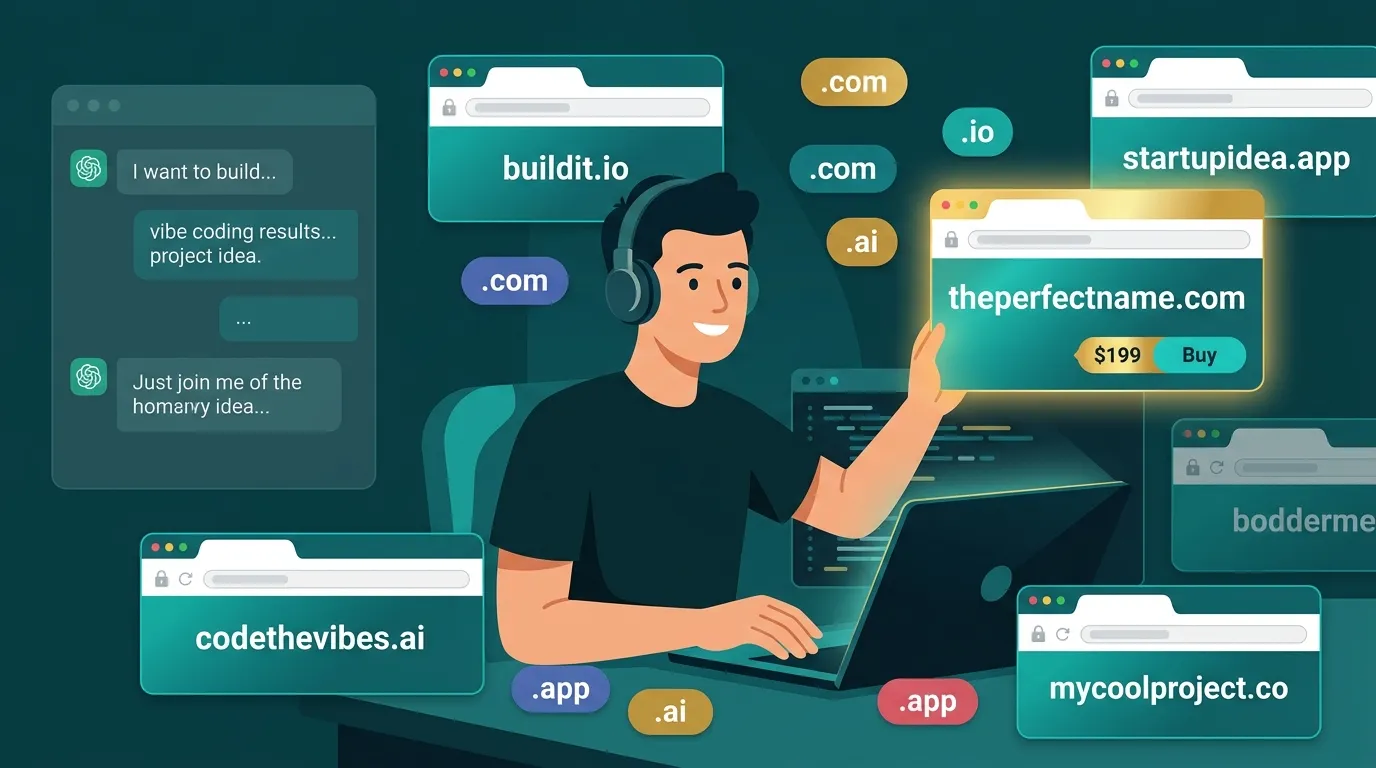
Here's the pattern I see over and over now, and it didn't exist five years ago: a developer messages me on a Sunday night having built a working product since Friday — real auth, a real database, a deployed front end — and the thing blocking launch isn't code. It's the name. The code took two hours with an AI pair-programmer. The name has taken two days.
I've spent 20+ years buying, selling, and writing about domains, and I'll be honest: this is the most lopsided bottleneck I've ever watched. Building used to be the hard part and naming was the afterthought you'd handle in an idle ten minutes. AI-assisted "vibe coding" — describing what you want in plain language and letting a model scaffold it — has collapsed the build time to an afternoon. Naming didn't get any faster. So the cheap, slow step is now the one holding up the expensive, fast one.
This guide is the fix I give those Sunday-night builders: why naming is now the blocker, a 30-minute sprint to break it, a straight answer on whether to buy before you validate, and the ship-now domains that get a weekend project live today. Every name featured here is $199 or less, ready to transfer within 72 hours.
Why naming became the bottleneck for weekend projects
The old order of operations was: pick a name, buy the domain, then spend three months building. Naming sat at the front of a long process, so the days you spent on it disappeared into the noise of everything that came after.
That order has inverted. Now you build first — often before you've named anything — and the domain becomes the last gate between a finished repo and a public link. When the build collapses to a weekend, every hour you spend deliberating on a name is suddenly a visible, frustrating fraction of the whole project. A two-day naming detour after a two-hour build feels absurd, because it is.
There's a second reason it stings more than it used to. The audience for a vibe-coded project judges it on its surface — a Product Hunt tile, a tweet, a Hacker News headline. The single most-shared asset is the URL, and a long, hyphenated, or three-word compromise name taxes you on every share. You did the hard part fast and well; an awkward name quietly undercuts it at the exact moment you're asking strangers to click.
The good news: the same trend that created the bottleneck also created the way out. As AI builders flood in, the market has shifted decisively toward short, brandable names on modern extensions — and away from the assumption that you must have a premium .com.
The 2026 data: short, brandable, and not necessarily .com
If your mental model is "a real project needs the .com," it's worth updating with what the market actually did over the last two years. The numbers below come from OpenProvider's domain name trends report, which aggregates registry data across the industry.
| Trend (2024–2026) | Figure | What it means for your side project |
|---|---|---|
| Startups using a new-gTLD as their primary domain | ~33% | A third of funded startups now launch on a non-.com — a share that's doubled in four years. You're in good company, not the exception. |
| Exact brand-match availability | 85% on nTLDs vs. 54% on .com |
The clean version of your name is far likelier to exist on .app, .io, or .ai. |
| New-gTLD market growth (annual) | ~14%, 39.5M active domains | Modern extensions are mainstream and still accelerating — not a fad. |
| .ai adoption among startups | 28% (after ~89% growth in 2024) | For AI-built projects, .ai is now a normal, credible primary domain. |
| .com renewal rate | ~75%, down from 80%+ | Even .com holders are letting names lapse — scarcity at the short end is loosening, not tightening. |
The takeaway for a weekend builder is liberating: you do not need to win a five-figure bidding war for a .com to look legitimate. A short, clean word on .app, .dev, .io, or .ai reads as modern and intentional to the technical, early-adopter audience that sees a side project first. If you want the deeper trade-offs between those developer extensions, I broke them down in .app vs .dev vs .io compared.
Should you buy a domain before you validate the idea?
This is the question every thoughtful builder asks, and the honest answer is yes, but cheaply and on purpose. Let me steelman both sides, because the usual advice picks one and ignores the cost of being wrong.
The case for waiting is real: weekend projects pivot. The thing you built Friday may become something different by the time it has users, and a name chosen too early can stop describing the product. Locking branding before the idea settles is a genuine risk.
But the case for buying early is stronger than the "wait and see" crowd admits, because the downside is so cheap to manage:
- You can't fake the launch link. A custom domain is the one asset Product Hunt, Hacker News, and a professional email all require. A
vercel.appsubdomain reads as "I haven't committed," which is the wrong signal when you're asking for attention. - The name you want disappears. The single most common regret I hear is "I waited until launch and the clean version was gone." Short brandables move; the one you're eyeing today may be registered next week.
- A $199-or-less name is a call option, not a commitment. If the project pivots hard, you've lost the price of a nice dinner — and because curated brandables hold resale value, you've often lost much less than that. A clean, pronounceable name is liquid in a way a hyphenated three-word registration never is.
So the disciplined middle path is: buy a clean, brandable, fixed-price name you'd be happy to grow into, point it at your deploy, and ship. You get the launch credibility now and keep your optionality, because the cost of being wrong is trivial. The mistake isn't buying early — it's overpaying early, sinking real money into a speculative name before you know the project lives. Fixed pricing exists precisely to take that risk off the table. (For why open-aftermarket pricing balloons while curated fixed prices stay sane, see fixed-price vs. auction domains.)
The 30-minute naming sprint for vibe coders
You don't need a week. You need a hard stop and a process. Here's the sprint I give builders who want to lock a name and get back to the code — four blocks, with a timer.
Block 1 — List 8–10 candidates (10 minutes)
Open a notes file and generate fast, without filtering. Lean on the same AI assistant that built the project: describe what the thing does and ask for short, brandable name ideas, then mine the list for real words and clean coinages. Aim for one or two words, under 12 characters total. Don't judge yet — quantity now, quality next.
Block 2 — Filter with the say-spell-search test (10 minutes)
Run every candidate through three questions:
- Say it — can you tell someone the name on a call without spelling it?
- Spell it — can they type it correctly on the first try, with no "is that one word or two?"
- Search it — does it return your thing, or collide with an existing brand?
Anything that fails one of these is out. Numbers, hyphens, and intentional misspellings almost always fail the spell test and cost you on every shared link. The names that survive are the ones people can pass along by voice — the cheapest distribution you'll ever get. I go deeper on why certain names stick in the psychology of startup naming.
Block 3 — Sweep availability on a curated catalog (10 minutes)
This is where most builders lose their afternoon: checking the open registrar, finding everything good is taken or parked at $9,000, and spiraling. Skip it. Sweep your surviving candidates against a curated fixed-price catalog where every listing is already vetted for clean history and trademark conflicts. You're choosing from pre-screened, ready-to-transfer names instead of gambling on the aftermarket — which is the entire point of a curated marketplace. Browse recently added brandable domains to see what's live right now.
Block 4 — Decide and buy
Pick the best available name, not the perfect imaginary one. When two extensions fit, default to the one that matches what you're shipping (.app for apps, .io/.dev for developer tools, .ai for AI products). Lock it, point your host at it, and you're done. The goal was never the perfect name — it was a clean, defensible name bought before deliberation ate another evening.
Ship-now domains for weekend projects
Here's a live sampling of the kind of name this sprint is meant to land — short, brandable, voice-shareable, and every one $199 or less, ready to transfer within 72 hours. 199.domains now has a dedicated "Vibe" category for exactly this — names you can build an app on — so these pull straight from current marketplace inventory and what you see below is actually available right now:
If your weekend build is an AI project specifically, the .ai extension is now a normal, credible primary domain — here are live .ai names in the same $199-or-less catalog:
What these share is the filter, not luck: each is a short, pronounceable, one- or two-word name that passes the say-spell-search test. The same qualities that make a name easy to share are the ones that make it worth buying. Browse the full set of Vibe domains you can build an app on to run your own shortlist against live inventory.
The upgrade path: when a weekend project becomes a company
The quiet anxiety behind the "should I buy early?" question is really "what if this works?" So let's plan for success, not just failure.
A fixed-price brandable at $199 or less is built for exactly this path. If your weekend project finds users, raises money, or turns into a real company, the name you bought during the sprint either is the company name or becomes the redirect that carries your early SEO and the muscle memory of every user who bookmarked you. Either way, you start the serious phase already owning a clean, trademark-screened asset — instead of scrambling to acquire the name you should have locked at launch, now at a premium because you have visible traction.
If you outgrow the name entirely, the upgrade is a known process, not a catastrophe: secure the new primary, set up clean 301 redirects, migrate email, and keep the original as a defensive registration. The cost of doing this well is far lower than the cost of having launched on a vercel.app subdomain and lost a year of link equity to a name you never owned. For the broader strategy of acquiring a genuinely premium name without broker markups when that day comes, see how to get a premium domain for under $500, and for naming patterns that scale into a fundable brand, the best domain names for SaaS startups.
The bottom line for vibe coders
The build is no longer the hard part — which means the name is the last place a weekend project goes to die. Don't let it. The fix isn't more deliberation; it's less, structured better. Run the 30-minute sprint, trust the say-spell-search filter, buy a clean brandable you'd be proud to put on a launch tile, and ship while the momentum is still warm.
A fixed-price name at $199 or less takes the two risks that paralyze builders — overpaying and over-committing — off the table at once. It's cheap enough to be a call option and good enough to grow into a company. Stop staring at the registrar search box. Browse the curated Vibe catalog of names you can build an app on, lock the name, and get back to the thing you actually came to build.