
Put the same domain into three different appraisal tools and you will get three different answers — and they won't be close. One says $340, another says $2,100, a third confidently reports $8,750. Nothing about the domain changed between clicks. That gap is domain valuation, and every generic "how much is my domain worth" guide quietly skates past it on the way to recommending you click their appraisal button.
I've spent 25+ years buying, selling, and writing about domains, and the question I get more than any other isn't "what's my name worth" — it's the buyer's version: "They're asking $4,000 for this. Is that real, or am I being played?" Most valuation content can't answer that, because it's written for sellers and ends at a tool. This guide is written for the person about to spend money. By the end you'll understand the six levers that actually set a domain's price, why the automated numbers are so unreliable, how to run comps the way investors do, and how to look at $199, $1,999, or $19,999 and know which one is fair.
What actually determines a domain's value?
Strip away the mystique and a domain's price comes down to six levers. Every credible appraisal — human or algorithmic — is really just weighing these, and understanding them lets you reverse-engineer almost any asking price.
1. Length
Shorter is worth more, and the curve is steep. Three- and four-letter .coms sell for thousands regardless of what they spell, because the supply is mathematically fixed and nearly exhausted. Each additional character reduces value, which is why the funded-startup data consistently lands names in the six-to-ten-character sweet spot. Length is the first thing every appraisal tool measures because it's the one lever that's perfectly objective.
2. Extension (TLD)
The extension is a trust multiplier applied to everything else. .com still commands the highest premiums because the entire internet was trained on it. Strong alternatives — .ai for AI products, .io and .dev for developer tools, .co as a .com stand-in — hold real value in their niches but rarely match the .com of the same word. Weak or spammy extensions can actively subtract value. We tier exactly which extensions earn trust with which audiences in TLD trust rankings 2026.
3. Keyword demand
A name that matches what people actually search and buy carries commercial weight. "insurance," "loans," "crypto" — high-volume, high-intent words that a real business would pay to own. Informational or obscure keywords are worth far less. This is the lever that separates a domain a company needs from one that's merely clever.
4. Brandability
The single biggest multiplier for modern names. A brandable domain is short, easy to say, easy to spell after hearing it once, and free of collisions or awkwardness. It passes the "radio test" — you can say it out loud and someone can type it correctly. Invented or evocative words (think the pattern behind most funded startups) score high here precisely because they're ownable and trademark-friendly.
5. History and age
The most overrated lever, and the one sellers lean on hardest. Age adds value only when it comes with something real — existing traffic, a clean backlink profile, evidence the name was genuinely used. An old, unbrandable domain with nothing behind it is worth barely more than a fresh registration. And a name with spam or adult history can be worth less than a new one, because that past can poison its search reputation. Age is a multiplier on a good name, never a value on its own.
6. Scarcity and comparable sales
Finally, what have similar names actually sold for? A one-word dictionary .com is scarce by definition; a three-word hyphenated phrase is not. Real, recent comparable sales are the closest thing the industry has to a market price — and they're the check that keeps the other five levers honest.
| Valuation lever | Raises value when... | Overrated / red flag when... |
|---|---|---|
| Length | 1–2 words, 6–10 characters | 3+ words, hyphens, numbers |
| Extension | .com, or strong niche alt-TLD | obscure/spam-associated TLD |
| Keyword demand | high commercial search intent | long-tail phrase nobody searches |
| Brandability | passes the radio test, ownable | hard to spell, collides with brands |
| History | real traffic or clean backlinks | old but unused, or spam history |
| Scarcity/comps | recent sales back the price | "comps" are cherry-picked outliers |
Why do domain appraisal tools disagree so wildly?
Here's the uncomfortable truth the tool pages won't lead with: automated appraisals routinely disagree with each other by an order of magnitude on the same name. GoDaddy's appraiser might say $900, Estibot $2,400, an AI tool like HumbleWorth $6,000. All three are "right" by their own math and useless as a market price.
The reason is structural. An automated appraisal runs your domain against a database of past sales and scores it on the objective levers — length, TLD, keyword patterns, syllable count. That's genuinely valuable for one job: telling a $50 name apart from a $50,000 name. It puts you in the right zip code. What no algorithm can price is the two things that actually close a deal: real buyer demand at this exact moment, and how badly one specific buyer needs that one specific word. A domain is worth what a willing buyer pays — and no willing buyer has told the tool anything.
So use the tools correctly. Run a name through GoDaddy's free appraisal or Estibot to get the rough magnitude, then throw away the exact number and go verify it against reality. Which brings us to the method the professionals actually trust.
| Valuation method | What it's good for | What it can't tell you |
|---|---|---|
| Automated appraisal (GoDaddy, Estibot) | Instant rough magnitude; sorting cheap from expensive | The real market price; current demand |
| Comparable sales (NameBio) | Grounded, evidence-based range | Value of a truly unique one-off name |
| Professional appraisal ($99–$500+) | Unique or high-value names; a defensible number | Guaranteed sale; worth it only above ~5 figures |
| What a buyer pays | The only true valuation there is | Anything, until money actually changes hands |
How to research comparable sales like an investor
Comps are the single most reliable valuation method, and the good news is the core tool is free. NameBio is a searchable database of hundreds of thousands of reported domain sales going back over a decade — it's where investors settle pricing arguments. Here's the walkthrough I'd give any buyer:
- Search the exact keyword and pattern. Looking at a two-word brandable .com? Search NameBio for recent sales of similar two-word .coms in the same vibe. You're building a range, not finding a twin.
- Filter by TLD and recency. A 2015 sale is a data point; a 2026 sale is a market. Weight the recent ones and the matching extensions far more heavily.
- Ignore the outliers at both ends. One $90,000 sale of a category-defining word doesn't mean your name is worth $90,000, and one $12 fire-sale doesn't mean it's worthless. The honest number lives in the fat middle of the distribution.
- Separate wholesale from retail. Investor-to-investor sales run lower than investor-to-end-user sales. If you're a startup buying to use the name, you're an end user — expect the retail end, but know that's exactly the premium a fixed-price marketplace strips out.
Do this for fifteen minutes and you'll know more about a name's real value than any single tool will tell you. You'll also spot the tell that a listing is overpriced: an asking price that sits far above every comparable sale, "justified" by a valuation deck instead of a market.
The names that hold value across every lever — short, brandable, clean, one or two words — are exactly what a curated marketplace surfaces without the treasure hunt:
So why does the same domain cost $199, $1,999, or $19,999?
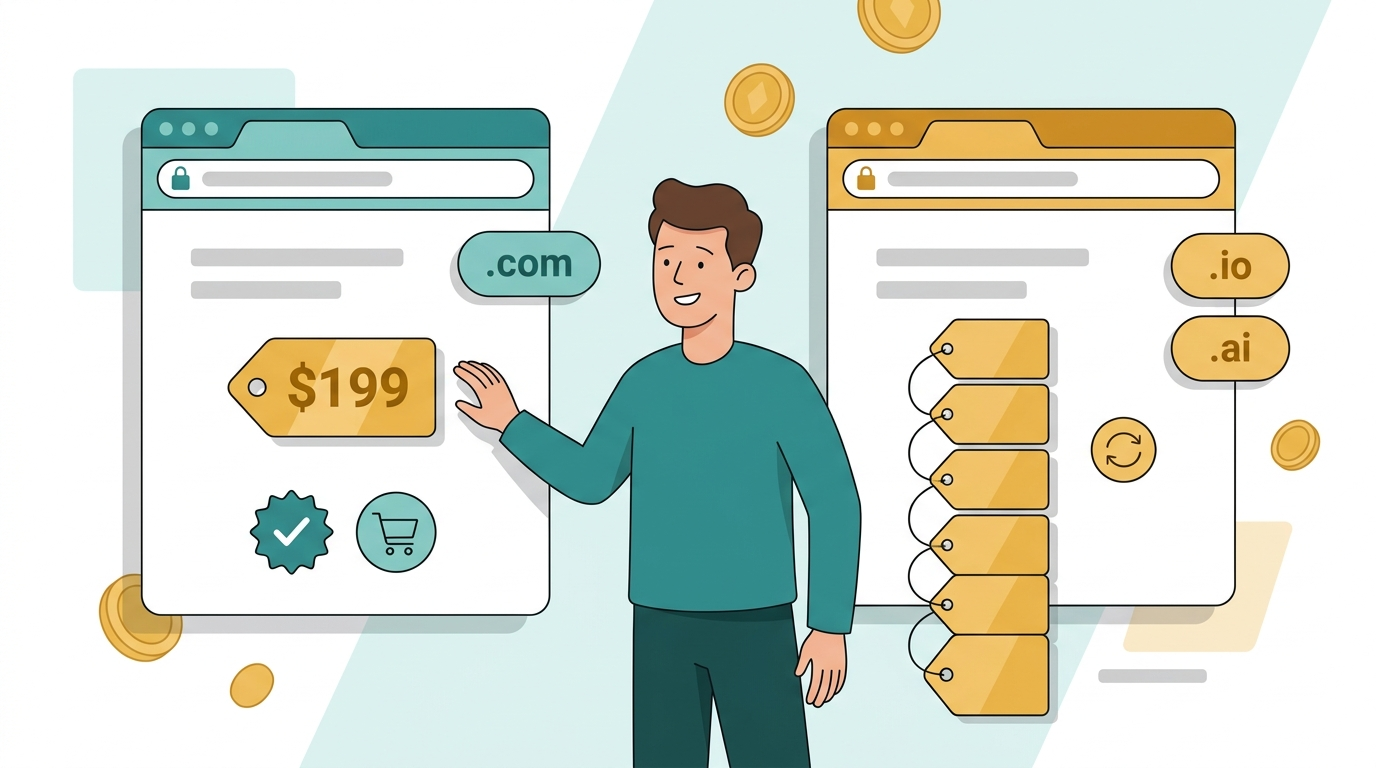
Now the headline question. How can one name carry three prices that differ by a hundredfold? Because most of a "premium" price isn't the domain — it's the story and the venue.
The $19,999 version lives on a make-an-offer or broker listing, where the price is set to whatever a motivated buyer might pay, anchored deliberately high. Same domain, documented cases of the identical name showing up at $2,899 on one platform and $5,995+ on another — nothing about the name changed, only the seller's ambition and the venue's tolerance for a big ask. This is anchoring bias doing its job, the exact mechanism we dissect in the psychology of "make an offer" pricing.
The $1,999 version is the "reasonable premium" — often the same name after a founder negotiated the broker down and felt like they won. Usually they paid about what the broker was aiming for all along. That whole dynamic, and how the commission model quietly drives it, is the subject of how domain brokers really work.
The $199 version is what the name is worth when you remove the anchor, the negotiation, and the commission — the fixed-price model. It's not a lesser domain; it's the same class of name with the story stripped out and one visible number in its place. For the enormous middle of the market — good, ownable, sub-$1,000-worthy names — that's where fair value actually sits, which is the whole case for fixed pricing over the auction-and-broker model.
The domain didn't get more valuable between those three prices. The sales machinery around it did. As a buyer, your job is to see through the machinery to the levers — and if the levers say a name is a clean, short, brandable two-worder with modest comps, then $199 or less isn't a discount. It's the price.
Investor's note: the overpaying red flags I watch for
After decades on both sides of these deals, a few signals reliably mean you're about to overpay:
- The price is defended with a valuation report, not comparable sales. A screenshot of an automated appraisal saying "$14,000" is a story, not a market. Ask for comps or make your own.
- The number sits far above the fat middle of NameBio. Outlier asks need outlier justification — real traffic, real revenue, a genuinely category-defining word. Absent that, it's an anchor.
- "Make an offer" with no visible price. This is engineered to make you reveal your budget first. The information asymmetry is the entire point.
- Age is the headline selling point. If a listing leads with "registered in 2004" and can't show traffic or backlinks, age is being used to paper over a weak name.
- Renewal costs aren't mentioned. Some premium extensions carry steep annual registry fees. A cheap purchase with an expensive renewal is a different deal than it looks — always check the carrying cost.
The through-line of everything above is simple: price the name on what it does for your business, not on the seller's framing. A domain that scores well on the six levers, backed by honest comps, at a transparent fixed price is the cleanest transaction in this market. Everything else is a negotiation you were invited to lose.
If you'd rather skip the appraisal guesswork entirely, that's the premise of getting a genuinely premium name for under $500: every listing is AI-vetted for clean history and trademark conflicts, owner-verified by DNS, and priced up front at $199 or less with the transfer initiated within 72 hours. You can browse the full featured catalog, narrow to curated brandable names, or study the naming style first through our guides to brandable domains and keyword domains.
Twenty-five years in domains taught me that valuation isn't a mystery — it's six levers, an honest look at comps, and the discipline to pay for the name instead of the story. When money finally changes hands through a service like Escrow.com, the only number that ever mattered is the one a willing buyer agreed was fair. Make sure that buyer is you, and make sure you can see the price before you say yes.