Search "what domains do startups use" and you'll find the same handful of blog posts, each quoting one study, most of them years out of date, and almost none of them doing the one thing that actually matters: telling you what the numbers mean for the name you're about to buy.
I've spent 20+ years buying, selling, and writing about domains, and founders would send me these exact articles as justification — "the data says I need the exact-match .com," or "the data says .ai is fine now." Usually they'd cherry-picked a single stat from a single sample and built a five-figure decision on it. So I did the boring, useful thing: I pulled the largest published datasets on funded-startup domain choices, lined them up next to Verisign's current 2026 industry figures, and reconciled them into one picture.
This is that roundup. You'll get the headline numbers, what they look like at each funding stage, three contrarian takeaways the single-study posts miss, and — because a data article is worthless if you can't act on it — how to turn the findings into a name you can actually own for $199 or less.
What percentage of startups own their exact-match domain?
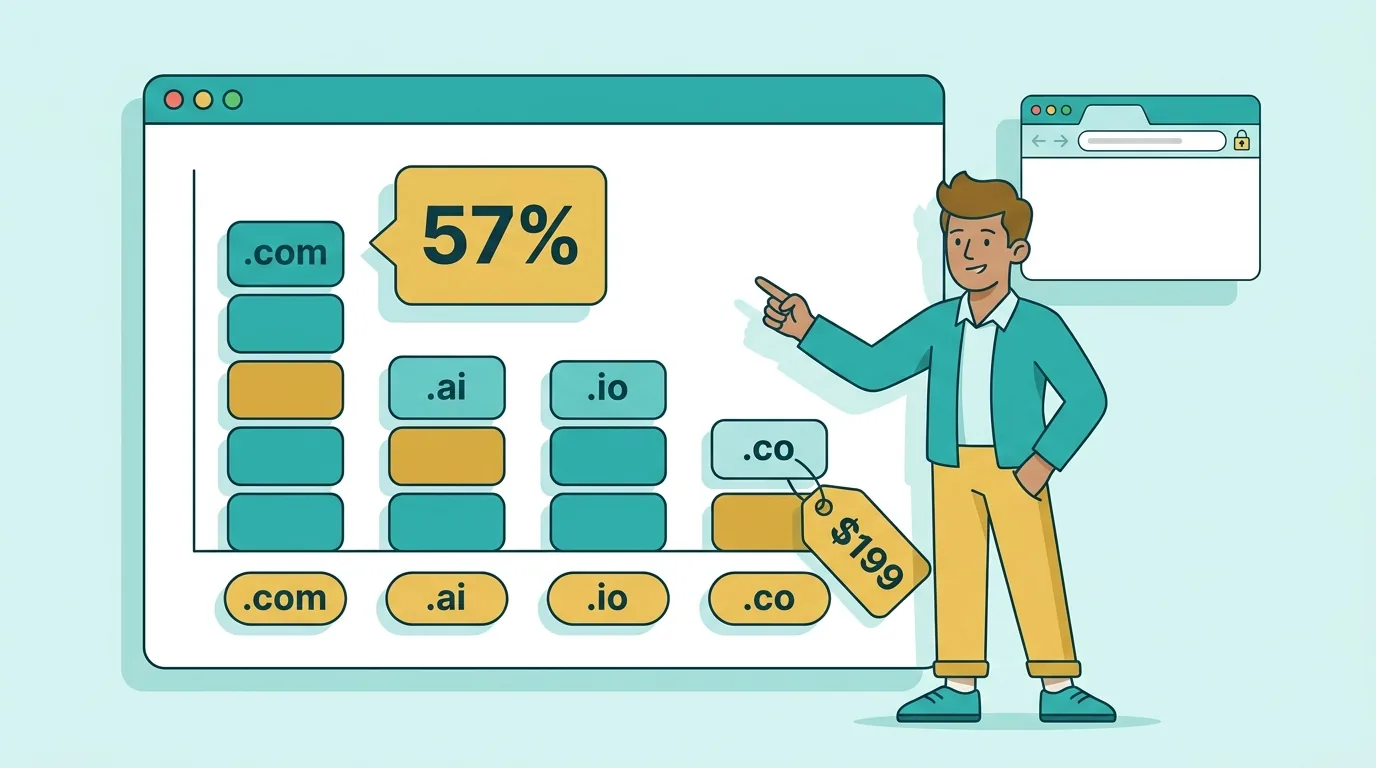
Start with the most-cited number in the entire space. In an analysis of 1,587 startups that applied to Y Combinator, published by MarkUpgrade, 908 of them — 57.2% — secured the exact brand-match .com: their brand name, nothing added, nothing removed. You can read the full 1,587-startup breakdown on Medium.
That 57% is the number worth tattooing on a founder's whiteboard, but the more revealing figure sits one layer down. Of the startups in that sample that went on to exit, 144 of 200 — 72% — held their exact-match .com. Exact-match ownership was higher among the winners than the population at large.
Newer data confirms the appetite hasn't cooled, even as availability has. In a 2025 analysis of over 4,000 Y Combinator and Techstars startups, Domain Name Wire reported that 54% of the .com domains in the newest batch weren't exact matches — founders were forced to bolt on a "get," "use," or "try" because the clean version was gone. The demand is constant; the scarcity is what changed.
Which domain extension do funded startups actually use?
Here's where the single-study posts contradict each other, because they're quoting different samples from different years. Reconciled, the picture is clear and consistent.
| Dataset | Sample | .com share | Notable alt-TLDs |
|---|---|---|---|
| MarkUpgrade (YC applicants) | 1,587 startups | 77.8% (1,205 of 1,548) | .io 80, .co 46, .ai 29 |
| TheWebsiteFlip (VC-funded) | 3,168 brands | 62% (~1,963) | .io + .co ~11% (348), .ai 134 |
| YC/Techstars (2025 batch) | 4,000+ startups | ~46% of new batch | .ai ~28%, .io declining |
| Verisign DNIB (all TLDs) | 392.5M domains | .com 163.6M registrations | Global baseline |
Two things jump out. First, .com dominance is real but sample-dependent — it lands anywhere from 46% of the newest accelerator batch to 78% of a broader historical set, and Verisign's Q1 2026 Domain Name Industry Brief still shows .com alone at 163.6 million registrations worldwide out of 392.5 million total. It remains the default the internet was trained on.
Second, and more interesting: the ground is shifting under that number. According to TheWebsiteFlip's multi-year analysis of funded startup brands, non-.com adoption more than doubled from roughly 15% to 33% over four years. A third of funded startups now launch on something other than .com — a statement that would have been unthinkable a decade ago.
The .ai surge: the fastest-moving stat in the dataset
No number in this roundup has moved faster than .ai. In the 2021 VC-funded sample, .ai was a rounding error — 134 domains, about 4.2%. By the 2025 accelerator batch, Domain Name Wire's data put .ai on roughly 28% of Y Combinator and Techstars startups — a nearly sevenfold jump, and the same analysis noted .io is slowly losing ground as companies swap it for .ai.
That's the single loudest signal in the data: for AI-native products, .ai has crossed from "quirky ccTLD" to "expected." But an investor's caveat applies — the surge has pushed .ai aftermarket and renewal prices up, so the play is to capture the signal without overpaying for the halo. We cover exactly how to find affordable ones in .ai domains for startups: what's still affordable in 2026.
How long are the domains startups pick?
The length data is the most actionable and the most ignored. In the 3,168-brand 2021 sample, 74% of funded startups used a single-word domain and 23% used two words — meaning over 97% of every domain purchased by VC-backed startups was one or two words long. Three-or-more-word names were statistically negligible.
The YC applicant set skews slightly longer but tells the same story: 51.9% single-word, 42.1% two-word — again, the overwhelming majority at one or two words, with only 3.3% reaching three words. On character count, the sweet spot lands at 6 to 10 characters, short enough to pass the radio test and survive a business card.
The behavioral tells are just as consistent. Across the funded samples, hyphens and numbers are almost absent — in the YC set, just 9 of 1,587 startups used a dash and 33 used a number. Funded founders treat those as amateur signals, and the market agrees.
The practical translation: if your candidate name is three-plus words, hyphenated, or numeric, you are naming outside the entire funded-startup distribution. The names that match the data are short, clean, and one or two words — exactly the profile we broke down in one-word domains for startups and its affordability sibling, one-word .com domains under $500.
What the data means by funding stage
Aggregate stats hide the fact that the right choice changes as a company matures. Here's how a veteran investor reads the numbers stage by stage.
Pre-seed / side project
Availability and speed beat perfection. The data shows a third of funded startups thrive on non-.com extensions, so don't stall your launch hunting a five-figure exact-match .com. Grab a clean, short name on the best available extension — and if you launch on an alt-TLD, note the matching .com's price for later. The founder's naming logic for weekend projects applies directly.
Seed / Series A
This is when the 72%-of-exits-owned-their-exact-match stat starts to matter. If you've found traction and the exact-match .com is attainable, this is the cheapest it will ever be — securing it now is defensive insurance against the leak that forces a rebrand, one of the warning signs we catalogued here.
Growth / scale
Now the portfolio thinking kicks in: the plurals, the common typos, the key alt-TLDs. The funded data shows branded and type-in traffic silently flowing to whoever owns the matching .com — so at scale, owning the obvious variants is table stakes, not paranoia.
| Stage | What the data says to prioritize | Typical spend that makes sense |
|---|---|---|
| Pre-seed | Speed + a clean short name; extension flexible | $199 or less, fixed price |
| Seed / A | Grab the exact-match .com while it's cheap | Whatever the fixed price is — before a broker anchors it |
| Growth | Defensive variants + matching .com | Portfolio of $199-or-less names |
Three contrarian takeaways the single-study posts miss
1. The exact-match .com correlates with success, but it doesn't cause it. The 72%-of-exits stat gets waved around as proof you must own the exact match. Read it correctly: decisiveness and brand discipline travel together, and founders who invest early in the right foundation tend to be the same founders who build well. Buying the .com won't make you an outlier — but the habit it reflects might.
2. "Non-.com is winning" is half true. Adoption doubling to 33% is real, but .com still owns the majority in every sample and 163.6 million registrations globally. The honest reading is coexistence: .com is the safest default, and a strong alt-TLD is now fully legitimate — not that .com is dying. We tier exactly which extensions earn trust with which audiences in TLD trust rankings 2026.
3. The most expensive number in the data is the one nobody prints. None of these studies mention what founders paid. The trust-and-brand names the data rewards are precisely the ones brokers price at four and five figures. The dataset tells you what to buy; it stays silent on the fact that you don't have to overpay to buy it — the entire premise behind getting a premium domain for under $500.
Methodology and source notes
Because a data roundup lives or dies on its sourcing, here's exactly what went into it:
- Exact-match and YC applicant figures (57.2%, 77.8% .com, 72% of exits, .io/.co/.ai counts): MarkUpgrade's analysis of 1,587 YC-applicant startups.
- VC-funded distribution (62% .com, 74% single-word, 33% non-.com growth, .ai at 4.2%): TheWebsiteFlip's multi-year funded-startup brand analysis.
- 2025 accelerator data (28% .ai, 54% of .com non-exact, .io decline): Domain Name Wire's study of 4,000+ YC and Techstars startups.
- Global baseline (392.5M total registrations, .com at 163.6M in Q1 2026): Verisign's Domain Name Industry Brief.
A caveat any honest roundup owes you: these samples span different years (2019–2026), different populations (YC applicants vs. all VC-funded vs. accelerator batches), and different methodologies. The percentages aren't perfectly comparable across rows — which is precisely why lining them up matters. The direction every source agrees on (short, clean, one-or-two-word, .com-default-but-alt-TLD-rising, .ai-surging) is far more reliable than any single decimal point.
How to act on the data: buy the name the numbers point to
Strip the roundup to its instructions and it's remarkably simple. The funded-startup data says: pick a short (6–10 character), one-or-two-word, hyphen-free, number-free name, on .com when you can and a strong alt-TLD (.ai, .io, .co) when it fits your audience, and grab the exact match early because scarcity only gets worse. That's the whole playbook, and it's the same profile whether you're pre-seed or scaling.
The one variable the studies never address is price — and that's the gap a fixed-price marketplace closes. Every name in our catalog matches the funded-startup profile the data rewards, each is AI-vetted for clean history and trademark conflicts, and every one is $199 or less with no auction and no broker anchor. You can browse the full featured catalog, narrow to curated brandable names, or study the style first through our guides to brandable domains and keyword domains.
The data has told the same story for a decade: funded founders buy short, clean, ownable names and buy them early. The only thing that's changed is that you no longer have to pay a broker four figures to follow the same playbook.