For 20+ years I've bought, sold, and written about domains for a living. Long enough to understand the side of a domain deal that most buyers never get to see.
I've watched premium-domain brokers work every angle of this market — representing buyers trying to pry a name loose from an owner who won't list it, and sellers who want top dollar without doing the outreach themselves. I've sat across the table from them as a buyer and a seller, tracked their deals for my readers, and reverse-engineered how they run the anchoring, write the "the owner is firm at this number" emails, manage the escrow, and take a cut of the spread. Their whole edge rests on one fact: the people they negotiate against can't see what they can see.
This is the article I wish existed when I started out. If you've ever searched "how domain brokers work" or "domain broker tips" and gotten a polite listicle that reads like it was written by a brokerage's marketing team, this is the honest counterweight — ten lessons on how the trade actually operates, what they mean for you, and the uncomfortable ending about why the model stopped making sense.
How do domain brokers actually get paid?
Start here, because every other lesson flows from it. A domain broker is almost never paid a flat fee for neutral advice. They're paid a commission — a percentage of the final sale price, usually 10% to 20%, and as high as 30% on smaller transactions. Some add a non-refundable upfront fee or a retainer for big-game acquisitions. GoDaddy's brokerage, to name a public example, charges a non-refundable fee plus 20% of the sale.
Read that structure carefully: a commission broker earns more when you pay more. That doesn't make brokers dishonest — most I've dealt with over the years were straight shooters — but it does mean the incentive baked into the model is misalignment with your budget. Keep that lens on for the rest of the list.
| Broker fee model | What you pay | Where it shows up |
|---|---|---|
| Pure commission | 10–20% of sale (up to 30% on small deals) | Most buyer/seller brokerage |
| Upfront + commission | $99–$500 non-refundable + reduced % | Big-registrar brokerage services |
| Retainer + commission | ~1% of estimated value + success fee | Six- and seven-figure acquisitions |
| Fixed-price marketplace | One visible price, no commission to you | $199-or-less curated names |
Lesson 1 — The commission is the entire business model, not a detail
Everything a broker does — the valuation, the "comparable sales," the patience, the urgency — ultimately serves the number the commission is calculated on. A higher close is a bigger paycheck. Once you internalize that, the rest of the playbook stops looking like expertise and starts looking like sales.
Lesson 2 — Anchoring is the most powerful tool in the kit
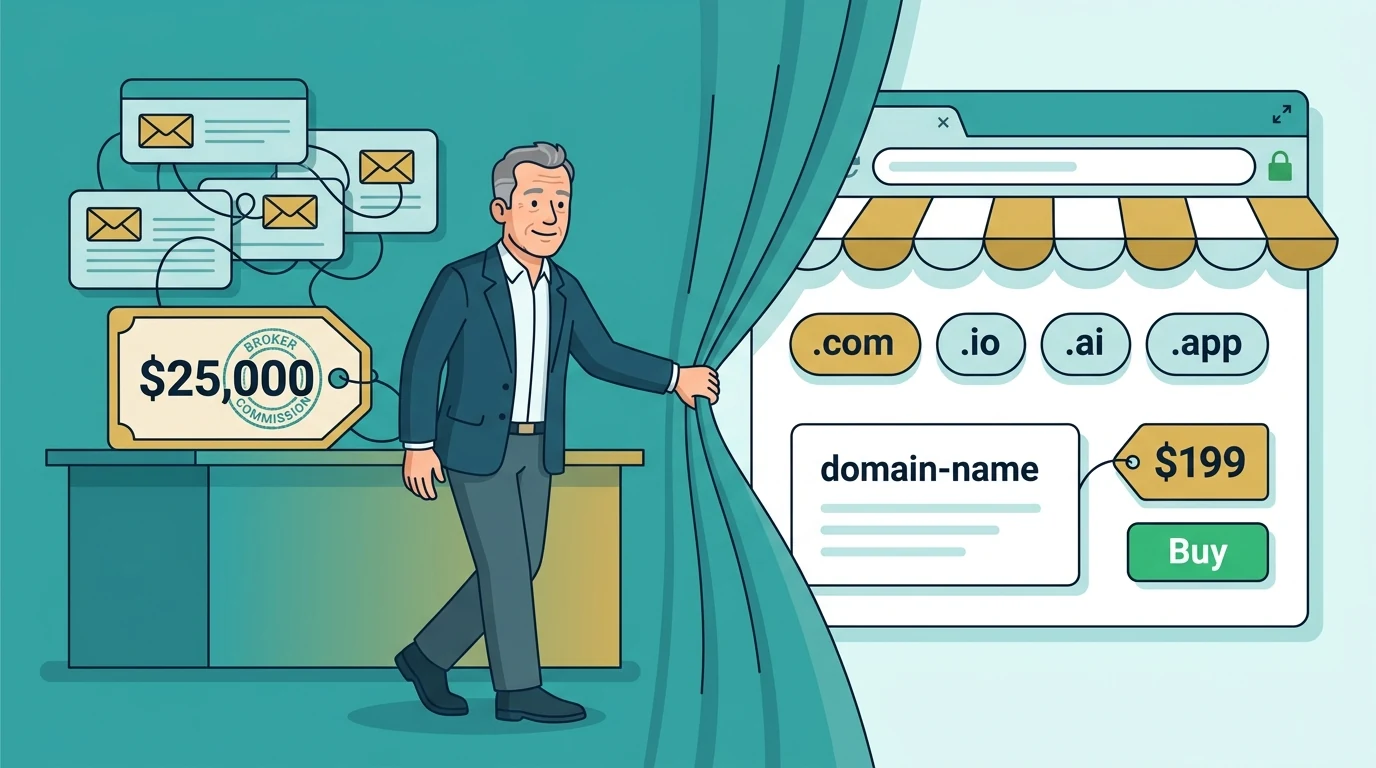
The first number in a domain negotiation is rarely a valuation. It's an anchor. A broker will open at $39,000 on a name they'd happily close at $18,000, because the entire rest of the conversation gets measured against that first figure. When a founder "negotiates them down" to $25,000, the founder feels like they've won — and they've paid right about what the broker was aiming for all along. This is the same anchoring bias we break down in the psychology of "make an offer" pricing: the person who names the first number controls the whole range.
Why do domain sellers ghost — and other negotiation truths?
The buyer side has its own set of hard-won lessons, and most of them are about human behavior, not domains.
Lesson 3 — Sellers ghost for a reason, and it's usually leverage
Nothing frustrates a buyer more than a seller going silent for two weeks mid-negotiation. Sometimes that's disorganization. More often it's deliberate: silence is cheap, and it makes an eager buyer negotiate against themselves. The correct counter is patience — the party who needs the deal less always wins it. A founder on a launch deadline is the worst possible negotiator, which is why the smartest ones secure names before they're desperate.
Lesson 4 — The renewal date is quiet leverage nobody talks about
Here's a genuine insider trick: a domain's expiry date is public. If a seller's name is coming up for renewal and they're a passive holder, they may be more motivated to sell than to pay another year's registration on an asset that isn't moving. Timing an approach around that calendar is one of the cleaner edges in the business — and it works precisely because most buyers never think to look.
Lesson 5 — Walking away is a negotiating position, not a failure
The best deals I've seen buyers get were the ones where they were genuinely willing to walk. A named, credible alternative — "we like this one, but we've shortlisted two others" — resets the entire power dynamic. Founders who fall in love with a single exact-match name lose that leverage instantly. The data backs the discipline: as the funded-startup domain research shows, plenty of successful companies launched on a strong second-choice name and never looked back.
How does domain escrow actually protect the deal?
If you take one purely practical thing from two decades of watching these deals close and fall apart, take this section.
Lesson 6 — Never move money without escrow, and understand the flow
A private domain sale has two symmetrical nightmares: the buyer pays and never gets the name, or the seller transfers and never gets paid. Escrow exists to make both impossible. Using a licensed service like Escrow.com's domain process, the sequence is: buyer and seller agree terms, the buyer pays Escrow.com (not the seller), the service confirms the money, the seller is then instructed to transfer, Escrow.com verifies the new owner in WHOIS, and only then are the funds released. The money is held in trust the entire time. If you're buying privately and there's no escrow in the conversation, that is the red flag.
Lesson 7 — The transfer is where deals quietly die
Agreeing a price is the easy half. The transfer is where deals actually break: a domain locked at the losing registrar, a missing or stale EPP authorization code, or the ICANN 60-day post-registration and post-transfer lock catching a name that changed hands too recently. I've watched fully-agreed deals stall for weeks on a single unlocked setting. If you're doing this yourself, our complete domain transfer guide walks the whole chain — unlock, EPP code, initiate, approve, DNS cutover — and the ICANN Registrar Transfer Policy is the authority on the lock rules. Verifying the other party is a real, ICANN-accredited registrar is part of the same due diligence.
Names with the qualities brokers hunt for — short, clean, one or two words, no baggage — are exactly what a modern curated marketplace surfaces without the treasure hunt:
What finally killed the traditional broker model?
This is the part the brokerage industry would rather you didn't read.
Lesson 8 — Fixed pricing disrupted the entire broker model, and it was overdue
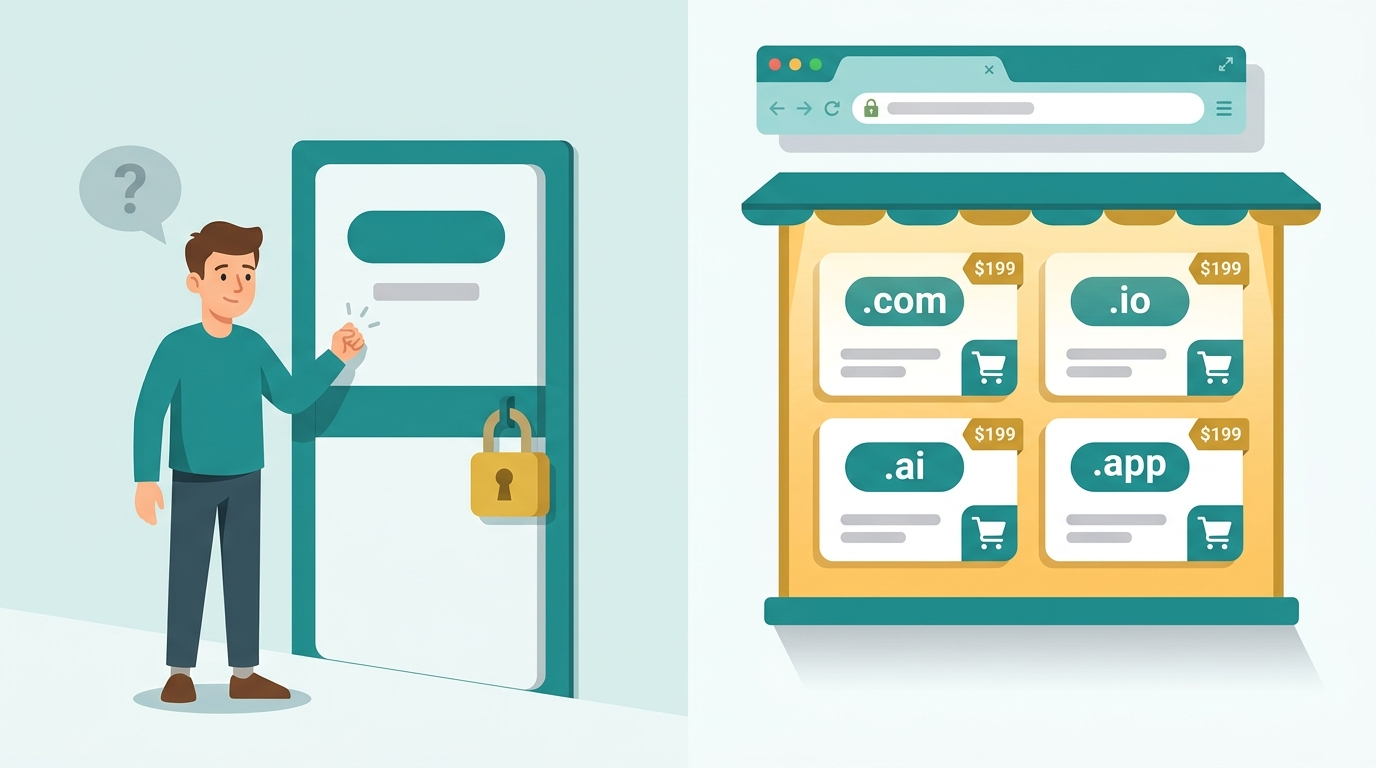
The dirty secret of brokerage is that most of the value it captured lived in the middle of the market — good, ownable, sub-$1,000 names where the negotiation cost more than the name. For those, the entire ritual of offers, counteroffers, anchoring, and commission was pure friction dressed up as service. When transparent, fixed-price marketplaces put one visible number on names like that, they didn't out-negotiate the broker — they made the negotiation unnecessary. That's why fixed-price beats the auction-and-broker model for the vast majority of buyers: there's simply nothing left to extract.
Lesson 9 — "Premium" pricing is a story, not a number
A broker can justify almost any price with a valuation deck — length, keyword volume, comparable sales, extension scarcity. But automated appraisals routinely disagree by an order of magnitude on the same name — the exact phenomenon I break down in domain valuation explained: why that name costs $199, $1,999, or $19,999 — which should tell you how much of "premium" pricing is narrative. A lot of what buyers pay for is the confidence of the person quoting the number. Strip the story away and price the name on what it does for your business, not on the broker's framing. The affordable end of that logic is the whole premise behind getting a genuinely premium name for under $500.
Lesson 10 — The best deal is the one you never had to negotiate
After two decades in this business, the through-line is almost embarrassingly simple: the buyers who come out ahead are the ones who avoid the game entirely. They pick a strong, available name, pay a fair visible price, and spend the saved weeks building instead of emailing a broker. Negotiation is a skill worth having for the rare six-figure name that isn't for sale. For everything else, it's a tax on your time.
Insider glossary: the terms brokers assume you don't know
- Anchor — the deliberately high first number that sets the range for the entire negotiation.
- Comps — comparable sales used to justify a price; genuinely useful, and also endlessly cherry-picked.
- End user vs. reseller — brokers price higher for "end users" (a business that will actually use the name) than for other investors, because you'll pay for utility.
- EPP / auth code — the password-like key that authorizes a domain transfer between registrars.
- Escrow — a neutral third party holding funds until the transfer is verified; your single best protection.
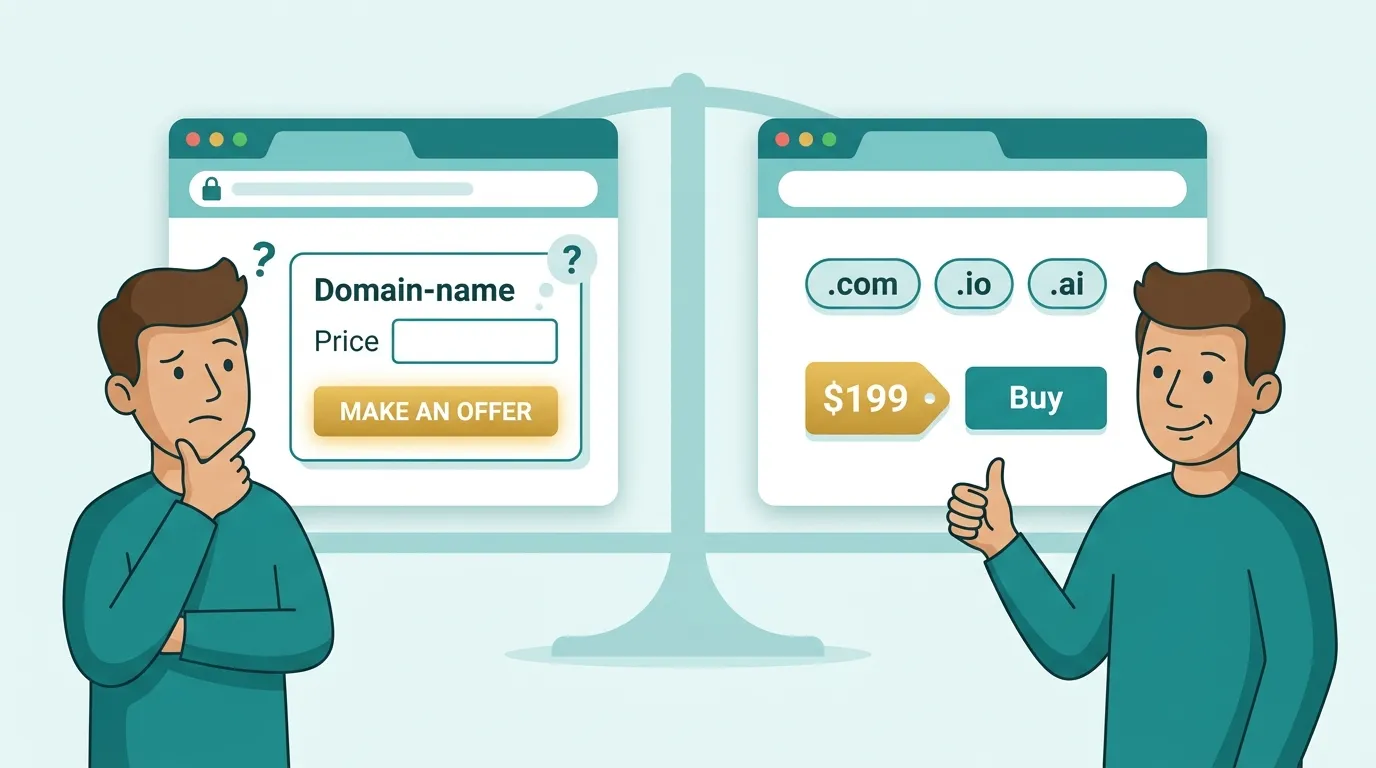
- Make an offer — a listing with no visible price, engineered to make you reveal your budget first.
- Registrar lock / 60-day lock — settings and ICANN rules that can freeze a transfer for up to 60 days.
So when should you actually use a broker?
I'm not anti-broker. I'm anti-paying-for-a-middleman-you-don't-need. Here's the honest decision line, from someone who's spent 20+ years on both sides of the buy and the sell:
| Situation | Use a broker? | Why |
|---|---|---|
| The exact name you need isn't for sale, owned by a hard-to-reach party, worth 5–6 figures | Yes | Discreet outreach and negotiation genuinely earn the commission |
| A great name is available at a visible, fair price | No | You need a checkout button, not a negotiator |
| Sub-$1,000 budget, flexible on the exact word | No | The negotiation costs more than the name |
| You want the matching .com defensively, cheaply | No | Fixed-price marketplace, buy it and move on |
If your situation is in the top row, hire a reputable broker, insist on escrow, and verify every credential. If it's in any of the other rows — which, in my experience, is where the overwhelming majority of founders actually sit — you're the buyer a broker quietly marks up.
That's the deal a curated, fixed-price marketplace makes structurally impossible. Every name is AI-vetted for clean history and trademark conflicts before it goes live, owner-verified by DNS, priced up front with no offer game, and $199 or less with the transfer initiated within 72 hours. You can browse the full featured catalog, study the brandable-name playbook, or start from the keyword-domain guide — but whichever way you go in, you'll see the price before you commit a single email to a negotiation.
And if you're on the other side of the table — a domainer holding good sub-$200 names that keep rotting in make-an-offer purgatory — the same model works in your favor: you can list your domains free and keep up to 81% of each sale, with no listing fees and the buyer's transfer handled in 72 hours.
Twenty years in domains taught me that the name matters enormously and the negotiation almost never does. Buy the good name, skip the game, and get back to the actual work.