
I've spent more than two decades buying, selling, and writing about domain names, and for most of that time I had the same complaint every domain investor has: the good, affordable names are the ones the industry treats worst. A sharp two-word brandable worth maybe $150 doesn't get a broker's attention. It gets listed on a giant marketplace, buried under a wall of six-figure holdouts, tagged "make an offer," and then it sits. Months pass. A buyer who would happily have paid $149 on the spot never even finds it, because the marketplace is optimized around the rare $50,000 sale, not the everyday $150 one.
So I built the other thing. 199.domains is an open, curated marketplace where every name is $199 or less, every listing is quality-vetted and owner-verified before it goes live, and any domain investor can submit their own names in a few minutes. This post is the honest, end-to-end walkthrough of how selling on it actually works — what the submission flow checks, what you keep, how fast a sold name transfers, and which of your domains to list first. If you've got quality names priced to actually sell instead of priced to sit, this is written for you.
Why do good sub-$200 domains rot on the big marketplaces?
The problem isn't that the major aftermarket venues are scams. It's that their economics point away from the names most sellers actually hold. Three things happen to a quality, affordable domain on a big marketplace:
It disappears into make-an-offer purgatory. When a domain has no visible price, every interested buyer has to open a negotiation, wait for a counter, and guess at a number only the seller knows. Most buyers — especially founders who value their time — simply close the tab. I wrote a whole breakdown of why this backfires in the psychology of "make an offer" pricing: the missing price tag doesn't extract a premium, it filters out the buyers who'd have paid a fair number without a fight.
The commission stack eats the margin. On a low-priced name, fees hurt disproportionately. GoDaddy and Afternic charge 15% if your domain points to their nameservers at sale time and 25% if it doesn't, according to GoDaddy's own commission-model update. Sedo charges 15% on fixed-price and negotiated sales and 20% on auctions, per Sedo's published seller terms. For a name selling in the low hundreds, that's a real bite — and on community venues that take no commission, you're back to arranging your own escrow, which adds its own fee and its own delay.
It's the wrong shelf for the price. A marketplace whose front page is built around premium five-figure inventory isn't going to surface your $99 name to the right buyer. Scarcity of attention, not scarcity of buyers, is what kills affordable listings.
The fix isn't "avoid all marketplaces and build your own landing page" — that advice, popular as it is, quietly assumes you can generate your own buyer traffic, which almost no individual seller can. The fix is a marketplace whose entire model is built around names priced to move.
What is 199.domains now — and what changed?
199.domains started as a curated catalog we stocked ourselves. As of July 2026 it's an open, member-submitted plus house-curated marketplace. The core rules that make it work:
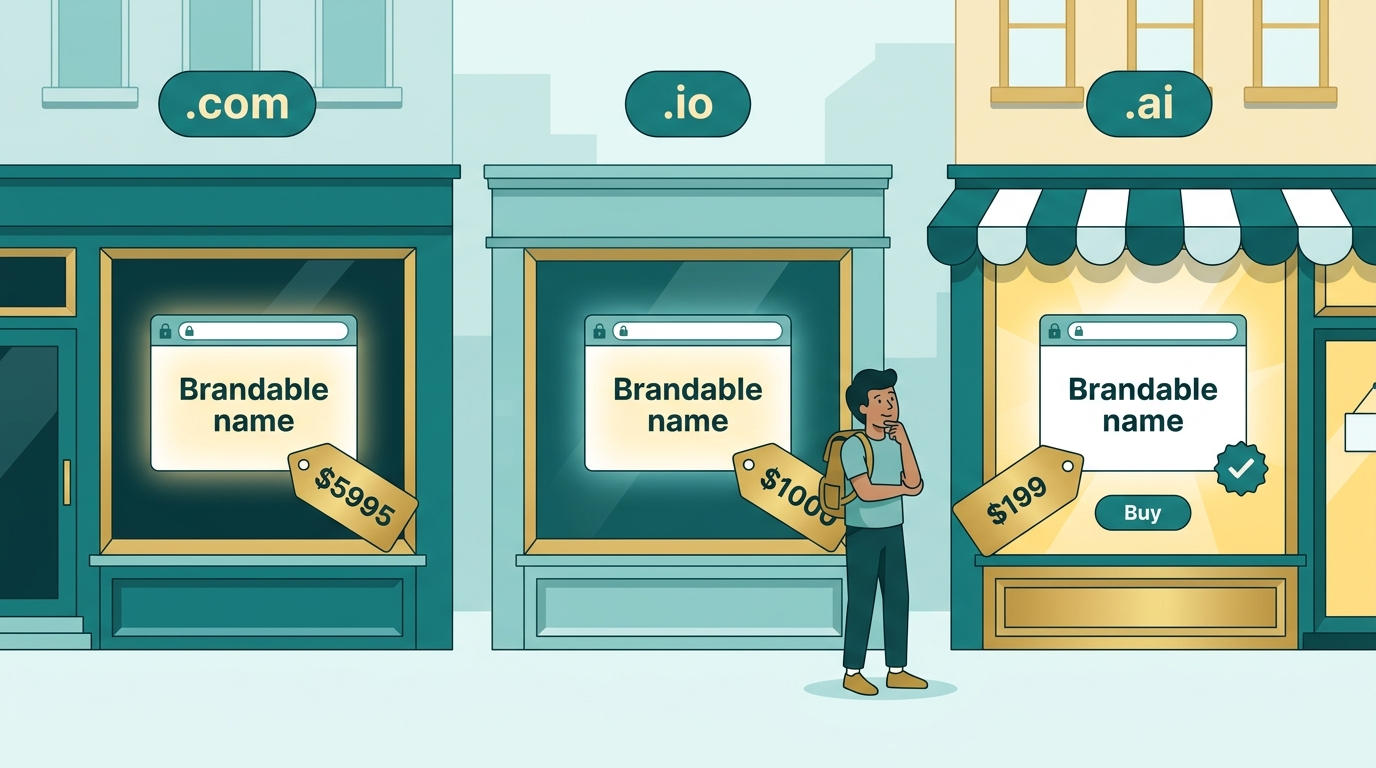
- Every name is $199 or less. Sellers (or our team) set each domain's price on a ladder from $29 to $199 — one fair, visible price per listing. No auctions, no make-an-offer, no hidden floor.
- Every listing is AI quality-vetted and owner-verified before it goes live. Curation is the product. Buyers trust the shelf, so they check out fast instead of haggling.
- Anyone can submit. If you own quality names in the affordable band, you can list them yourself, free.
That last point is the change this article exists to explain. Let me walk you through the whole flow.
How do you sell a domain on 199.domains? The full walkthrough
The submission flow is designed to take a few minutes per domain, not an afternoon. Here's every step.
Step 1 — Submit your domain free at 199.domains/sell
You start by listing a domain free at 199.domains/sell. There's no listing fee, no delisting fee, and no monthly cost to keep a name live. You enter the domain you own; that's the whole entry ticket. Because there's no cost to list, there's also no penalty for submitting a name and having it not sell — the only fee that ever exists is a commission on an actual sale.
Step 2 — Instant AI quality review
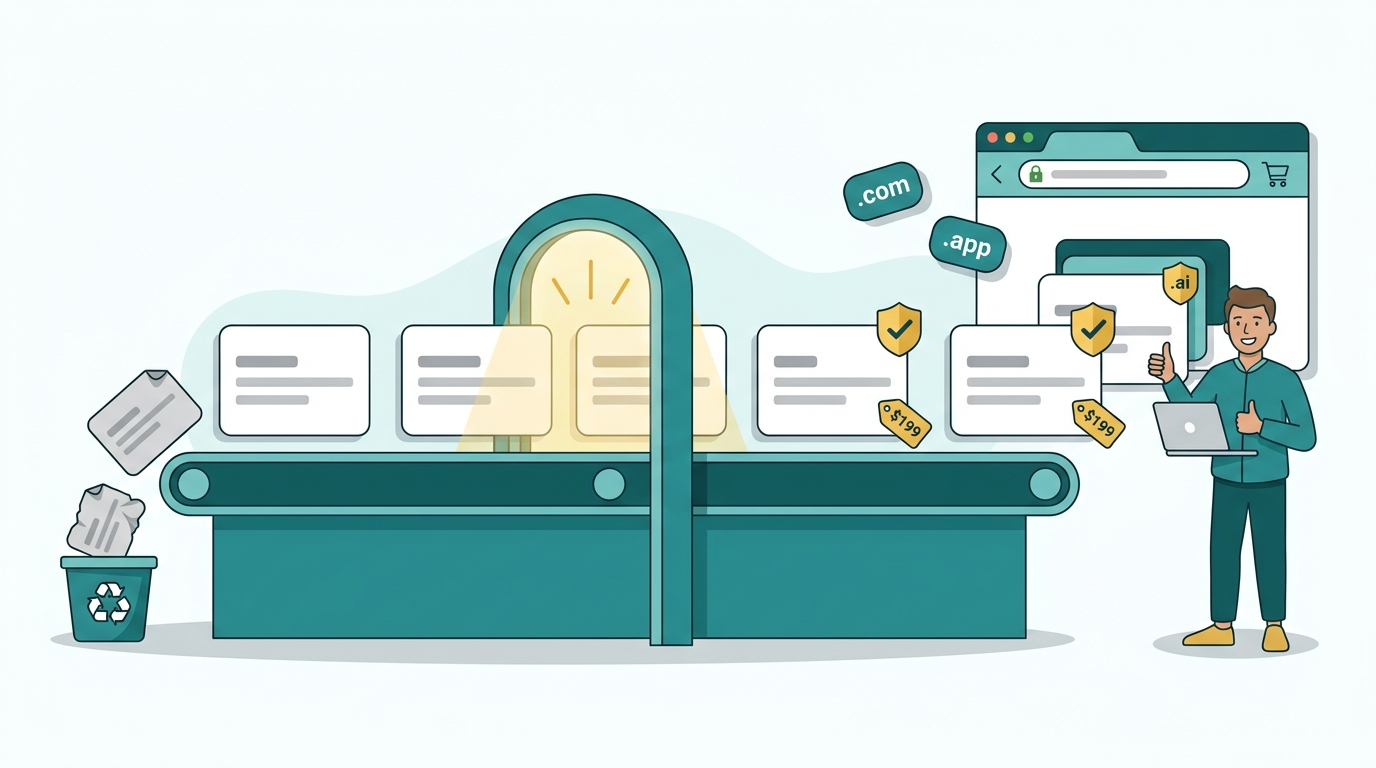
Every submitted domain runs through an automated quality review immediately. It's checking the things that make a name sellable and safe:
- Brandability and readability — is it short, spellable, and pronounceable, or a long hyphen-and-number string?
- Category fit — does it read as a real brandable, a useful keyword name, a buildable app-style name, or a clean one-word?
- Trademark red flags — obvious conflicts with well-known marks get caught here.
- History signals — a name with a prior spam or phishing footprint is radioactive to buyers and gets screened out.
If a name doesn't pass, that's not the marketplace being precious — it's protecting you as much as the buyer. A curated shelf is the entire reason buyers on 199.domains check out at the sticker price instead of assuming everything is negotiable. Every junk listing that gets through would erode the trust that makes your good listings sell. (This is the same clean-history, trademark-clear vetting standard I described in the buyer's guide to getting a premium domain for under $500 — the seller side is just the other end of the same pipe.)
Step 3 — Verify ownership by DNS
Before a name goes live, you prove you actually control it. Verification is done via DNS — you add a record we specify to the domain's zone, and the system confirms it. This is the same class of ownership check used across the industry for exactly this reason: it makes it effectively impossible to list a domain you don't hold, which is what keeps the marketplace free of the "seller vanishes after checkout" problem that plagues informal domain sales.
Step 4 — Set your price on the $29–$199 ladder
Now you pick your number. Any price from $29 to $199. This is the part sellers used to overthink for weeks under a make-an-offer model, and the fixed ladder is designed to end that. My honest advice: price where it sells. A name that would be worth fighting for at $2,000 on a broker will move quickly at $149 here, to a buyer who found it, believed the price, and clicked buy — no anchoring war, no month of silence. Transparent pricing is the whole antidote to the negotiation tax I covered in fixed-price vs. auction domains.
Step 5 — Go live in the marketplace
Once it's vetted, verified, and priced, your listing is live and discoverable in the catalog and its category views — featured, brandable, keyword, and the rest. Here's the kind of vetted, owner-verified inventory a live listing sits alongside:
How much do sellers actually keep? (The commission table)
Here's the part that matters when the money changes hands. On 199.domains sellers keep up to 81%: the fee is 19% on sales of $50 or more and 25% on sales under $50, with a $5 minimum. There's no separate escrow charge and no buyer's-premium skim on your side — the fee comes out of one transparent number.
How that stacks up against where affordable names usually get listed:
| Where you list | Listing fee | Sales commission | Escrow on top? | Price model |
|---|---|---|---|---|
| 199.domains | None | 19% ($50+), 25% (under $50) | No — built in | Fixed, $199 or less |
| GoDaddy / Afternic | None | 15% (parked) / 25% (not) | Handled in-platform | Fixed or make-offer |
| Sedo | None | 15% fixed, 20% auction | Handled in-platform | Fixed or auction |
| Namecheap Market | None | ~10% | Handled in-platform | Fixed |
| Community forums (e.g. NamePros) | None | 0% | Yes — you arrange it | You negotiate |
Commission figures are the platforms' own published rates as of 2026; verify current terms on each provider's fee page before listing.
Two honest observations. First, our 19% isn't the rock-bottom number in the table — a couple of registrar-tied marketplaces charge less if your domain is registered with them. What you're buying with the 19% is the whole system around the sale: free listing, no escrow to arrange, a curated shelf that makes buyers trust the price, and a fast, guaranteed transfer. Second, the zero-commission forum route isn't really free — you become your own escrow agent, your own buyer-finder, and your own dispute handler. For most sellers of affordable names, that's a worse trade than a clean 19%.
What happens when your domain sells?
The moment a buyer checks out, the process is built to be fast and low-drama:
- The buyer pays the fixed price through the marketplace's checkout. No offer thread, no counter, no waiting on a broker to relay numbers.
- The transfer is initiated within 72 hours. You don't have to babysit an escrow timeline that stretches into weeks.
- A full refund guarantee protects the deal. If a transfer can't be completed for any reason, the buyer is refunded in full — which is exactly why buyers are comfortable paying up front on a fixed price.
The mechanics under the hood are the standard ICANN inter-registrar transfer process — authorization code, registrar-to-registrar move, the usual locks. If you want the full mechanical detail of how that handoff works, I broke it down step by step in the complete domain transfer guide. The point of the 72-hour target is to compress that standard process into something that feels like a normal e-commerce order rather than a legal negotiation.
Which of your domains should you list first?
Not every name in your portfolio belongs here, and being honest about that will make you more money, not less. 199.domains is the fast lane for names priced to actually sell — not a parking lot for four-figure holdouts you're hoping someone overpays for. If you've got a genuine $8,000 one-word .com, keep it where it can find that buyer. For everything else, this is where it moves.
The names to submit first, in the order I'd reach for them:
- Clean one-word names in the affordable band — the single strongest category, and the one buyers hunt hardest. (Here's why they hold value even under $500: one-word .com domains under $500.)
- Short two-word brandables under about 12 characters — the fastest-selling pattern in the whole market.
- Buildable, app-style names a vibe coder could ship a weekend project on.
- Clear keyword domains where the words match real search or category demand.
Run each candidate through the same quick test a buyer will: can a stranger spell it after hearing it once, does it read as a real brand, and is the history clean? If yes, it'll likely pass the AI review and — priced sensibly on the ladder — actually sell. The data on what funded startups actually buy is a useful gut-check on which of your names have real demand behind them.
The bottom line
For twenty years the domain business has been organized around the rare expensive sale, which means the everyday affordable name — the one most investors actually hold — gets buried, unpriced, and ignored. 199.domains is my answer to that: an open, curated marketplace where listing is free, every name is one fair price of $199 or less, every listing is vetted and owner-verified so buyers trust it, sellers keep up to 81%, and a sold domain is on its way to the buyer within 72 hours.
If you've got quality names sitting in make-an-offer limbo somewhere, pull one out and list it free at 199.domains/sell. Price it to sell, let the curation do the trust-building, and let a fixed price do the negotiating for you. That's the whole idea — the fast lane for names that were always good enough to sell, just never priced to.