Buying a domain from a stranger has one awkward problem at its center. Somebody has to go first.
If you wire the money first, you are trusting that the seller will actually hand over the name. If the seller transfers the domain first, they are trusting that your payment will arrive and stay arrived. In most online purchases a card network sits in the middle to sort out disputes. In a private domain deal, nothing does, unless you put something there.
That something is escrow. I have been buying and selling domains for a long time, and escrow is the single piece of the process I would never skip on a meaningful private deal. I also think it gets recommended far too often on small purchases, where the fee can eat a third of the price and a better protection already exists.
This guide explains exactly how domain escrow works, what it really costs at every price point, how long it takes, the scams that imitate it, and when you need it versus when a marketplace's built-in guarantee already covers you.
Why do domain sales need escrow?
Because both halves of the trade are hard to undo.
- Domain transfers are sticky. Once a domain moves into another person's registrar account, the only way to get it back is for that person to send it back, or a formal dispute. ICANN's Transfer Policy sets out how names move between registrars, and it also means a freshly transferred name is normally locked against another registrar transfer for 60 days. Reversing a bad deal is slow even in the best case.
- Wire payments are close to final. Bank wires, crypto and many payment apps are the fastest ways to move money and the hardest to claw back. That is exactly why fraudsters prefer them.
- Neither side can easily verify the other. WHOIS data is mostly redacted today, sellers can list names they do not control, and buyers can use a card they will later dispute.
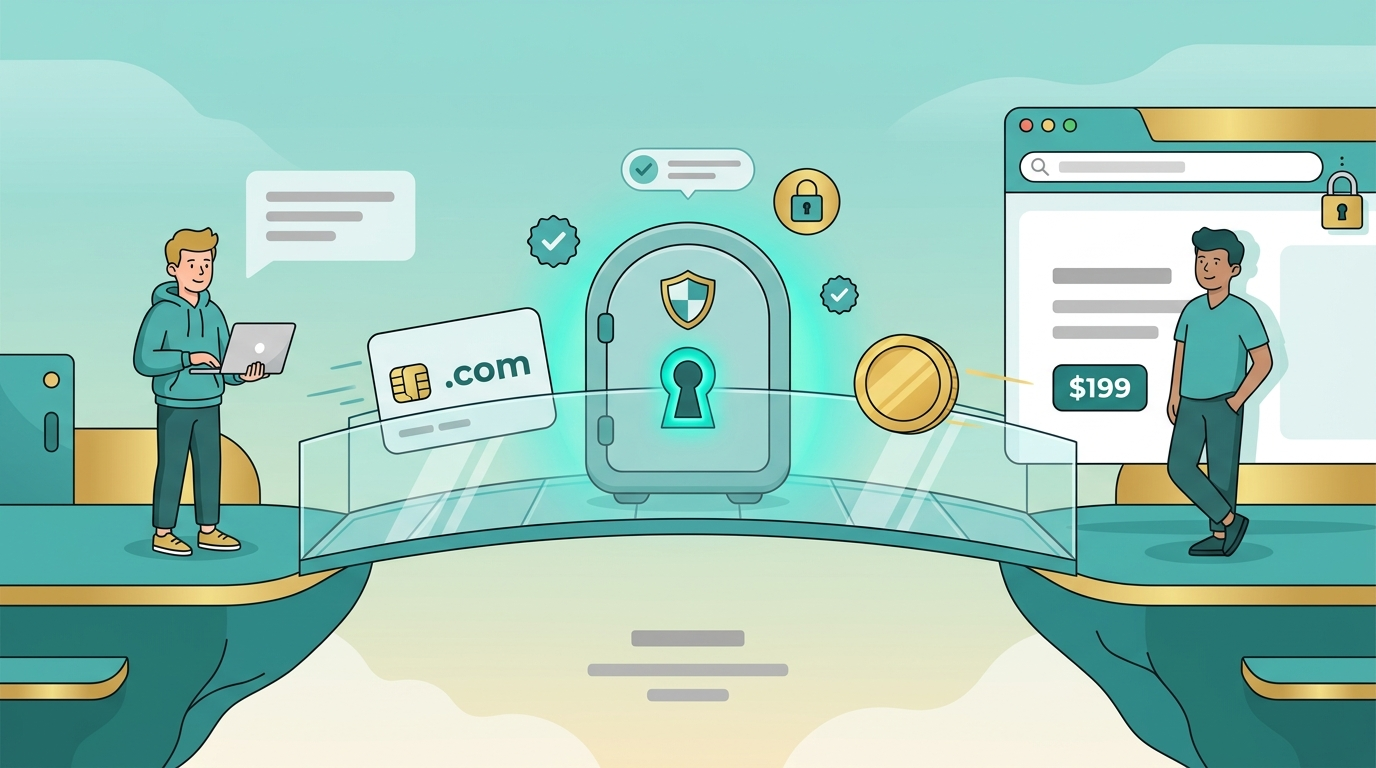
Escrow breaks the standoff by holding the money in a neutral account until the domain has actually arrived. The seller transfers knowing the funds exist. The buyer pays knowing the money comes back if the name never shows up. Neither has to trust the other. They both trust the referee.
How does domain escrow work? The five steps
The flow is the same at every reputable provider. Escrow.com's own guide to buying and selling domains through escrow describes it in five steps, and it matches how I have seen deals run for years.
Step 1: Agree on terms
Buyer and seller agree on the domain, the price, who pays the escrow fee and how long the buyer has to inspect the domain once it arrives. One of them opens the transaction on the escrow service and the other accepts it. Open the transaction yourself, or log in from a bookmark. Never click an "escrow link" a stranger sent you (more on why below).
Step 2: The buyer funds escrow
The buyer pays the escrow company, not the seller. The escrow company confirms the funds have cleared and then tells the seller it is safe to transfer. Until that confirmation, the seller should not move the domain.
Step 3: The seller transfers the domain
There are two ways this happens:
- An internal push. If both parties use the same registrar, the seller moves the domain from their account to the buyer's account. This is often done within hours.
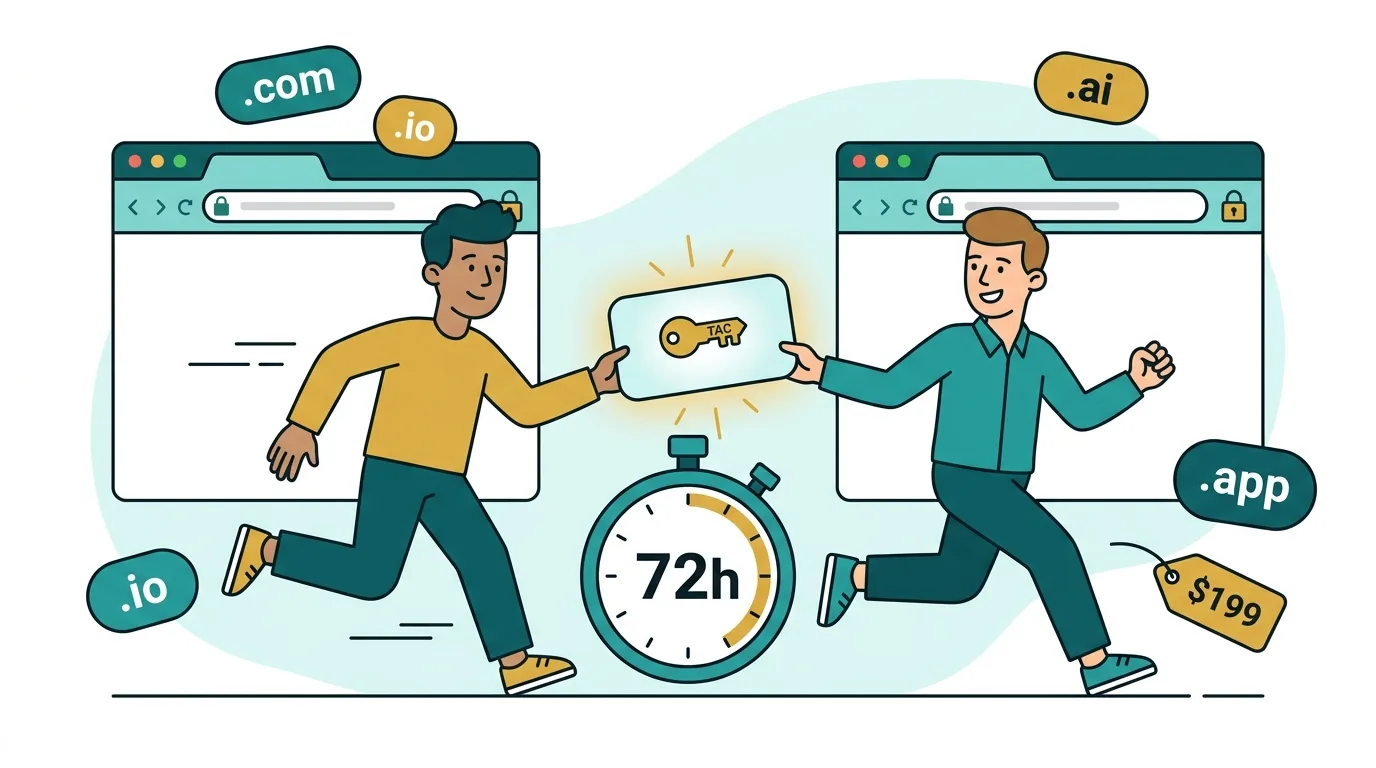
- An inter-registrar transfer. The seller unlocks the domain and provides the authorization code (the old EPP code). The buyer starts a transfer at their own registrar, which usually takes up to five to seven days to clear. The full mechanics are in the complete domain transfer guide.
Step 4: The buyer confirms receipt
Once the domain is in the buyer's account, the buyer confirms it with the escrow service, and an agreed inspection period starts. This is the moment to check that the domain is genuinely under your control: you can log in, change DNS, and see yourself as the registrant.
Step 5: Escrow pays the seller
When the buyer accepts the domain, or the inspection period ends without a dispute, the escrow company releases the funds to the seller. The deal is done.
The one rule that makes all of this work: the seller is paid last. Any process where the seller is paid before the domain reaches you is not escrow, whatever it calls itself.
How much does domain escrow cost?
Escrow is charged as a percentage of the price with a minimum fee. As of September 2026, Escrow.com's published fee calculator lists these standard rates for US dollar transactions:
| Transaction amount | Standard fee | Minimum |
|---|---|---|
| Up to $5,000 | 2.6% | $50 |
| $5,000 to $50,000 | 2.4% | $130 |
| $50,000 to $200,000 | 1.9% | $1,200 |
| $200,000 to $500,000 | 1.5% | $3,800 |
Paying by card or PayPal adds a payment processing fee on smaller transactions, an international wire adds an intermediary bank charge, and sellers can pay a small fee depending on how they choose to be paid out. Other escrow providers price differently, so treat this as a benchmark rather than the market rate.
The percentages look small. The minimum is the part that matters. Here is what that schedule means in practice:
| Domain price | Escrow fee (standard) | Fee as a share of the price |
|---|---|---|
| $150 | $50 (minimum) | 33% |
| $500 | $50 (minimum) | 10% |
| $2,500 | $65 | 2.6% |
| $20,000 | $480 | 2.4% |
| $100,000 | $1,900 | 1.9% |
On a five-figure name, escrow is cheap insurance on money you cannot afford to lose. On a name under $500, the fixed minimum turns it into a heavy tax on a small purchase. That is the practical reason escrow feels essential at the top of the market and awkward at the bottom.
Who pays the escrow fee?
Whoever you agree pays it. The split is set when the transaction is created: buyer pays, seller pays, or 50/50. In private deals, buyer-pays and an even split are the most common. Settle it before anyone opens the transaction, because it is added to the buyer's total or taken from the seller's payout automatically, and arguing about it mid-deal is how simple sales stall.
Investor's note: on private deals, I have found that offering to split the escrow fee does more for a negotiation than shaving the same amount off the price. It signals that you intend to close properly and that you are not the kind of buyer who is about to suggest a "quicker" payment method. If you are working out what to offer in the first place, how to buy a domain name that's already taken covers the outreach side.
How long does domain escrow take?
Plan for one to two weeks on an inter-registrar deal. Roughly:
| Stage | Typical time | What slows it down |
|---|---|---|
| Agree terms and open transaction | Same day | Haggling over who pays the fee |
| Buyer funds escrow | 1 to 3 business days | International wires, card holds |
| Seller transfers the domain | Hours (push) to 5 to 7 days (registrar transfer) | Unresponsive seller, expired auth code, 60-day lock |
| Buyer inspection | A few days, as agreed | Buyer not checking their account |
| Seller paid | Same or next business day after release | Payout method |
Almost every slow escrow deal is slow at the transfer step. Before you fund anything, ask the seller when the domain was registered or last transferred. If it is inside a 60-day lock, a registrar transfer cannot start yet, and you will either wait or arrange an internal push at the seller's registrar.
Domain escrow scams: the red flags to know
Escrow is safe. Fake escrow is one of the oldest domain scams there is, and it works precisely because buyers have been told to "always use escrow."
Fake escrow websites
The seller insists on a specific escrow company you have never heard of, and sends a link. The site looks professional, shows a transaction with your domain in it, and gives you wire instructions. The money goes straight to the scammer. The domain never existed as a sale.
The defense is simple: you choose the escrow service, or you pick one of the long-established licensed providers, and you type its address yourself. A legitimate seller will not object. Escrow.com, for example, states on its about page that it is licensed as an escrow company in California and regularly audited by state regulators. That is the kind of claim you can check independently.
Off-platform payment requests
The seller offers a "discount" if you skip escrow and pay by wire, crypto, gift card or a payment app. The FTC's guidance on how to avoid a scam is blunt about this: never pay someone who insists you can only pay with cryptocurrency, a wire transfer service, a payment app or a gift card. A domain deal is not an exception.
The other warning signs
- Pressure to pay today. Real sellers of real names can wait 48 hours for escrow to be set up.
- Seller control you cannot verify. Ask the seller to change a DNS record or add a TXT record you choose. Anyone who genuinely controls the domain can do it in minutes.
- Transfer before funding, from the seller's side. If you are selling, never push the domain before escrow confirms the funds have cleared, however nice the buyer seems.
- Email-only instructions that change mid-deal. New bank details arriving by email halfway through a transaction is a classic account-takeover pattern. Confirm through the escrow dashboard, not the inbox.
When is escrow mandatory, and when is it overkill?
Escrow is a tool for one specific job: protecting a payment between parties who have no other protection. Whether you need it depends on whether something else is already doing that job.
| Situation | Use escrow? | Why |
|---|---|---|
| Private deal with a stranger, $1,000+ | Yes, always | No other party holds the money or guarantees the transfer |
| Private deal after WHOIS or email outreach, any price | Yes | You cannot verify who you are talking to |
| Buying through a broker | Yes | Brokers typically run deals through licensed escrow; insist on it |
| Registrar or marketplace purchase with a built-in transfer guarantee | No | The platform already holds payment and refunds failed transfers |
| Private deal under a few hundred dollars | Usually not worth it | The minimum fee can exceed 10% to 30% of the price; buy through a guaranteed platform instead |
| A friend or long-standing business partner | Your call | Trust exists, but escrow still costs less than a dispute |
The pattern is simple. Escrow is essential when the only thing standing between you and a loss is the other person's honesty. It is redundant when a platform has already put itself in the middle.
How marketplace guarantees replace DIY escrow at $199 or less
This is where small purchases get much easier.
A good marketplace does the three things escrow does as part of the checkout: it takes your payment, it makes sure the domain actually reaches you before the seller gets paid, and it refunds you if the transfer fails. You get the protection without the fee, the paperwork or the risk of a fake escrow link.
Here is how that works on 199.domains, compared with a private escrow deal:
| Private deal with escrow | 199.domains purchase | |
|---|---|---|
| Price | Negotiated | $199 or less, shown up front |
| Seller verification | Your own checks | Owner-verified by DNS before the listing goes live |
| Name quality check | Your own judgment | AI quality-vetted before listing |
| Escrow fee | Often $50 minimum, split by agreement | None charged to the buyer on top of the price |
| Transfer | Depends on the seller's responsiveness | Initiated within 72 hours |
| When the seller is paid | After you accept the domain | Only after you confirm you received the domain |
| If the transfer fails | Escrow refund process | Full refund |
That structure is the reason every listing can sit at $199 or less without a fee stacked on top. The trust work is done once, at listing time, instead of being negotiated deal by deal. If you want to see exactly what happens between submission and sale, how 199.domains curates, vets and prices the catalog walks through every gate.
A few names from the featured collection right now, each covered by the same guarantee:
When you look at a grid like this, you can spend your attention where it belongs: on whether a name is short, easy to say, easy to spell after hearing it once, and on an extension your customers will trust. The safety question is already answered. If you prefer invented or compound names, the brandable collection works the same way.
For the bigger picture on where to buy, the best places to buy a domain name in 2026 compares registrars, auction houses and fixed-price marketplaces side by side.
A simple domain escrow checklist
Before you send money for any domain outside a guaranteed platform, run through this:
- Use a licensed escrow service you chose yourself, and type its address into the browser.
- Agree in writing on price, fee split and inspection period before anyone opens the transaction.
- Confirm the seller controls the domain by asking them to make a DNS change you specify.
- Check for a 60-day transfer lock and agree on push versus registrar transfer.
- Never pay the seller directly, and never accept new payment details by email mid-deal.
- Confirm the domain is in your account and your name before you accept it in escrow.
- Secure it immediately: turn on the registrar lock and two-factor authentication.
The bottom line on domain escrow
Domain escrow is the right answer to a real problem. When you are paying a stranger for a name, it is the difference between a safe transaction and hoping for the best, and on a five-figure deal its fee is a rounding error.
It is also a tool with a minimum price. Below a few hundred dollars, a $50 fee is a large slice of the deal, and the smarter move is to buy where the protection is already part of the purchase. Pay once, let the platform hold the money, and get the domain or your money back.
If that is the kind of purchase you want, browse the featured domains. Every name is $199 or less, owner-verified before it goes live, and the seller is only paid once the domain is in your account.