Ask how domain marketplaces work and you'll mostly hear the same short answer: sellers list names, buyers search, money moves through escrow, a transfer happens. All true. It also skips every part that decides whether you should trust the name in front of you.
Who checked that the seller actually owns it? Who decided it was worth listing? Where did that price come from? What happens to your money if the transfer stalls?
I've spent 25+ years buying, selling, and writing about domain names, and those four questions are where most bad domain purchases go wrong. So this post opens the hood on 199.domains and walks through the whole pipeline a listing passes before you can buy it, and everything that happens after you do. It also covers what the review deliberately doesn't judge, because a trust page that only lists strengths isn't one.
How do domain marketplaces work behind the scenes?
At the simplest level, every domain marketplace does four jobs: it gets names onto the shelf (sourcing), decides which names are allowed to stay there (curation), attaches a price (pricing), and moves the domain and the money safely (transfer and payment).
Where marketplaces differ is how much of that work they do for you, and how much they quietly leave to you.
| Stage | What a buyer often has to take on trust elsewhere | What happens on 199.domains |
|---|---|---|
| Sourcing | Large bulk feeds; listings can be anything a seller uploads | Names enter one at a time, from sellers or the house catalog, through the same gates |
| Quality | Little or no review; you sort signal from noise | Every name passes a pre-screen and an AI quality review first |
| Ownership | Often assumed until a sale is underway | Proven by a DNS record before the listing can go live |
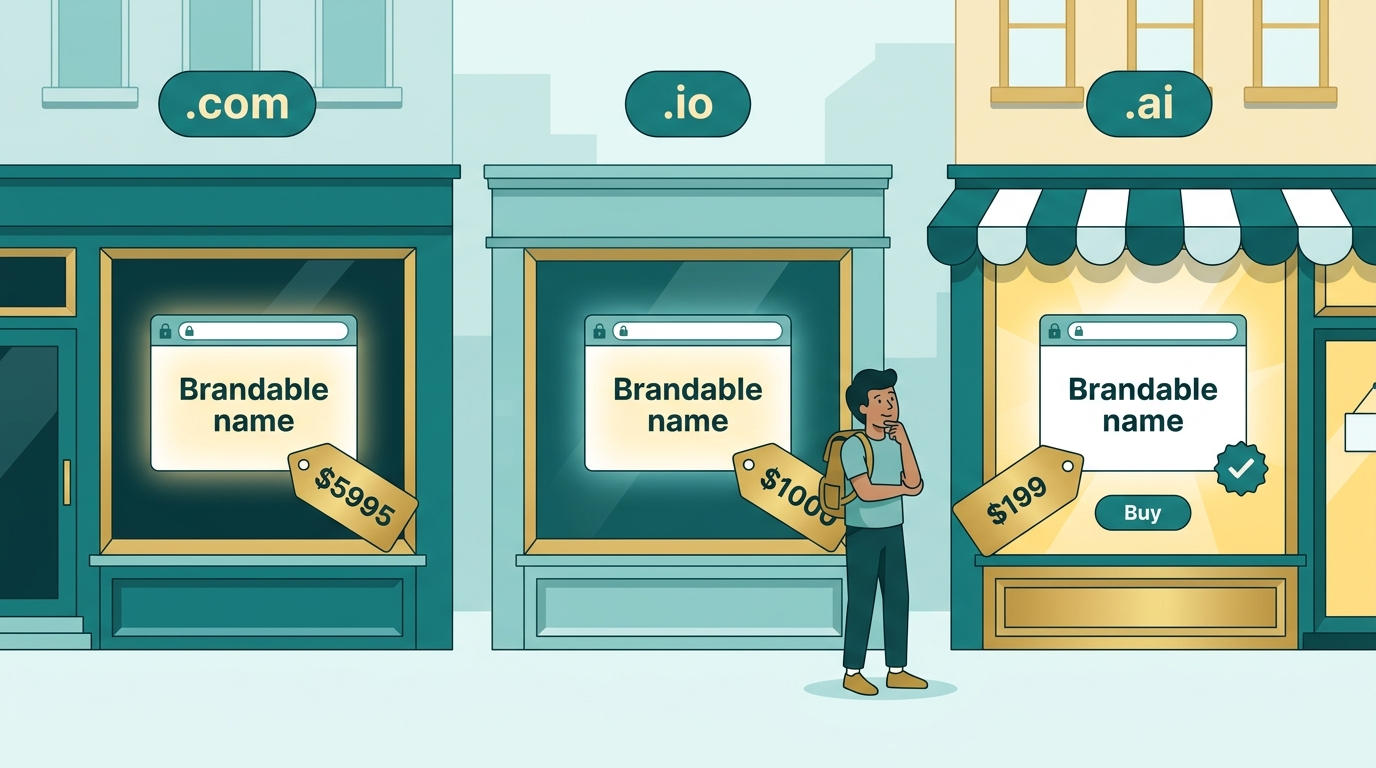
| Price | Hidden behind "make an offer," or set to anchor a negotiation | One visible price, $199 or less, on a $29 to $199 ladder |
| Payment | Arranged separately, sometimes by the buyer and seller directly | Stripe checkout, with the fee shown as its own line |
| Transfer | Timeline depends on how responsive the seller is | Initiated within 72 hours; full refund if it can't complete within 10 days |
| Seller payout | Can be released before the buyer has the domain | Released only after the buyer confirms receipt |
The rest of this post takes each row apart.
Where do the domains come from?
There are two ways a name reaches the marketplace, and they meet the same standard.
Member submissions. The marketplace is open. Any domain owner can list a domain for free, in a single submission or a bulk batch. There is no listing fee and no monthly cost, so the only thing a seller spends is a few minutes.
The house-curated catalog. A smaller set of names is added and curated by our own team.
What there isn't is a bulk feed. Names don't arrive by the thousand from an expiring-domain list and get sorted out later. Every listing, from either door, passes the same review before anyone can buy it. If you want the seller's side of this story in detail, including the payout math, read how selling on 199.domains works.
How does 199.domains vet domains before they're listed?
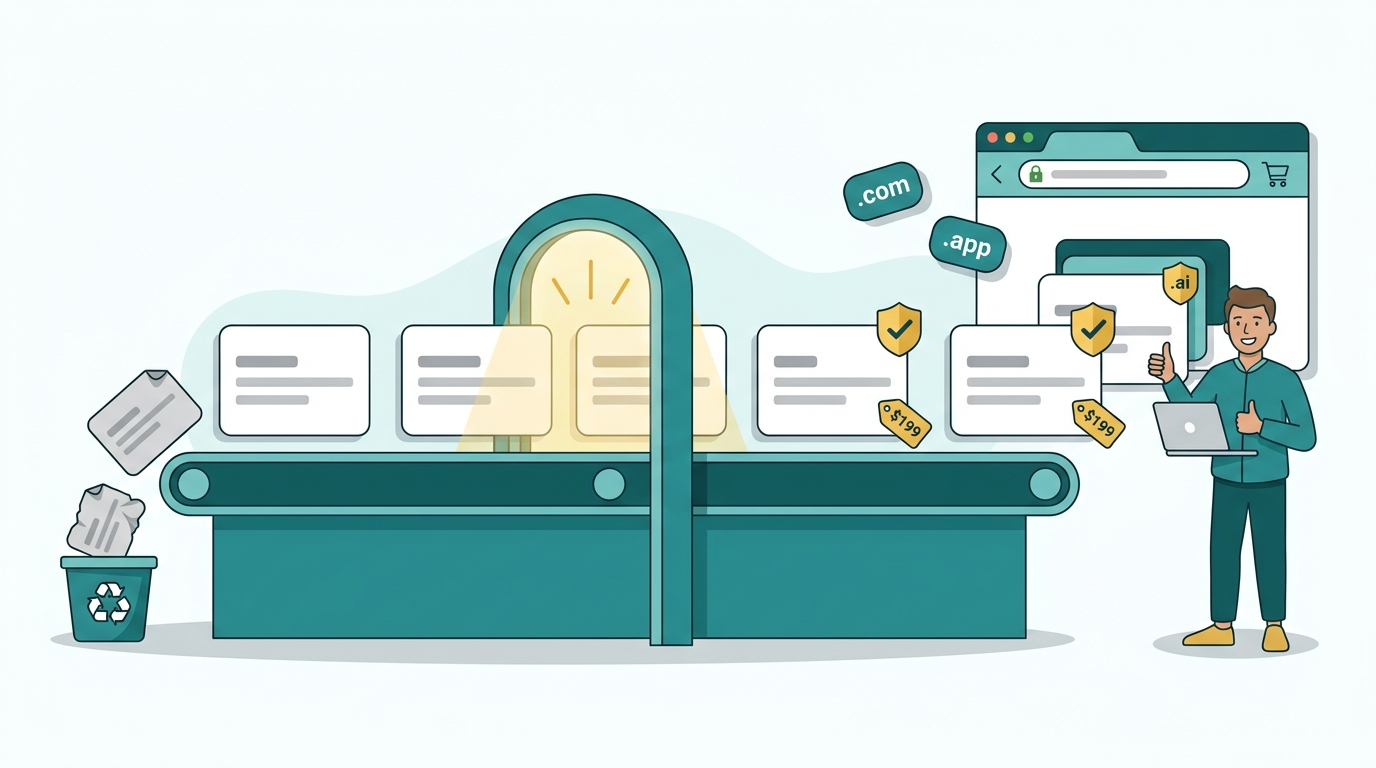
Think of it as five gates. A name has to clear each one, in order, before it appears in search results.
Gate 1: The pre-screen
Before any judgment about quality, the basics get checked automatically:
- Is it a real, registrable domain? Malformed entries are rejected on the spot.
- Is it on an accepted extension? Extensions that don't meet the marketplace's standard are turned away before review.
- Is it already live? A name can only have one listing, so duplicates stop here.
- Has it already failed? Names already on the house blocklist don't get a second pass.
Gate 2: The AI quality review
This is the heart of the curation. Every surviving name is reviewed by an AI model working from a written rubric, and the rubric is calibrated with real examples on both sides: names that were accepted and now sell as listings, and names that were rejected. That way the bar is set by the actual catalog rather than by a model's guess at what "good" means.
Two design choices matter here.
Coined names are treated as valuable, not as gibberish. A name doesn't have to be a dictionary word. Short, pronounceable invented words are exactly the pattern behind brands like Etsy, Twilio, and Zapier, and a review that punished them would reject the names founders most want. If a name is short, can be comfortably said, and can be spelled after hearing it, it's brandable.
A rejection requires confidence. The review scores how sure it is that a name is low quality, and a name is only rejected when that score clears a set threshold. On the fence means it stays.
What reliably fails:
| Rejected pattern | Why it fails a buyer |
|---|---|
| Unpronounceable random strings | Can't be said on a call or remembered after an ad |
| Heavy hyphens or digits | Every hyphen and number is a typo waiting to happen |
| Ultra-long or awkward compounds | Too long to type, too clumsy to brand |
| Misspellings of common words | Sends your traffic to whoever owns the correct spelling |
| Adult, offensive, or hateful terms | A liability for any business |
| Obvious trademarks or a real person's full name | Invites a dispute you would very likely lose |
That last row isn't theoretical. According to WIPO's 2025 domain name report, WIPO handled more than 6,200 domain name cases in 2025, its highest caseload on record. Most of those cases are trademark owners going after domains that borrow their marks. Screening out the obvious ones protects buyers from buying a problem.
Each seller gets the verdict per name, with a short reason for anything rejected, plus an email summary of what passed. If you want the deeper version of what separates a strong name from a weak one, our guide to domain valuation breaks down the six levers behind every price.
Gate 3: Proof of ownership by DNS
A name that passes review still can't be bought yet. The seller has to prove they control it.
The marketplace issues a unique verification token for that submission. The seller adds it as a TXT record in the domain's DNS, either at the root of the domain or on a dedicated verification subdomain, and the marketplace looks it up through public DNS resolvers. Only someone with control of the domain's DNS can publish that record, so a match is real evidence of control, not a promise.
Two protections come with it. First, it makes listing a domain you don't hold effectively impossible. Second, once a domain is live under one seller, a second seller can't claim it, even if they can somehow produce a token.
Investor's note: The most common domain scam I've seen over the years isn't a clever technical exploit. It's someone "selling" a name they don't control, collecting payment, and disappearing. Ownership proof before the listing goes live, rather than after the money moves, is the single check that ends that whole category of fraud.
Gate 4: The price
Every price sits on a ladder from $29 to $199, and the system won't let a listing go outside it. A new listing starts from a suggested price based on how strong the name scored, and the seller can change it at any time from their dashboard.
There is no "make an offer" button, no auction, and no hidden reserve. The price you see is the price. We covered why that matters for buyers in the psychology of make-an-offer pricing: an unpriced listing doesn't extract a better number, it filters out the buyers who would have paid a fair one without a fight.
Gate 5: Live, and tagged only when it earns it
Once a name is vetted, verified, and priced, it goes live in search and in its category views. The labels are applied sparingly. An automated tagger marks a name as a keyword or brandable pick only when it's highly confident, and a Featured tag requires a name to already qualify as keyword or brandable, at an even higher confidence, with caps on how many can be added at once. Featured can't be inflated just by adding more inventory.
Here's what currently sits on the Featured shelf:
You can also browse the brandable domains, keyword domains, one-word domains, and Vibe names you can build an app on.
Why is every domain $199 or less, and how does that work economically?
A fair question. Plenty of the names on the shelf would carry four-figure asking prices somewhere else. So how does a marketplace make money selling them for $199 or less?
By cutting out the costs that exist only because prices are hidden.
On a traditional high-ticket sale, a lot of the price pays for work between the seller and the buyer: outreach, back-and-forth negotiation, a broker's commission, escrow arranged by hand. That work exists because each sale is rare and large. Remove the negotiation and the rarity, and most of that cost disappears.
Here's how the economics line up:
- Sellers list free. No listing fee means sellers submit names they want to actually sell, at prices that move, instead of parking holdouts.
- Sellers keep up to 81%. The commission is 19% on sales of $50 or more and 25% on sales under $50. On a $199 sale, the seller keeps about $161.
- Buyers see one number. A small service fee of 4% plus $0.50 is added at checkout and shown as its own line before payment. On a $99 domain, that's $4.46.
- The marketplace earns on volume. It makes money on many fairly priced sales rather than waiting months for one big one.
This is the same logic we walked through in fixed-price vs. auction domains. An auction or an open offer suits a buyer and seller willing to spend weeks finding the top number. A visible price suits everyone who would rather be done today.
The trade-off is honest: this isn't where to sell a genuine $20,000 one-word .com. It's where good, affordable names finally get priced to move, which is most of the names most people own.
What happens after you buy?
The pipeline doesn't stop at checkout. The guarantees are only as good as the mechanics behind them, so here they are.
Step 1: Payment through Stripe
Checkout runs on Stripe, which is certified to PCI Service Provider Level 1, the most stringent level of certification in the payments industry. Your card details go to Stripe, not to the marketplace.
Step 2: You choose where to receive the domain
You tell us which registrar you want the domain delivered to, and the seller is notified right away. Receiving it at the registrar where it already sits is usually fastest, often a same-day push inside one registrar with no transfer code needed. Otherwise the seller sends you an authorization code for a standard inter-registrar transfer.
Step 3: The transfer starts within 72 hours
The transfer is initiated within 72 hours of payment. Most complete in one to five days, depending on the registrars involved. The full mechanics, including authorization codes and registrar locks, are in our domain transfer guide.
One rule is worth knowing before you buy anything: under ICANN's inter-registrar transfer rules, a domain generally can't move to a new registrar within the first 60 days after it was registered or last transferred. The marketplace checks each seller listing's public registration data for that lock, so a seller sees it early. If a lock applies, a push inside the domain's current registrar is usually the way to deliver it.
Step 4: The seller is paid only after you confirm
You accept the domain in your registrar account and confirm you've received it. That confirmation releases the seller's payout. A seller never gets paid for a domain the buyer doesn't have.
The marketplace also checks public registration data to see whether the domain has changed registrars. That's a supporting signal, not proof, because the owner's identity is usually hidden in public records. That's exactly why the payout waits for your confirmation.
Step 5: The refund guarantee
If the domain can't be transferred to you within 10 days, for any reason, including a problem on the seller's side, you get a full refund and the domain goes back on the marketplace. If a payment is disputed, any open payout to the seller is frozen until it's resolved.
What does the review not check? Your 10-minute history audit
Here's the part most trust pages leave out.
The AI quality review judges the name: how it sounds, how it's spelled, what it means, and whether it collides with an obvious mark. It is not a backlink audit, and it doesn't reconstruct every domain's past life. A name can be perfectly brandable and still have been used for something you wouldn't want attached to your company.
That's true of domains bought anywhere, including a fresh hand registration of a name that expired years ago. So before you buy any previously registered domain, run this check. It takes about ten minutes:
- Look up the registration data. ICANN Lookup shows the registrar, the creation date, and the domain's status codes. An old creation date means there's a history worth looking at.
- See what it used to be. The Internet Archive's Wayback Machine shows snapshots of past versions of the site. You're looking for spam pages, adult content, or a real business that might still have customers looking for it.
- Check it against a safety blocklist. Google's Safe Browsing site status tool shows whether the domain is currently flagged as unsafe.
- Search the trademark register. Run the name through the USPTO trademark search, and the equivalent registers for your other markets. Our trademark clearance guide walks through it.
- Check the search footprint if you plan to use the domain for SEO. Our guide to buying domains for SEO covers what a clean or damaged history looks like.
| What gets checked | Handled by the marketplace | Worth checking yourself |
|---|---|---|
| Name quality and readability | Yes, AI quality review | Say it aloud to someone who hasn't seen it |
| Obvious trademark conflicts | Screened in review | Full register search for your markets |
| Seller controls the domain | Yes, DNS proof before listing | No |
| Transfer lock status | Checked on seller listings | Confirm in ICANN Lookup |
| Past website content | No | Wayback Machine |
| Safety blocklist status | No | Google Safe Browsing |
| Backlink and spam history | No | Only matters if you're buying for SEO |
None of that should make you nervous. The overwhelming majority of short, brandable names have boring pasts. It just means the fastest way to get total confidence is ten minutes of your own checking layered on top of a vetted, owner-verified listing.
The bottom line
A domain marketplace is only as trustworthy as its gates. On 199.domains, every listing enters one at a time, passes a pre-screen and an AI quality review that rejects the patterns buyers regret, proves ownership through DNS before it can be sold, and carries one visible price of $199 or less. After a sale, the transfer starts within 72 hours, the seller is paid only once you confirm you have the domain, and you get a full refund if it can't be delivered within 10 days.
That's the whole anatomy. Here's a sample of brandable names that made it through:
Browse today's featured domains to see what the review lets through, or, if you own names that would pass, list them free. And if you're still deciding how much a genuinely good name should cost, start with our guide to getting a premium domain for under $500.