Type "best place to buy a domain name" into any search bar and you get two kinds of answer mixed together as if they were the same thing. One kind tells you which registrar has the cheapest .com. The other kind ranks marketplaces where people sell names they already own.
Both are useful. They just answer different questions, and picking the wrong one is how founders end up paying $12 for a name they do not want, or thousands for a name they did not need.
So before any rankings, the split that decides everything.
Where to buy a domain: the two questions hiding in one search
Question one: is the name unregistered? Then nobody owns it, there is nothing to negotiate, and you buy it from a registrar, a company accredited to register names on your behalf. You pay a yearly fee for as long as you keep it. The work here is choosing a registrar that will not quietly cost you more every year.
Question two: is the name already registered? Then someone owns it, and you buy it from them through a marketplace, an auction, a broker or a direct deal. You pay the owner a one-time price, then keep paying the normal renewal at whatever registrar the name lands in. The work here is choosing a venue where the price is fair and the transfer actually happens.
Here is the shortcut: search the exact name at any registrar first. If it comes back available at the standard price, you are in question one. If it comes back taken, or available only at a "premium" price set by the registry, you are in question two, and a registrar's search box stops being the right tool. The full playbook for names that are already owned lives in how to buy a domain name that's already taken.
| Registering a new name | Buying an existing name | |
|---|---|---|
| Who you pay | A registrar | The current owner, via a venue |
| What you pay | Annual registration fee | One-time price, then normal renewals |
| Typical cost | Roughly $10 to $20 a year for a .com | Under $100 to seven figures |
| Negotiation | None | Depends entirely on the venue |
| Main risk | Renewal hikes and lock-in | Overpaying, or a transfer that stalls |
| Speed | Minutes | Minutes to months |
How to choose a domain registrar in 2026
Almost every registrar sells the same .com. The registry behind each extension sets a wholesale price, and ICANN adds a small fee on top, so the underlying product is identical everywhere. What differs is everything wrapped around it. These are the five things worth checking, in order of how much money they move.
1. The renewal price, not the first-year price
The single most common registrar trap is a cheap first year followed by a much higher "regular" price. It is not hidden, exactly. Most registrars publish it. Porkbun's public pricing table, for example, lists a first-year sale price next to the regular renewal price for every extension, and on some newer extensions the gap is dramatic.
Always read the second column. You will pay the first-year price once and the renewal price for as long as you own the name. For a name you plan to keep ten years, the renewal is ninety percent of the bill.
2. What is bundled, and what is upsold
WHOIS privacy should be free in 2026. So should basic DNS. A registrar that charges extra for privacy, or pre-ticks a hosting plan, an email plan and a "domain protection" add-on at checkout, is telling you how it makes money. None of those add-ons are necessary to own and point a domain.
3. How easy it is to leave
A good registrar lets you unlock the domain and copy the transfer authorization code from your dashboard in under a minute. A bad one makes you open a support ticket, wait, or pay. Check this before you register, because you will not care about it until the day you want to move, and by then it is too late to choose differently. The mechanics of moving a name are laid out in the complete domain transfer guide.
4. Accreditation and security
For generic extensions like .com, .io or .app, buy from a registrar on ICANN's list of accredited registrars, or from a reseller of one. Then turn on two-factor authentication the same day. A hijacked registrar account is the fastest way to lose a domain, and it is almost always preventable.
5. Whether it fits your stack
Some registrars tie the domain to their own infrastructure. Cloudflare's registrar is a clear, honest example: it charges only what the registry and ICANN charge, with no markup, and its documentation is upfront about that. Its registrar FAQ is equally upfront that every domain registered there uses Cloudflare's nameservers, and that if you need different nameservers you have to move the domain to another registrar. That is a great trade if you already run on Cloudflare and a poor one if you do not. Neither answer is wrong. Just know which one you are signing up for.
Investor's note: after 25 years of holding domains at more registrars than I can count, the only registrar feature I have ever regretted ignoring is the exit. Cheap renewals save you a few dollars a year. A registrar that makes leaving painful costs you a weekend exactly when you can least afford one.
How to choose a domain marketplace
Once the name is owned, you are no longer comparing prices for the same product. You are comparing venues, and venues differ in how the price is set, who checks the listing, and how the name gets to you. Five criteria matter.
How the price is set. A listed fixed price means you evaluate an offer. An offer form or an auction means somebody evaluates you. Fixed price is faster and almost always cheaper for names in the low hundreds. The mechanics of why are covered in fixed-price vs. auction domains.
Who checks the listing. On an open exchange, anyone can list almost anything, so the quality filter is you. On a curated marketplace, someone has already rejected the weak names, the trademark problems and the spam-history domains before you ever see them.
Who verifies the seller. A listing is only as good as the seller's control of the name. Venues that verify ownership, by DNS or by holding the name at a partner registrar, remove the most dangerous failure in the aftermarket: paying for a name the seller cannot deliver.
What fees sit on top. Most commissions are charged to the seller, but they shape the asking price. Buyers should also watch for escrow fees on direct deals, buyer's premiums at some auctions, and financing charges on payment plans.
How fast the name reaches you. The transfer is the product. A great price on a name that takes six weeks to arrive is a worse deal than a fair price on a name you control by Friday.
Registrars, auctions and marketplaces compared: the honest venue table
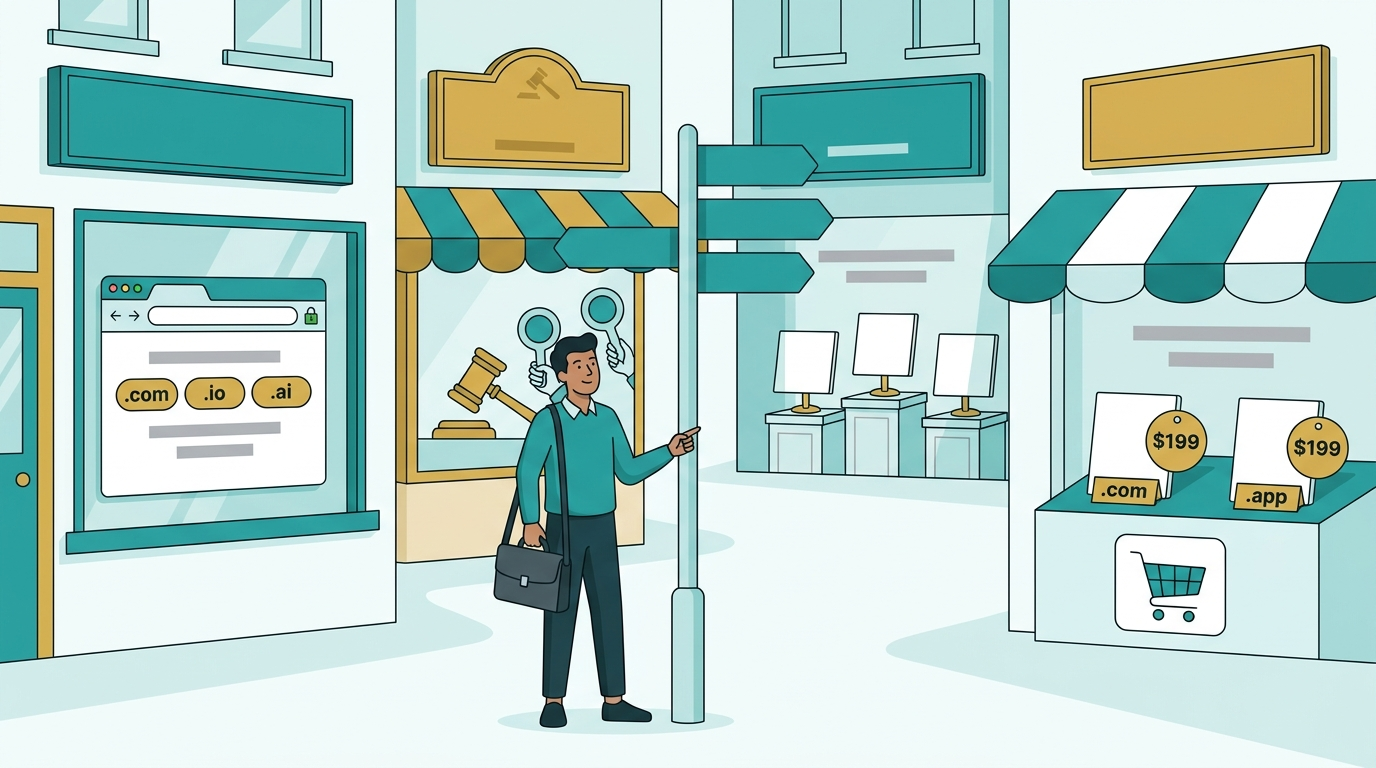
Every place you can buy a domain falls into one of these types. The best choice depends on what you are buying, so read this as a map rather than a ranking.
| Venue type | Best for | How the price is set | Typical buyer cost | Curation | Transfer speed |
|---|---|---|---|---|---|
| Registrar | Unregistered names | Registry wholesale plus registrar margin | Annual fee only | None needed | Instant |
| Registry premium (via a registrar) | New names the registry has flagged as premium | Set by the registry | Higher first year, sometimes higher renewals forever | None | Instant |
| Expired-name auction house | Investors hunting dropped or expiring names | Competitive bidding | Winning bid, sometimes a premium | Minimal | Days, after the auction closes |
| Open listing exchange (Sedo, Afternic and similar) | Browsing the widest possible inventory | Seller-set, often make-an-offer | Wide range, frequently negotiated | Light | Minutes to weeks |
| Curated brandable marketplace (Atom, BrandBucket and similar) | Funded teams buying an invented premium brand | Set by the marketplace and seller | Commonly four figures and up | Heavy | Days, longer on payment plans |
| Fixed-price marketplace (199.domains) | Founders who want a vetted aftermarket name this week | Seller-set on a $29 to $199 ladder | $199 or less, paid once | AI-vetted and owner-verified | Initiated within 72 hours |
| Broker or direct deal | One specific name that is not listed anywhere | Negotiated | Price plus commission or escrow fees | You do the checking | Weeks to months |
Three notes on reading that table.
Registry premiums are not the same as aftermarket premiums. When a registrar shows an unregistered name at a "premium" price, that price comes from the registry, and on some extensions the high price repeats at every renewal. An aftermarket name bought from an owner is a one-time price followed by standard renewals. I break down both cost structures in how much a premium domain costs.
Open exchanges and curated marketplaces solve different problems. An open exchange gives you reach: millions of listings, including gems, and the job of sorting them. A curated brandable marketplace gives you polish and hand-picked invented names, at prices built for funded startups. If you are weighing the premium end, the head-to-heads in 199.domains vs. Atom (Squadhelp) and 199.domains vs. Brandpa vs. BrandBucket go through fees, curation and payment plans in detail.
Brokers are for contested names. When the one name your company rests on is held by someone who has never listed it, a broker's anonymity and persistence can earn the commission. On an ordinary two-word name in the low hundreds, the commission can exceed anything they save you.
Is it cheaper to buy from a registrar or a marketplace?
For the same name, the question never actually comes up. An available name costs a registration fee. An owned name is not available at a registrar at any price.
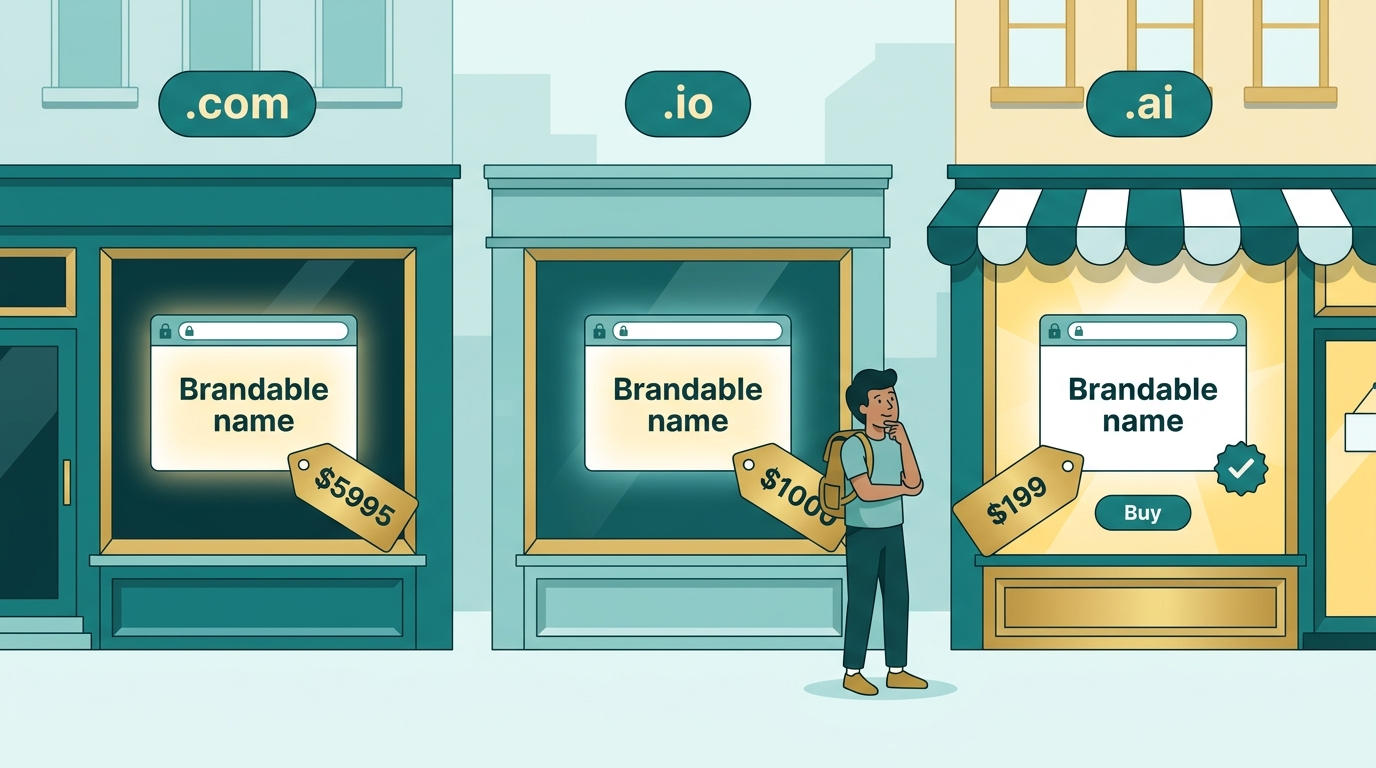
The real comparison is between two different names: the best available name you can register for a few dollars, and a stronger existing name you can buy. Here is how the total cost usually shakes out over five years for a .com.
| Path | Upfront | Five-year renewals | What you get |
|---|---|---|---|
| Register the best available .com | Registration fee | Standard renewals | Often a compromise: longer, hyphenated or odd |
| Buy a vetted name at $199 or less | $199 or less, once | Standard renewals | A short, clean, brandable aftermarket name |
| Buy a curated premium brand | Four figures or more | Standard renewals | A polished invented name, if the budget allows |
| Register a registry-premium name | Registry-set price | Sometimes premium renewals every year | A strong string, with a recurring cost |
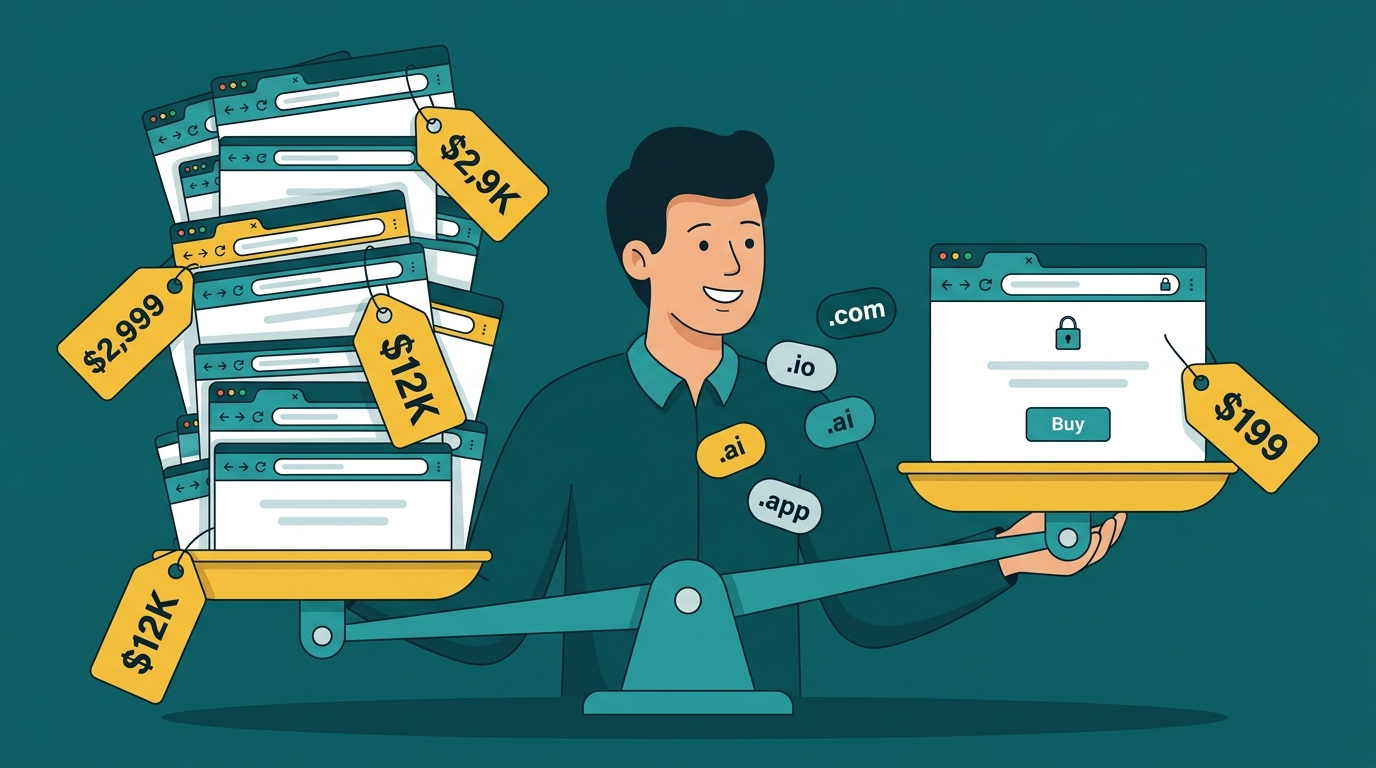
The middle row is the one most guides skip. Between "register whatever is left for $12" and "spend $3,000 on a brand" there is a tier of genuinely good names priced in the low hundreds. For most first-time founders, that tier is where the value is: a few hundred dollars once, then the same renewal you would have paid anyway.
What fees do domain marketplaces charge?
Fees are where venue comparisons get murky, so here is what to look for from the buyer's side.
- Seller commission. The most common fee in the aftermarket, usually a percentage of the sale price. You do not pay it directly, but a venue with a high commission tends to carry higher asking prices because sellers price the fee in.
- Escrow fee. On direct deals and many high-value sales, an escrow service holds the money until the name moves. Its fee is typically a percentage of the price, and who pays it is part of the deal.
- Buyer's premium. Some auction formats add a charge on top of the winning bid. Read the auction terms before you bid, not after you win.
- Financing cost. Payment plans spread a big price over months. Convenient on a four-figure name, but the name usually stays with the seller until the final installment clears.
- Renewal and transfer costs. Moving a name into your registrar usually includes a year of renewal, so budget for it on top of the purchase price.
On 199.domains the buyer pays the listed price and nothing else at checkout. Every name is $199 or less on a seller-set ladder from $29 to $199, there is no auction, no offer form and no buyer's premium, and sellers keep up to 81% of each sale. The process behind every listing is documented in how we curate, vet and price the catalog.
How fast do marketplace purchases transfer?
Transfer speed depends on where the name sits and how the deal is structured.
- Names held at a partner registrar can move into your account within minutes to a day or two.
- Fixed-price purchases typically complete within a few days. On 199.domains the transfer is initiated within 72 hours, with a full refund if it cannot be completed.
- Escrowed direct deals take longer, because escrow verifies both sides before releasing funds.
- Payment plans usually transfer only once the plan is paid off.
One rule catches buyers on every venue. ICANN's policy on transfers between registrars allows a registrar to deny an inter-registrar transfer when the name was created within the previous 60 days, or moved between registrars within the previous 60 days. A name that recently changed registrars may be yours on paper but stuck where it is for up to two months. It is not a scam, but it changes your timeline, so check the creation date and recent history before you pay.
Where should you buy your domain? A decision framework by budget and urgency
Run down this list and stop at the first line that matches.
- The exact name is available at the standard price. Register it today at an accredited registrar with fair renewals, free privacy and an easy exit. Turn on two-factor authentication before you close the tab.
- It shows as available, but at a premium price. That is a registry premium. Check whether renewals are premium too. If they are, price the name over ten years, not one, before you decide.
- It is taken, and you need a name this week on a small budget. Skip the negotiation. Browse a fixed-price, vetted marketplace for an equivalent name you can own by the weekend, starting with new arrivals or the brandable collection.
- It is taken, it is listed with a price, and the price fits. Buy it, through the listing venue, and let the marketplace handle the transfer.
- It is taken and listed with an offer form. Write your ceiling down first, then make one offer. The tactics are in why make-an-offer domains cost you more.
- It is taken, unlisted, and your whole brand depends on it. Direct outreach or a broker, with escrow, and a timeline measured in weeks. Also be honest about whether your brand truly depends on it. Most do not.
- You are funded and want a polished, invented premium brand. A curated brandable marketplace is built for exactly this.
The short version
- Two questions, two kinds of venue. Available names come from registrars. Owned names come from marketplaces, auctions, brokers or the owner.
- Judge a registrar by year two. Renewal price, free privacy, no forced add-ons, and an exit you can take in a minute.
- Judge a marketplace by its transfer. Who sets the price, who checks the listing, who verifies the seller, and how fast the name reaches you.
- Know which "premium" you are looking at. Registry premiums can renew high forever. Aftermarket names are a one-time price.
- Price the middle tier. Between a leftover name for a few dollars and a four-figure brand, there are strong names for $199 or less.
- Check the 60-day window before you fund any purchase, so a transfer lock does not ambush your launch.
If you have landed on question two and want to see what a fair, fixed price looks like, browse the full catalog. Every listing is AI quality-vetted and DNS owner-verified, priced $199 or less with the number shown up front, and paid once.