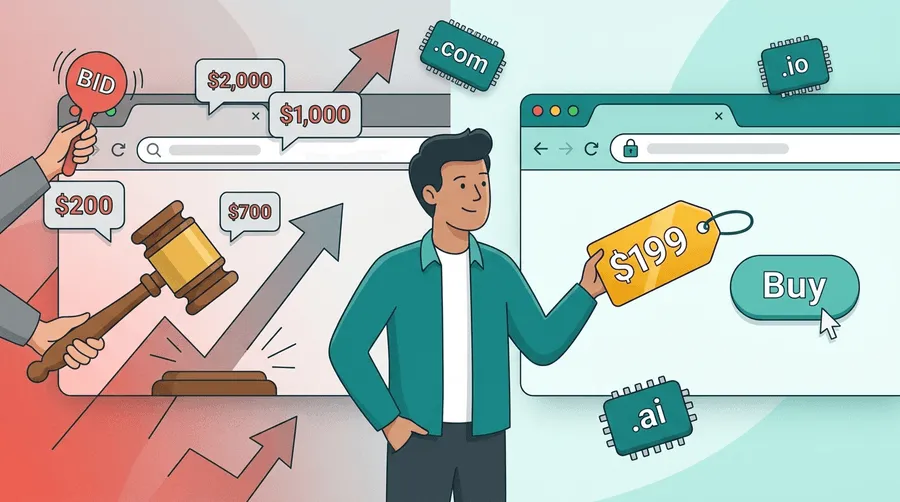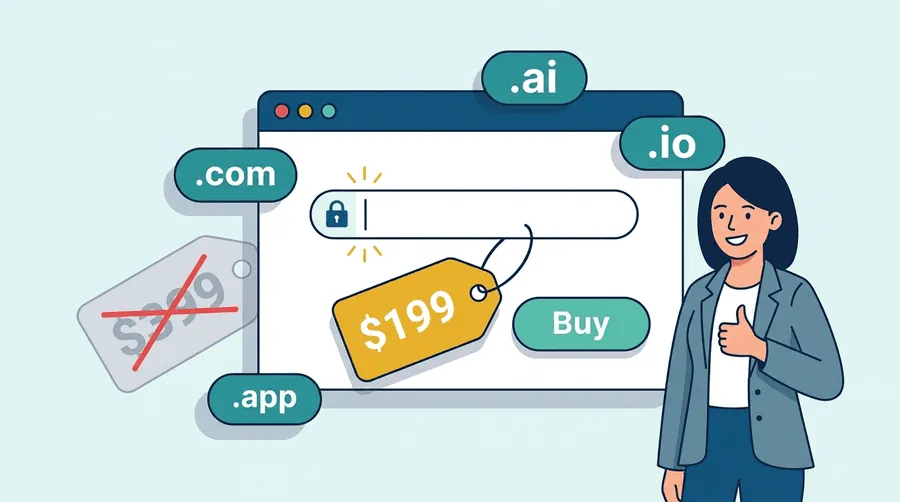

The honest answer to "how much does a premium domain cost" is that the sticker price is the wrong thing to be looking at.
I have watched founders spend a careful week comparing a $900 name against a $1,400 name, pick the cheaper one, and then discover in year two that the cheaper name renews at $900 every single year while the other one renews at twelve dollars. Over five years the "cheap" name cost roughly four thousand dollars more.
So here is the question that actually decides what a premium domain costs you: does this price happen once, or does it happen every year for as long as you own the brand? Everything else is detail.
This guide gives you the four price bands you will genuinely encounter in 2026, the one-time versus recurring distinction in full, a five-year cost comparison across every route, and the checks to run before you put a card in.
How much does a premium domain cost in 2026?
The range quoted everywhere is "hundreds to millions", which is true and completely unhelpful. In practice the market sorts into four bands, and knowing which band you are shopping in tells you more than any average ever will.
| Band | Typical price | What sits here | How you buy it |
|---|---|---|---|
| Fixed-price curated | $29 to $199 | Short brandables, two-word combinations, solid keyword names, modern extensions | Instant checkout, price shown up front |
| Mid-market resale | $500 to $5,000 | Better one-word brandables, strong .com keywords, names with some traffic | Make-an-offer, negotiation, sometimes a broker |
| Brandable marketplace | $5,000 to $50,000 | Invented brand names sold with logos, category-defining keywords | Listed price or offer, commission built in |
| Trophy names | Six and seven figures | Dictionary .com words, category names, names with existing revenue | Private sale, broker, or auction |
Most founders reading this belong in the first band and are being shown the third, because the third band is what marketplaces put on their homepage. The gap is not a quality gap. It is a pricing-strategy gap, and I break down exactly how that happens in how to get a premium domain for under $500.
At the top of the market the numbers get genuinely enormous. Cloudflare's explainer on how much a domain name costs notes that Icon.com changed hands for $12 million in 2025, per Domain Name Journal. That is a real transaction, and it is also a useful reminder that the headline sales you read about have almost nothing to do with the name you are trying to buy this week.
Is a premium domain a one-time fee or an annual cost?
This is the fork in the road, and the two things it separates are frequently sold under the same word.
Registry premium domains cost more forever
A registry premium is a name that the registry operating the extension has itself designated as high value. Registries keep internal lists of keywords they consider commercially attractive inside their namespace, and they charge a higher wholesale price for those names. Your registrar passes that through.
The part people miss: the higher price applies to registration, to transfer, and to renewal, every year. Porkbun's knowledge base article on what a premium domain is puts it plainly, noting that some premium domains renew at an ordinary rate while others renew at a higher price on an ongoing basis, and advising buyers to check the projected renewal price displayed at checkout before registering.
Registry premiums are most common in newer extensions, where the registry has more freedom to price individual keywords. If you are shopping in .ai, .io, .app, .shop or similar, this is the case you need to check for every single time.
Aftermarket premium domains cost once
An aftermarket premium is an ordinary registration that someone already owns and is now reselling. The premium is entirely the seller's asking price. Once the name transfers to you, the registry has no special flag on it, so it renews at whatever your registrar charges for any other domain in that extension.
That is the whole difference, and it is worth more than any negotiating tactic. A one-time $199 on an aftermarket name and a $199-a-year registry premium look identical in a search box and diverge by nearly a thousand dollars over a five-year runway.
| Registry premium | Aftermarket premium | Standard registration | |
|---|---|---|---|
| Who sets the price | The registry | The current owner | The registrar |
| Upfront cost | Elevated | Elevated | Ordinary |
| Renewal cost | Elevated, every year | Ordinary | Ordinary |
| Transfer cost | Often elevated | Ordinary | Ordinary |
| Price is negotiable | No | Sometimes | No |
| Where you find it | Registrar search results | Marketplaces, owner outreach | Registrar search results |
Every listing on 199.domains is the middle column: a one-time price of $199 or less on a name that renews at your registrar's ordinary rate.
What actually sets the price of a premium domain?
Strip out seller psychology and four properties do most of the work.
Length and word count. One clean word beats two, two beats three, and anything past three words falls off a cliff. This is why the two-word sweet spot is where affordable quality still lives.
Clarity when spoken. A name someone can hear once and type correctly is worth more than a cleverer name they have to spell out. That single test predicts value better than any appraisal tool.
The extension. A .com still carries the largest premium, with .ai commanding real money in its category and .io, .app and .dev sitting in a respectable middle. We ranked how buyers actually perceive each one in TLD trust rankings 2026.
History. A name that previously hosted spam, or that sits inside someone's trademark, is worth less than an equivalent clean name, and occasionally worth less than nothing.
What does not set the price, despite what a listing page implies, is the asking figure itself. Sellers price against hope, against the commission they expect to pay, and against how interested you appear to be. I unpack the mechanics of that in domain valuation explained and, for the psychology specifically, in why make-an-offer domains cost you more.
Investor's note: after 25 years in this industry, the single most reliable way to overpay is to reveal a deadline. The moment a seller knows you are launching in three weeks, you are no longer discussing the value of a name. You are discussing the value of your launch date.
The five-year cost of each route, side by side
Here is the calculation almost nobody shows you. These are worked examples using round numbers, assuming a standard .com renewal of about $15 a year, which sits inside the ordinary range for mainstream extensions.
| Route | Upfront | Renews at | Total after 5 years |
|---|---|---|---|
| Standard available name | $15 | $15/year | About $75 |
| Fixed-price aftermarket at $199 | $199 | $15/year | About $259 |
| Mid-market aftermarket at $2,500 | $2,500 | $15/year | About $2,560 |
| Registry premium at $400/year | $400 | $400/year | About $2,000 |
| Registry premium at $1,200/year | $1,200 | $1,200/year | About $6,000 |
Read the last two rows twice. A registry premium with a $400 sticker price costs you almost eight times what a $199 aftermarket name costs across the same five years, despite looking only twice as expensive on day one. And the registry premium keeps charging in year six, year seven and year ten, whereas the aftermarket name is a closed cost.
There is a second hazard buried in that column. If cash gets tight and a renewal slips, a domain does not simply stay yours. ICANN's Expired Registration Recovery Policy sets out the notices a registrar must send around expiration and the recovery process that follows, and pulling a name back out of redemption carries a restoration fee on top of the renewal. A recurring four-figure renewal is exactly the kind of cost that gets missed in a lean quarter.
The renewal-trap checklist: five checks before you buy
Run these in order. Together they take about four minutes and they are the difference between a one-time cost and a permanent line item.
- Find the projected renewal price, not the first-year price. Reputable registrars show both at checkout. If you can only find one number, you have not finished looking.
- Check whether the listing says "premium" anywhere. In registrar search results, registry premiums are usually labeled. That label is your signal to check renewal specifically.
- Confirm the transfer price. Registry premiums often carry an elevated transfer fee too, which matters the day you want to move registrars.
- Ask who currently holds the name. If it is a private owner reselling, you are in aftermarket territory and renewals are ordinary. If it is available to register directly, check the registry flag.
- Price the whole runway, not the purchase. Multiply the annual figure by the number of years you expect the brand to exist. If that total makes you flinch, the name is too expensive regardless of the sticker.
If the name you want passes all five, the rest of the buying process is mechanical. The transfer itself is covered step by step in the complete domain transfer guide.
Where does the $199-or-less tier sit on the curve?
It sits in the gap the market created and then ignored.
Sellers with real portfolios hold a great many genuinely good names that are worth a few hundred dollars and will never be worth five figures. On a commission-driven marketplace those names are economically awkward: the fee on a $150 sale barely covers the listing effort, so they get buried under the expensive inventory and sit there for years. In a make-an-offer system they are worse than buried, because the seller has little incentive to answer a small offer at all.
199.domains exists to clear that specific backlog. Every name is submitted or curated, passes an AI quality review, is owner-verified by DNS, and is priced on a ladder from $29 to $199 by the person who owns it. The price you see is the price, paid once. The seller keeps up to 81% of it, which is what makes listing a $99 name worth doing in the first place. The full vetting process is documented in how we curate, vet and price every listing.
The honest limitation: this tier is not where you find a one-word dictionary .com. If your brand requires a specific name that a specific person already owns, you are in a negotiation, and the fixed-price versus auction comparison will tell you what that route costs. What this tier does offer is the intersection of "good enough to build a company on" and "priced to buy this afternoon", which for most founders at most stages is the actual requirement.
So what should you actually spend?
A rule that has held up well across a lot of launches: spend no more on a domain than one month of your current runway, and never take on a recurring domain cost you would not happily pay in your worst quarter.
Pre-validation, a side project or a weekend build wants a name in the tens or low hundreds, bought outright. Early revenue justifies a few hundred dollars for a genuinely stronger name, because a forced rebrand later costs vastly more in lost search equity and reprinted everything. Four and five figures make sense only when the brand is already proven and the name is provably leaking customers to someone else.
And in every one of those cases, the same check applies at the end. Look at the renewal number. If it is the same as the purchase number, you are not buying a domain. You are signing a subscription.