Almost every short, clean, memorable domain is already registered. That is not a failure of your imagination, it is arithmetic: the pool of pronounceable short strings is finite and the internet has had thirty years to work through it.
So "is it taken" is the wrong question. The useful question is which kind of taken, because the answer determines whether you are looking at a five-minute checkout, a three-week negotiation, or a polite email that will never be answered.
Most guides on this topic give you the same five steps: look up the owner, estimate a value, make an offer, negotiate, use escrow. Those steps are not wrong. They are just missing everything that decides whether you overpay: how to tell a sellable name from an unsellable one before you invest any effort, what each route genuinely costs once commissions are counted, how to open a conversation without handing the owner your ceiling, and when the correct move is to buy a different name entirely.
Here is the version I would want if I were doing this for the first time.
Is the domain actually for sale? The 30-second triage
Before you look up a single owner record, load the domain in a browser. What comes back sorts the name into one of four states, and the state tells you almost everything about your odds.
| What you see | What it means | Realistic odds | Your move |
|---|---|---|---|
| A for-sale landing page with a price | Listed on a marketplace, priced to sell | Very high | Buy it, or compare it against equivalents |
| A for-sale page with an offer form | Listed, but priced by negotiation | Moderate | Proceed carefully, this is where buyers overpay |
| A parked page, ads, or nothing at all | Held as inventory or forgotten | Low to moderate | Worth one outreach email |
| A live website with real customers | Someone's working asset | Very low | Walk away unless the name is existential |
That last row is where founders burn weeks. A domain running an actual business is not inventory, it is infrastructure, and the price to prise it loose is the cost of somebody else's rebrand plus the risk they are taking. When a live business does sell its domain, the number is rarely in the range a pre-revenue startup can justify.
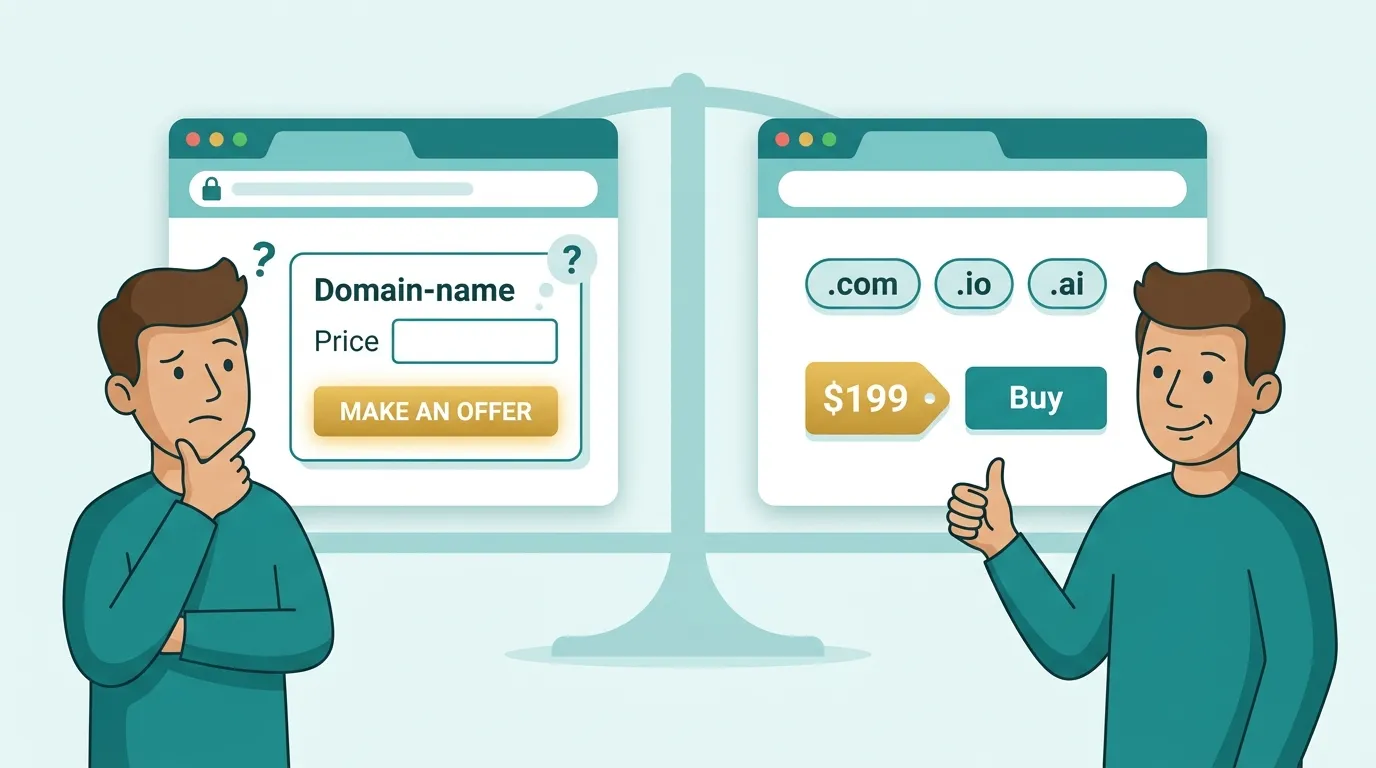
The second row deserves its own warning. An offer form looks like an invitation, and it is, but it is an invitation to set the anchor yourself. I have written at length about why make-an-offer listings cost buyers more than fixed-price ones for the same caliber of name. The short version: when the seller names the price, you are evaluating an offer. When you name the price, the seller is evaluating you.
The five ways to buy a domain someone else owns
Every acquisition runs through one of these five routes. They are ordered by how often they end with you owning the name.
| Route | What it really costs | How often it works | Time to own |
|---|---|---|---|
| Fixed-price marketplace | The listed price, nothing added | Essentially always | Minutes to 72 hours |
| Make-an-offer listing | Your offer, plus the seller's read of your urgency | Often, at a premium | Days to weeks |
| Direct owner outreach | Your offer, plus an escrow fee, plus your time | Roughly one reply in five | Weeks to months |
| Broker acquisition | The price, plus a commission commonly 15% to 25% | Good, at the highest cost | Weeks to months |
| Backorder or drop catch | A modest fee, often plus a private auction | Rarely, and only if it drops | Months to never |
Three notes on that table, because the numbers underneath it are where the money goes.
Brokers are paid on the price they negotiate. That is not a conspiracy, it is a commission structure, and it is worth understanding before you hire one. A broker earns their fee on a genuinely contested acquisition, where their relationships and their ability to stay anonymous on your behalf are real leverage. On an ordinary two-word name in the low hundreds, the commission can exceed the discount they win you. I wrote up what two decades of watching that side of the business taught me in how domain brokers really work.
Direct outreach has a reply rate, not a success rate. Roughly one in five cold emails to a domain owner gets any response at all, and a fraction of those become deals. Budget your time accordingly: send several, expect silence, and never let a single name become the plan.
A backorder is a queue, not a purchase. More on that below, because it is the route most often misunderstood.
How do I find out who owns a domain in 2026?
Start at ICANN Lookup, the official registration data lookup. Then adjust your expectations, because what that tool returns today is not what it returned a decade ago.
Since modern privacy rules took hold, registrant name, email and postal address are redacted on the large majority of domains. What you still get, reliably and usefully, is four things:
- The registrar. Tells you where the name lives and, often, which marketplace the owner is likely to list on.
- The creation date. A name registered in 2003 and held ever since belongs to someone deliberate. A name registered eight months ago may belong to someone who has already lost interest.
- The expiry date. Useful context, and occasionally a signal, though see the backorder section for why it is rarely the opportunity it looks like.
- The status codes. These are the machine-readable flags that govern what can happen to the name. ICANN publishes a plain-language guide to EPP domain status codes that is worth ten minutes of your life.
clientTransferProhibitedis normal and simply means the owner has the standard transfer lock on.pendingDeleteorredemptionPeriodmeans the name is in the expiry pipeline and nobody is going to sell it to you today.
You may see ICANN's Registration Data Request Service mentioned as the way to get behind the redaction. Be clear about what it is: RDRS is a standardized channel for requesting nonpublic registration data, built for parties with a legitimate interest such as law enforcement, cybersecurity specialists and intellectual property professionals. Wanting to buy the domain is not one of those grounds. It is not a buyer's tool, and guides that imply otherwise are wasting your afternoon.
What actually works for reaching an owner
- The anonymized forwarding address. Most privacy services publish a relay address in the record. Messages to it do reach the owner, though they compete with a great deal of spam.
- The for-sale landing page. If the parked page has a form or a listed contact, that is the owner telling you exactly how they want to be approached. Use it.
- The live site's contact page. Obvious, frequently skipped, and by far the highest response rate when a site exists.
- The company or person behind the brand. A quick search for the domain string plus the registrar's home country often surfaces a LinkedIn profile or a company record. One polite message to a real human beats twenty to a relay address.
How much should I offer for a taken domain?
The number matters less than the order of operations. Here is the sequence that keeps the final price sane.
Decide your ceiling before you send anything. Write it down. Not the number you hope to pay, the number above which you will buy a different name instead. This single act defuses most of the pressure that follows, because every subsequent message is now a test of a decision you already made rather than a negotiation with yourself.
Value the name against the market, not against your plan. A name is worth what a typical buyer would pay, and your particular attachment to it is not part of that calculation. The four properties that genuinely drive value are length, clarity when spoken aloud, the extension, and a clean history. I break the mechanics down in domain valuation explained.
Open below your ceiling, but not insultingly. A first offer somewhere near half of your maximum leaves room to move while still reading as serious. Offers of $50 on a name someone has held for fifteen years mostly get deleted.
Never reveal a deadline, a funding round, or a built brand. This is the whole game.
Investor's note: after 25 years around this industry, the fastest way to double a domain's price is to mention when you are launching. The moment an owner knows you are shipping in three weeks, they stop pricing the name and start pricing your calendar. If you have already printed the business cards, do not say so.
The outreach email that does not anchor you high
Most first emails lose money in the first two lines, either by gushing about the name or by naming a number under pressure. This structure keeps you neutral:
Subject: Enquiry about yourdomain.com
Hi,
I came across yourdomain.com and wanted to ask whether you would consider selling it. I am working on a small project and it is one of several names I am looking at.
If it is something you would part with, what sort of figure did you have in mind? If not, no problem at all, and thanks for reading.
Best, [Name]
Four things that email does deliberately. It asks the owner to name a price first, which flips the anchor. It says "one of several names", which is true if you have done this properly and removes your urgency from the table. It gives a clean exit, which raises reply rates because nobody feels cornered. And it never mentions a company, a launch, or a budget.
If the reply is a wildly high number, you have still learned something valuable: this owner is priced for a different buyer. Thank them, keep the thread civil, and move on. Prices come down over months, and a polite no leaves the door open for a follow-up next quarter.
What is a domain backorder, and when is it worth it?
A backorder is a paid attempt to grab a name the instant it becomes available again. The critical word is if. For a backorder to pay off, the current owner must fail to renew, and the name must then run the full expiry pipeline to deletion rather than being renewed during the grace period or redeemed afterwards.
Two facts kill most backorder hopes. First, owners who hold valuable names renew them, because renewal costs a fraction of the name's worth. Second, on the rare occasion a genuinely good name does drop, several drop-catching services all queue for it, and the one that catches it usually runs a private auction among its own customers. You may have paid for a queue position and still end up bidding.
So: treat a backorder as a cheap option on a specific name you are willing to wait years for, and never as the plan for a brand you are launching this quarter.
The three traps that cost buyers money after the handshake
Agreeing a price is the middle of the process, not the end. These three catch people who have already relaxed.
1. The 60-day transfer lock
This one surprises nearly everyone. ICANN's Policy on Transfer of Registrations between Registrars allows a registrar to deny an inter-registrar transfer when the domain was created within the previous 60 days, or when it was transferred between registrars within the previous 60 days.
In practice that means a name which recently moved, or which the seller registered only weeks ago, may not be able to reach your registrar for up to two months. It is not a scam and the deal is not dead, but it changes your timeline and it should change how the escrow terms are worded. Check the status codes and the creation date before you fund anything. The mechanics of the transfer itself, including EPP authorization codes and registrar locks, are covered step by step in the complete domain transfer guide.
2. The impersonated escrow service
In a direct deal there is no marketplace standing behind the transaction, so escrow is not optional. The scam that takes the most money in this space is a fake escrow site: the seller sends a link, the page looks right, the funds go somewhere else entirely.
The defence is simple and absolute. Navigate to the escrow provider yourself, type the address by hand, and confirm the transaction and the payment details inside your own account on that site. Never use a link, a wiring instruction or an account number supplied by the other party. If a seller resists a well-known escrow provider, that resistance is your answer.
3. The trademark you did not check
A domain can be perfectly available to buy and still be legally unusable by you. Buying a name that sits inside someone else's registered mark in your category can end in a dispute under ICANN's Uniform Domain-Name Dispute-Resolution Policy, which can transfer the name away from you regardless of what you paid for it.
Run the clearance check before you send the first email, not after the money moves. The process, including the free searches that catch most problems, is laid out in the trademark trap.
When to walk away and buy a better available name
Here is the part the guides written by people selling acquisition services tend to skip.
Run the arithmetic honestly. A direct acquisition of a name an owner is attached to typically means weeks of waiting, a real chance of no reply at all, a price set by how much you want it, an escrow fee, and a transfer window that may stretch two months. Set that against an equivalent-quality name you can buy this afternoon at a price you can see, transferring inside 72 hours.
For most early-stage brands, the second option wins on every axis that matters except one: it is not the exact string you first imagined. And that string is worth far less than founders believe. Customers do not compare your domain against the name you wanted. They meet the name you have.
The names worth chasing are the ones where the string itself carries the business, an exact-match category keyword, or a one-word dictionary term your entire positioning rests on. Everything else is a preference, and preferences should not cost you a month and a five-figure cheque.
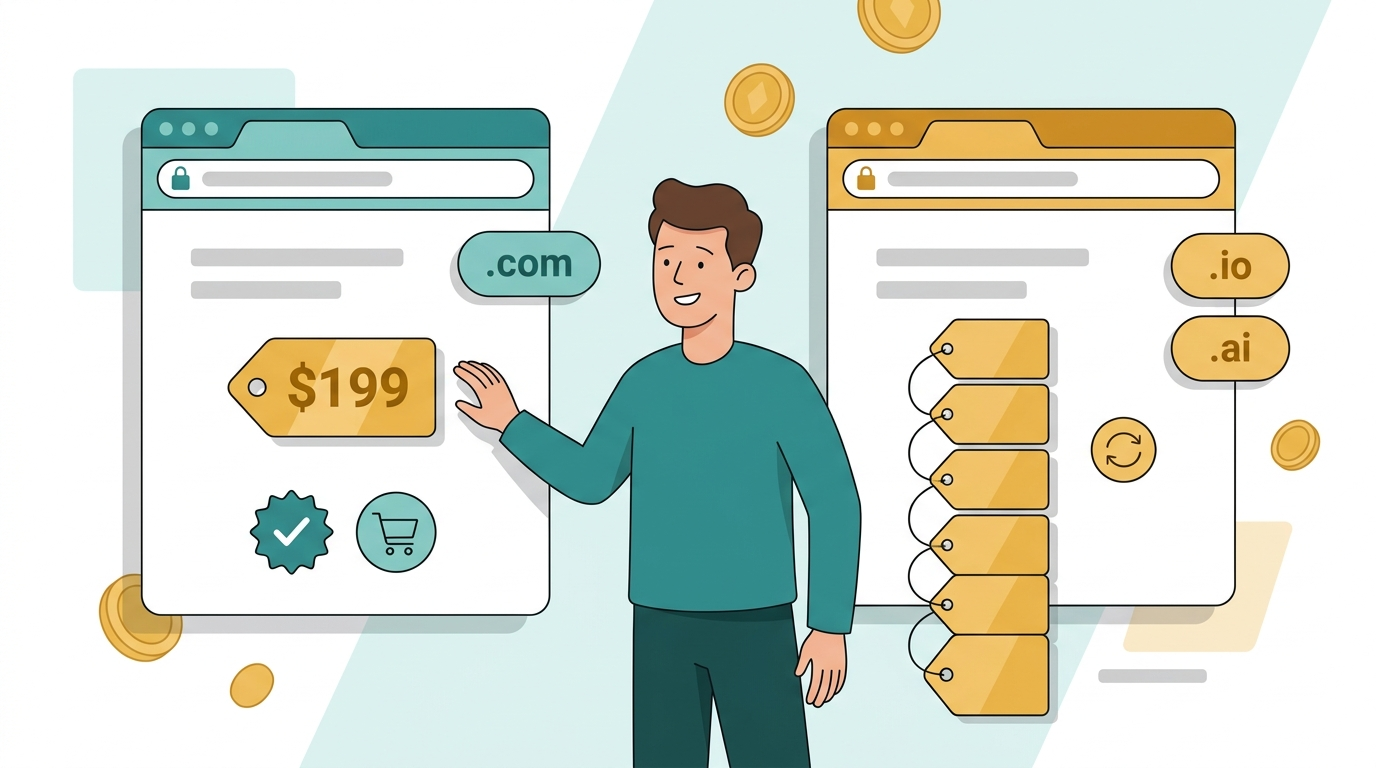
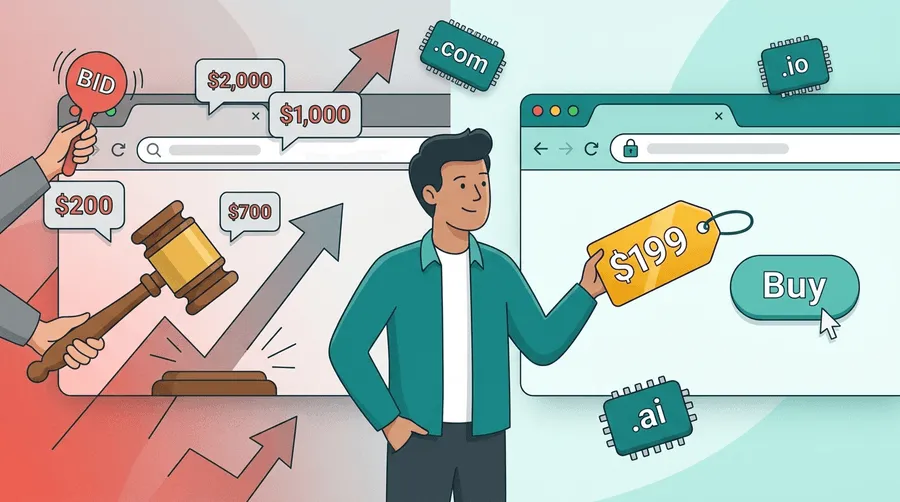
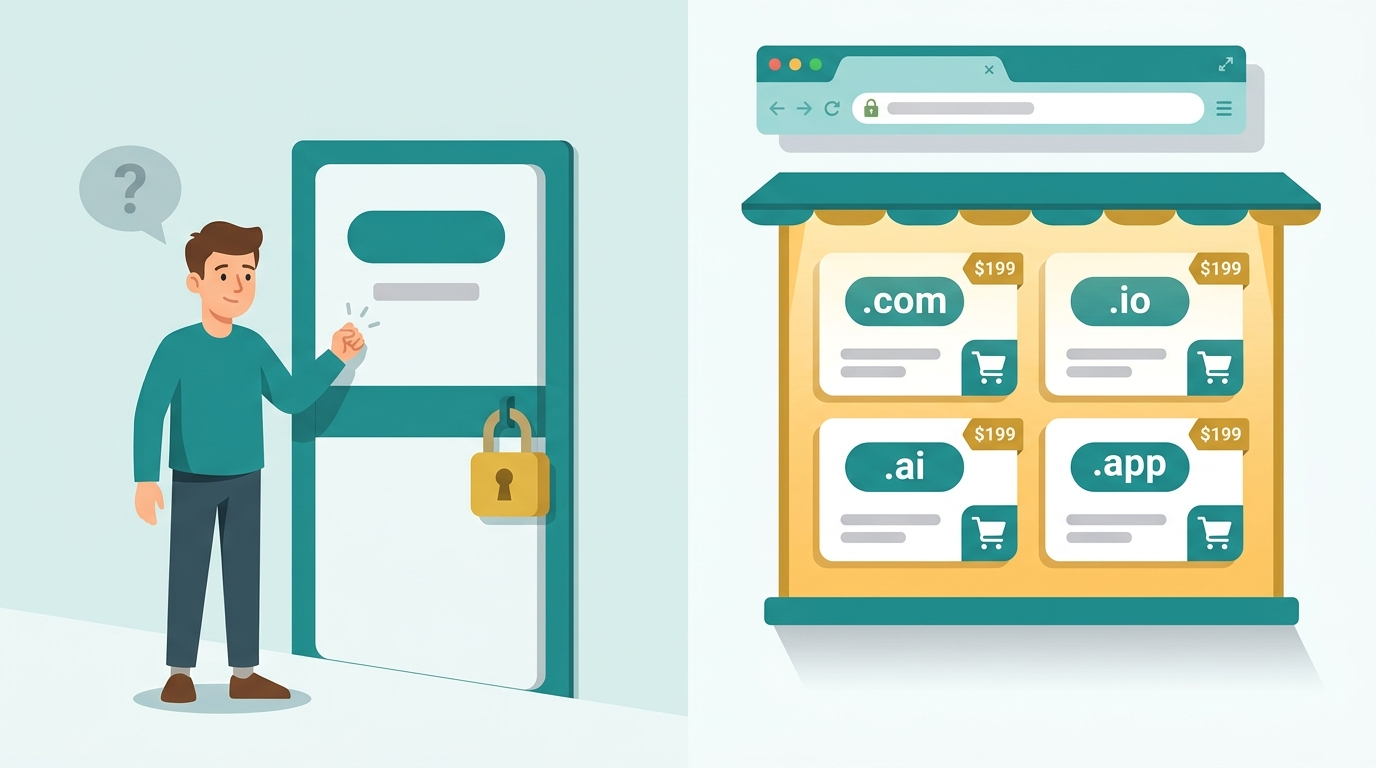
If you want to see what the alternative looks like at a real price, browse the full catalog or narrow to the brandable names. Every listing is AI quality-vetted, owner-verified by DNS, and priced on a ladder from $29 to $199, with the price shown up front and paid once. No offer form, no commission, no waiting to hear back. The vetting process itself is documented in how we curate, vet and price every listing, and if you want the wider view of what a few hundred dollars buys on the aftermarket, start with how to get a premium domain for under $500.
The short version
- Load the domain first. A live business is a no. A priced landing page is a checkout. Everything between is a conversation.
- Expect the owner record to be redacted. Use the registrar, the dates and the status codes, and reach the human through the relay address, the site, or a search.
- Write your ceiling down before you send anything. It is the only defence against your own enthusiasm.
- Let the owner name the price first, and never mention a deadline.
- Escrow every direct deal, and navigate to the escrow site yourself.
- Check the status codes and creation date before funding, so a 60-day lock does not ambush your launch.
- Price the alternative honestly. A great name you can own today usually beats a perfect name you might own in March.