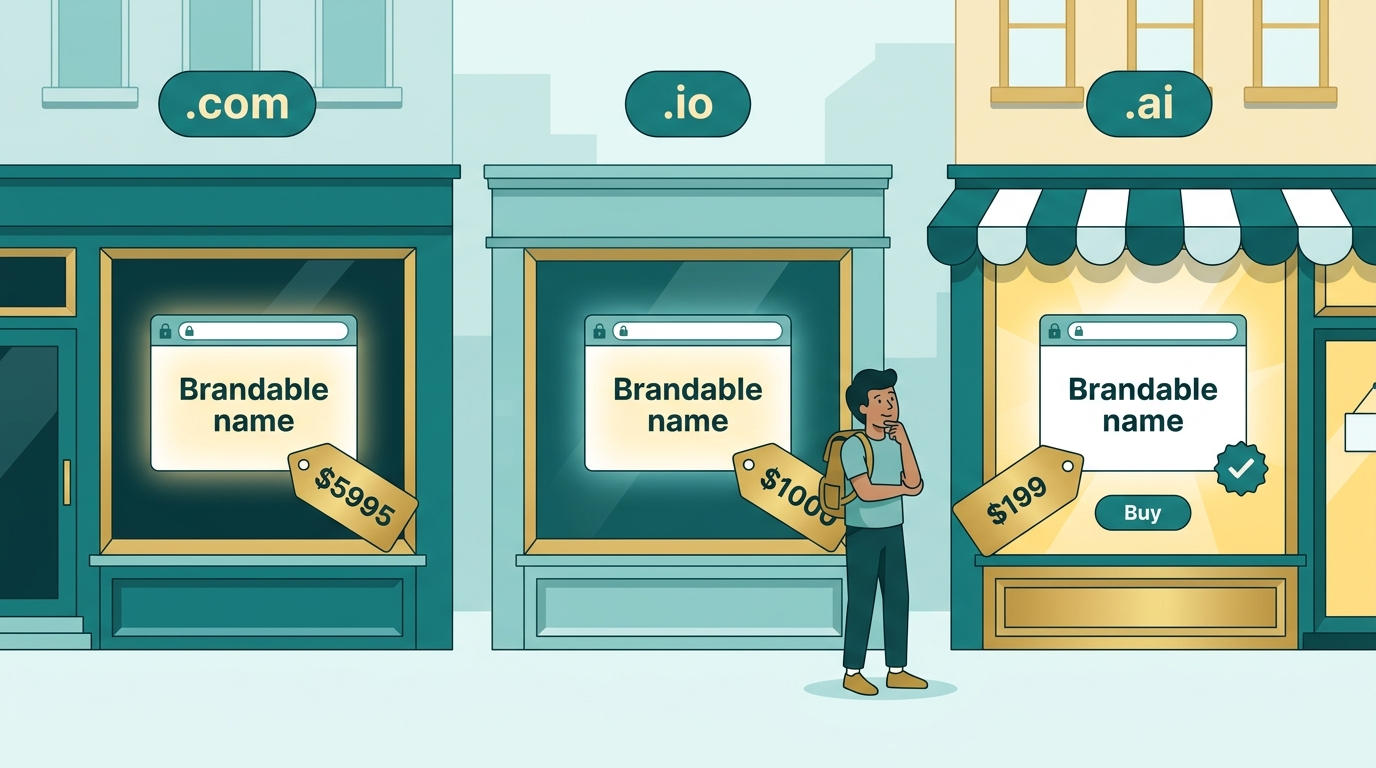
If you've spent any time hunting for a brandable startup name, you've met both ends of this market. On one end sits Atom — the marketplace most people still know as Squadhelp — with its beautifully photographed name cards, matching logo mockups, and prices that start in the low thousands and climb into the millions. On the other end sits the question every early-stage founder eventually asks out loud: do I really need to spend $3,000 on a name before I've written a line of code?
I've been buying and selling domains for 25 years, and I'll say up front: Atom is a genuinely excellent operation. This is not a hit piece. But "excellent" and "right for you" are different questions, and the domain industry is very good at blurring them. So this is the honest head-to-head — inventory, curation, real pricing, fees, payment terms, transfer speed — followed by a decision matrix so you can tell in about two minutes which marketplace actually fits the problem you have today.
What Atom (formerly Squadhelp) actually is
Atom rebranded from Squadhelp in 2024, but the model is the same one that made it the category leader for invented, ultra-brandable names — the Uber, Stripe, Spotify class of word. It's a deeply curated marketplace: sellers submit names, Atom's team reviews them strictly, and the ones that make the cut get a professional treatment — a logo mockup, a written description, and marketing exposure aimed squarely at funded Silicon Valley startups.
The scale is real. Atom lists over 300,000 curated brandable domains, has served more than 50,000 customers, and holds a 4.5 out of 5 rating across 775 reviews on Trustpilot, with BBB accreditation and secure escrow. Names are organized into tiers — Premium, Ultra Premium, and Sapphire — and documented listing prices run from around $5,000 on the low end to $2,500,000 for a name like Oasis.com. On the seller side, Atom charges a commission generally reported in the 15–35% range depending on the listing type and tier, with no listing fee and no charge for the logo design.
None of that is a criticism. If you're a funded team that needs a specific, world-class invented name and has a branding budget to match, Atom's curation and polish are worth paying for. The friction only appears when a founder with a $300 budget wanders into a $3,000 marketplace and assumes those are the only names worth having.
What 199.domains is (and isn't)
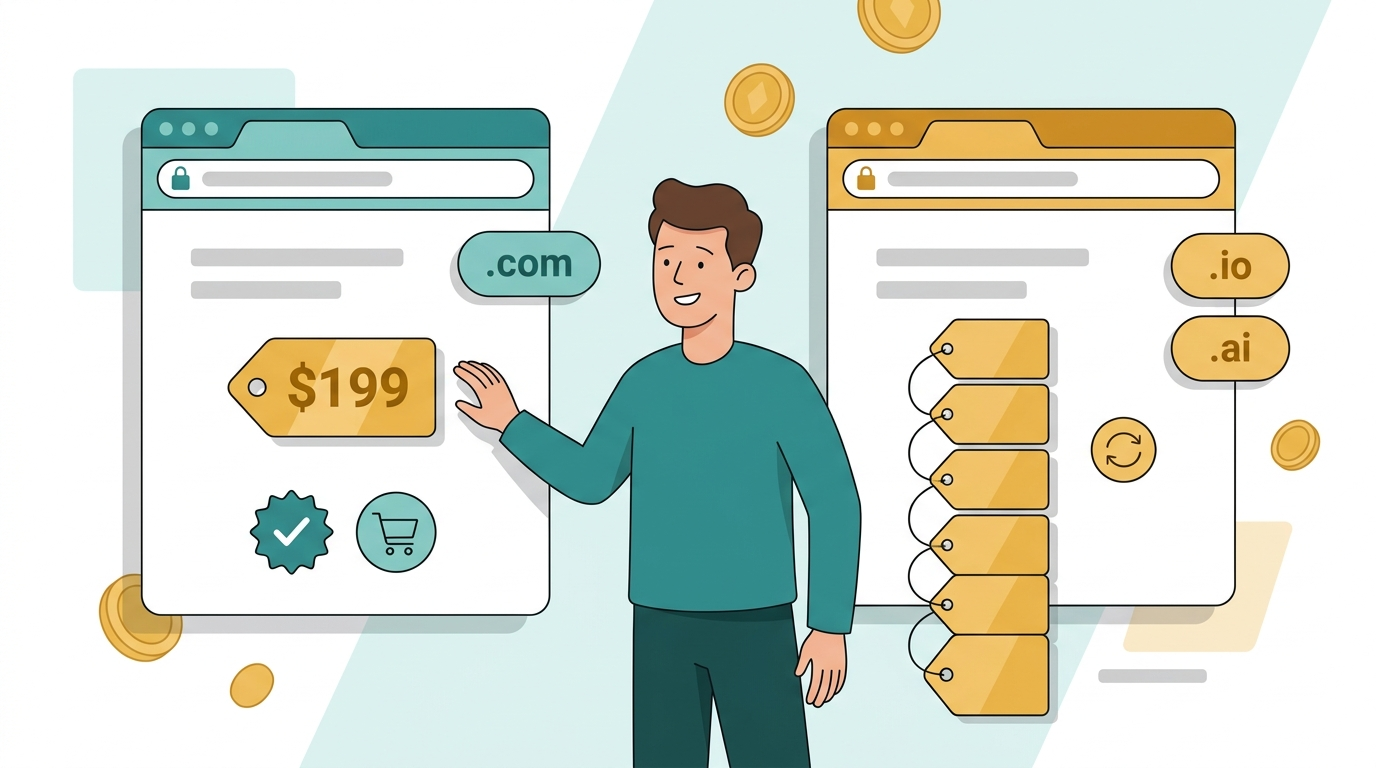
199.domains is built around a single, deliberately restrictive rule: every domain is $199 or less, one fixed price shown up front, set by the seller (or our team) on a ladder from $29 to $199. There are no auctions, no "make an offer," no negotiation, and no commission stacked on top of your price. Every listing is AI quality-vetted and DNS owner-verified before it goes live, and once you buy, the transfer is initiated within 72 hours with a full refund if it can't be completed.
Here's what it is not: it is not trying to sell you a $2 million one-word .com. It doesn't have Oasis.com. It's a marketplace for clean, brandable, buildable names priced to actually sell — the kind of name a solo founder, indie developer, or bootstrapped team can buy this week and launch on next week. The hard price ceiling is the whole product. It's what lets you skip the entire apparatus — curation-as-luxury, logo bundles, escrow on a five-figure deal, financing — that only exists because the prices elsewhere are high enough to require it.
If you want the deeper argument for why a fixed ceiling beats open-ended premium pricing, where to buy a domain name compares the total cost of registrars, auctions and fixed-price marketplaces.
The honest head-to-head
Here's the comparison the way I'd lay it out for a founder across a table, crediting Atom where it earns it and being straight about the tradeoffs on both sides.
| Feature | Atom / Squadhelp | 199.domains |
|---|---|---|
| Inventory size | 300,000+ curated names | Curated, smaller, deliberately capped by price |
| Typical price | ~$2,000 to $2,500,000 | $199 or less, always |
| Pricing model | Seller-set, premium tiers, negotiable above a threshold | One fixed price, $29–$199 ladder, shown up front |
| Seller commission | ~15–35% depending on tier | Up to 81% kept by seller (19% fee $50+, 25% under $50) |
| Curation | Strict human review + logo + copy | AI quality-vetted + DNS owner-verified |
| Best-in-class for | Ultra-premium invented brand names | Affordable, buildable, launch-ready names |
| Payment plans | Yes (financed, AtomPay) | Not needed — pay once, it's ≤ $199 |
| Logo / branding bundle | Yes, included on premium listings | No — you keep the budget for the build |
| Escrow | Yes, on higher-value deals | Not required at this price; refund guarantee instead |
| Transfer timeline | Fast on simple buys; longer with escrow/financing | Initiated within 72 hours |
| Primary buyer | Funded startups, established brands | Indie devs, bootstrappers, early-stage founders |
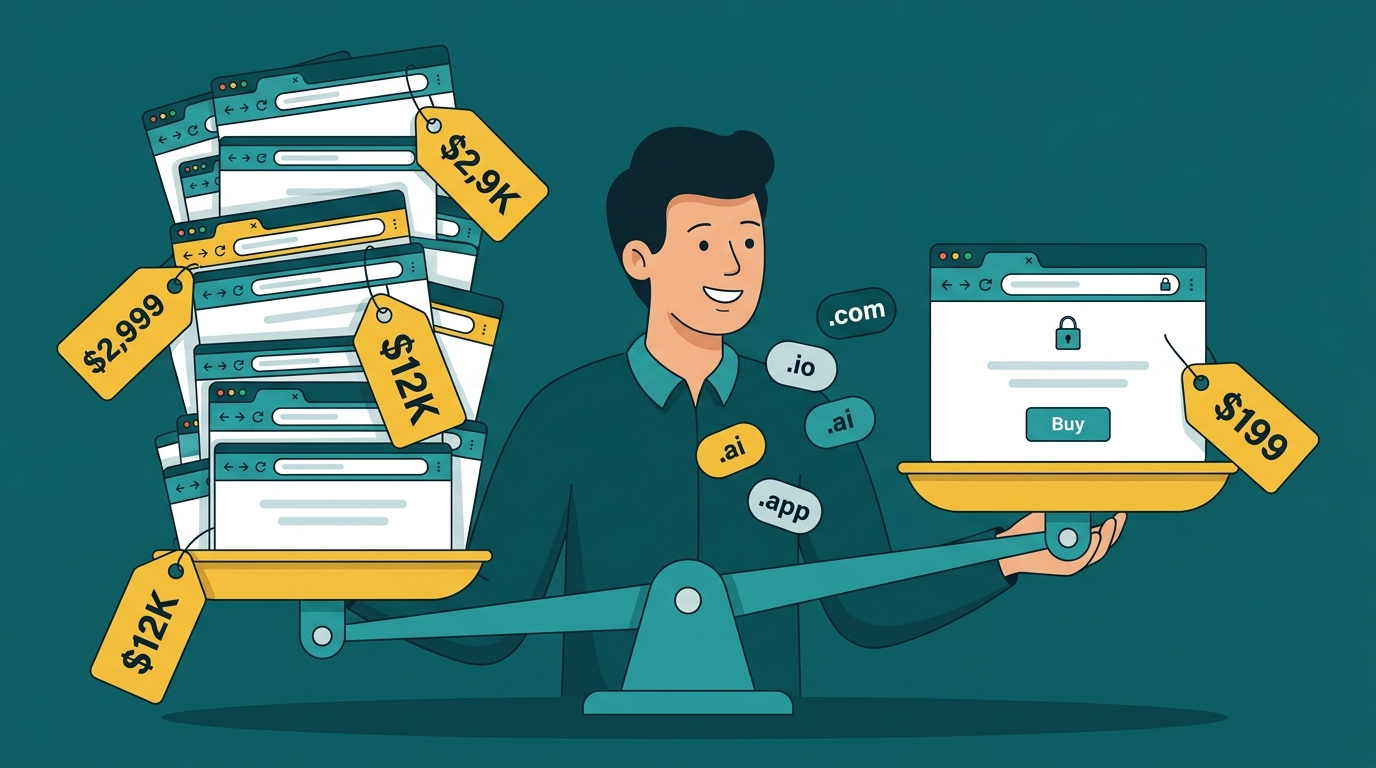
Two rows deserve a note. First, commission: Atom's 15–35% is a seller-side number, baked into the asking price you pay as a buyer — it's not wrong, it's just the economics of a high-touch marketplace. On 199.domains the seller keeps up to 81%, which is possible precisely because there's no expensive curation-and-marketing layer to fund. Second, payment plans: financing is a genuine Atom strength if you're buying a $12,000 name, but it's worth seeing it for what it is — a tool that exists because the prices are high. A name at $199 or less simply doesn't need to be financed.
Why the same "type" of domain costs so differently
This is the part that confuses people, so let's be direct about it. A brandable two-word .com can be listed at $2,899 on one marketplace and $5,995 on another for the same name — a spread I've watched play out more than once. Price on premium marketplaces is not a fixed property of the domain; it's a function of the venue's positioning, its commission structure, and what the seller thinks a funded buyer will tolerate.
That's not a scandal — it's just how open-ended pricing works. But it's exactly why a hard ceiling is clarifying. When every name is $199 or less, there's no anchoring game, no "what will they pay," no gap between the sticker and the real number. If you want the full breakdown of what actually drives a domain's price — length, TLD, keyword demand, brandability, comps — our domain valuation guide covers the six levers, and a fixed price is what removes the negotiation tax.
What an affordable brandable name looks like
The fear founders bring to a $199 marketplace is that the names must be leftovers. They're not — they're names chosen for the same qualities that make any brand name work: they're short, they're easy to say and spell, they read cleanly, and they leave room to build a brand on top. The difference isn't quality; it's that they're priced to move instead of priced to anchor a negotiation.
Here's a live sample of the brandable inventory in the marketplace right now — real names, real prices, updated automatically:
Notice what these have in common: they're the kind of names you could put on a landing page tomorrow without a single person asking you to spell it twice. That "say it once, spell it right" quality is the entire job of a brandable name — and it doesn't require a four-figure price tag to get it.
Which marketplace is right for you?
Forget the marketing on either side. The decision comes down to three honest questions.
Choose Atom (Squadhelp) when:
- You need a specific, ultra-premium invented name — the Uber/Stripe class — and no substitute will do
- You're a funded startup or established brand with a real branding budget (four to six figures)
- You want the full package: a curated name, a matching logo, professional copy, and escrow on the deal
- A financed payment plan genuinely helps you afford a name you've decided is worth thousands
Choose 199.domains when:
- Your budget is hundreds, not thousands, and you'd rather spend the difference on building
- You want a clean, brandable name this week, without negotiation or an approval queue
- You value a single transparent price and a fast, guaranteed 72-hour transfer over a marketing bundle
- You're an indie developer, bootstrapper, or early-stage founder who needs to launch, not to shop
Honestly consider both when:
- You're early and unfunded now, but expect to raise later. Start on a $199-or-less name to launch and validate; if the company takes off and the perfect ultra-premium name becomes worth five figures, the upgrade path is always there. Our premium domains under $200 show how far a small budget actually goes, and if you ever need to move a name you've outgrown, the domain transfer guide covers the mechanics.
The mistake isn't choosing Atom, and it isn't choosing a $199 marketplace. The mistake is paying for a Ferrari's worth of curation, logo design, and financing when what you needed was a great name and a fast checkout — or, less commonly, trying to launch a funded consumer brand on a name you picked mostly because it was cheap. Match the venue to the job.
Browse brandable names under $200
The same kind of brandable name, at a fixed price of $199 or less.
The bottom line
Atom earned its reputation honestly. It's the best in the world at one specific thing: selling ultra-premium, invented brand names to buyers who can pay ultra-premium prices, wrapped in curation and marketing that justify the cost at that level. If that's you, use it with confidence.
But most founders reading this aren't buying Oasis.com. They're buying their first real name, on a budget, under a deadline, and they need it to be clean, brandable, and theirs by next week. For that job, a marketplace with a $199 ceiling — every listing vetted, owner-verified, and transferable in 72 hours — isn't a compromise. It's the correct tool. And if you're on the other side of the table with names to sell, you can list them free and keep up to 81% instead of feeding a third of every sale to a commission.
Pick the marketplace that fits the problem you actually have. Then stop shopping and go build.