A payment plan makes a $12,000 domain feel like a $500-a-month decision. That is exactly why they work, and exactly why you should slow down before you sign one.
I have been buying and selling domains for a long time, and installment deals have gone from an oddity arranged by email to a checkbox on nearly every big marketplace. For the right buyer on the right name they are genuinely useful. For a lot of founders they are an expensive way to rent a name they will never quite own.
The difference comes down to three things the listing page rarely puts in front of you: who holds the domain while you pay, what happens if you stop, and what the whole thing costs by the last installment. This guide covers all three, then shows you when a plan is the smart move and when the smart move is a name you can pay for once.
How does a domain payment plan work?
The mechanics are similar across platforms, even when the branding differs. "Payment plan", "installments", "lease-to-own" and "buy now, pay later" all describe roughly the same deal.
- You pick a term. Usually anywhere from a couple of months to a few years. The seller sets the maximum they will accept.
- You pay a first installment or down payment. Some plans take the first month up front, others require a percentage deposit.
- You get to use the domain. You can typically point its DNS at your site and set up email almost immediately.
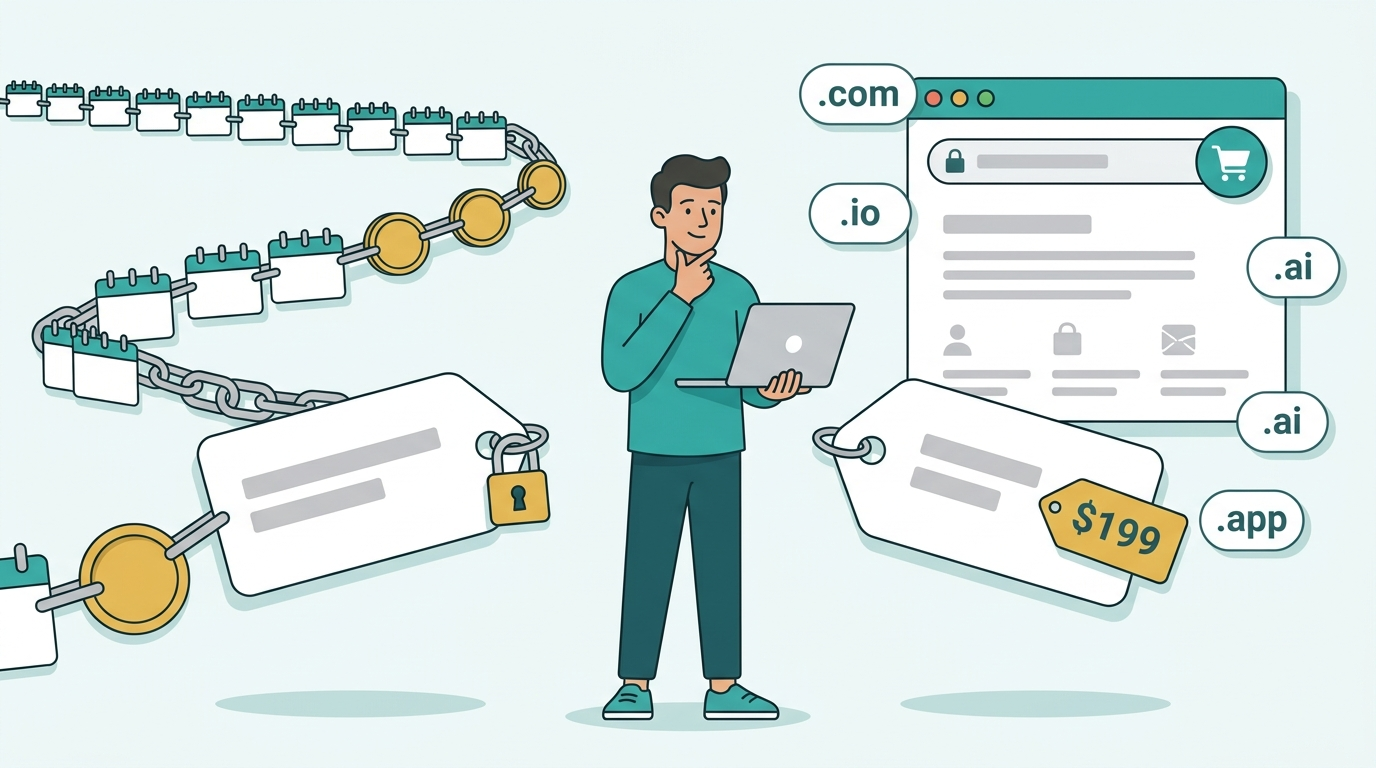
- The domain stays locked. It cannot be moved to your registrar account, and it usually remains under the seller's or the platform's control.
- You pay monthly until the balance is cleared. Then the lock comes off and the name is transferred into your ownership.
Step four is the one that matters. Afternic's own lease-to-own explainer is direct about it: the domain "remains in a locked state" during payments, and only "after all of the payments are made" is it transferred to the buyer. That is not a quirk of one platform. It is how the model works everywhere.
Payment plan vs lease-to-own vs domain leasing vs financing
Four terms get used interchangeably and they are not the same product.
| Arrangement | What you pay | Do you end up owning it? | Who holds the name meanwhile |
|---|---|---|---|
| Payment plan / installments | Purchase price split into monthly payments | Yes, after the final payment | Seller or platform, locked |
| Lease-to-own | Monthly payments over a set term | Yes, after the final payment | Seller or platform, locked |
| Pure domain lease | Ongoing rent for as long as you use it | No, unless a buy option is added | Owner, permanently |
| Domain financing | A loan, usually secured against a domain you already own | You already own it; the lender holds a claim | You, with a lien |
| Outright purchase | The full price, once | Yes, immediately after transfer | You |
If you only remember one row, remember the last one. Everything above it trades ownership now for cash flow now.
Who owns the domain during a lease-to-own plan?
Not you. You are a user with an option to own.
In practice that means the seller, or the marketplace acting for them, remains the party with real control over the registration until you finish paying. ICANN's summary of registrant benefits and responsibilities frames those rights around the person who holds the registration agreement with the registrar. During a payment plan, that person is not you, which is why so much of the fine print below exists.
What you usually can do during the term:
- Point the domain's DNS at your website
- Set up email on it
- Build your brand, marketing and search presence around it
What you usually cannot do:
- Transfer it to your own registrar account
- Sell it on or assign it to someone else
- Keep it if the plan ends early for any reason
That combination is the whole risk in one sentence: you are allowed to build everything on a name you do not yet hold.
What happens if you miss a domain payment?
This is where plans stop looking friendly. Missed-payment terms are published, and they are not generous.
Dynadot's payment plan terms are a clear, typical example. Plans run from 2 to 12 months with a 15% down payment. After a missed installment there is a 3-day grace period; at 3 days without payment the domain is disabled and placed on hold, and at 14 days it returns to the seller. The down payment and installments already made are non-refundable.
Other large marketplaces follow the same shape with different numbers. Atom's help center describes a 10-day grace period, after which the plan is cancelled, installments already paid are non-refundable, and the domain is not transferred.
Here is a hypothetical to make that concrete. Say you take a $9,600 name on a 24-month plan at $400 a month, with no interest. At month 18 your startup hits a rough patch and you miss two payments.
| Amount | |
|---|---|
| Paid so far | $7,200 |
| Balance remaining | $2,400 |
| Refund if the plan is cancelled | $0 under typical terms |
| Domain you keep | None |
| What goes offline | Website, email, every link you have built |
You would have paid three quarters of the price and walked away with nothing, while the seller keeps both the money and the name and can list it again. That is not a scam. It is the contract working as written. It is also why a plan is a bet on your next two years of cash flow, not just a way to buy a domain.
Investor's note: the most expensive default is not the lost installments. It is the rebrand. A startup that loses its domain at month 18 has to move email, redirect nothing (the old name is gone), reprint, and explain the change to customers. I have seen that cost more than the name ever did. If you are unsure whether a name is worth a rebrand risk, the signals in 7 domain name warning signs that mean it is time to rebrand are worth reading before you commit.
Are domain payment plans more expensive than buying outright?
Sometimes on paper, often in practice.
Many plans advertise no interest, and that is broadly accurate. Dynadot says there are no extra fees for choosing installments. Atom says most plans carry no additional charge, though longer plans of 12 months or more may add a small administrative fee. So the pure financing cost is often low or zero.
The real cost difference hides in three other places.
1. The price you start from
A name that is offered on installments is almost always a name listed at a high asking price, because plans exist to make big numbers feel small. Afternic, for instance, only makes lease-to-own available on names with a Buy It Now price of $495 or more, with terms of up to 60 months. The plan does not lower the price. It spreads a price that was set with room to spare.
That matters because asking prices on the aftermarket are set by what a seller hopes to get, not by a measure of quality. The same caliber of name can sit at wildly different prices in different catalogs, which I explain in domain valuation explained. A monthly figure makes it much harder to notice when the headline number is simply too high.
2. Negotiation you gave up
When you pay monthly, you tend to compare the installment to your monthly budget, not the total to the name's worth. Sellers know this. It is the same anchoring effect that makes offer forms expensive, covered in why make-an-offer domains cost you more.
3. Renewals and transfer costs
Ask who pays the renewal if the domain comes up for renewal mid-term, and whether any transfer fee applies at the end. On a registry-premium name, where the elevated price repeats every year, that renewal can be significant. The distinction between one-time aftermarket prices and recurring registry premiums is laid out in how much a premium domain costs.
Total-cost comparison
Here is how the options compare on a hypothetical name priced at $6,000, over the first 24 months.
| Route | Paid in first 24 months | You own it from | Risk if cash gets tight |
|---|---|---|---|
| Outright purchase | $6,000 once, plus normal renewals | Day one (after transfer) | None on the name |
| 24-month plan, no interest | $6,000 in installments | Month 24 | Lose name and payments |
| 24-month plan with admin fee | $6,000 plus the fee | Month 24 | Lose name and payments |
| Pure lease | Rent, indefinitely | Never, unless you buy | Lose name, nothing to recover |
| An equivalent fixed-price name | $199 or less once, plus normal renewals | Day one (after transfer) | None on the name |
The last row is the one founders skip. The question is rarely "plan or no plan for this exact name." It is "is this exact name worth $6,000 and 24 months of exposure, or is there a strong name I can simply own this week?"
When does a domain payment plan actually make sense?
I am not against installments. There are cases where a plan is exactly the right tool.
- The name is genuinely category-defining. A short, exact-match .com for your core product, where the name itself will save you real money in marketing for years. That is a five-figure decision, and spreading it can be rational.
- You are funded and the timeline is clear. If the money is already in the bank for the next two years and you just prefer to keep cash free for hiring, installments are a treasury decision, not a gamble.
- The seller will not budge on price but will on terms. Sometimes a plan is the only structure that gets a deal done. That is fine, as long as the total is a price you would pay anyway.
- You are upgrading, not launching. A company with revenue that is moving from a compromise name to its forever .com is in a very different position from a pre-launch founder with six months of runway.
And the cases where it usually does not:
- You are pre-revenue. You are betting the brand on cash flow you do not have yet.
- The monthly figure is the reason it feels affordable. If you would not pay the total today, you should not pay it over 24 months.
- The name is nice, not necessary. A good name is available outright for far less. A plan on a nice-to-have name is paying a premium for patience you did not need.
- You would build your email on it from day one. Email tied to a domain you can lose is a single point of failure for your whole business. The wider stakes of domain-based email are covered in email deliverability and your domain.
Questions to ask before you sign a domain payment plan
Get these answered in writing before the first payment. If a platform or seller will not answer them clearly, that is your answer.
- Who is the registrant during the term, and where is the domain held?
- Can I use DNS and email from the first payment, and is there any delay?
- What is the grace period for a missed payment, and what happens at each stage after it?
- Are any payments refundable if the plan is cancelled, including the down payment?
- Is there interest, an administrative fee, or a higher total price for choosing installments?
- Can I pay off early, and is there a penalty or a discount for doing so?
- Who pays renewals during the term, and is the domain a registry premium with elevated renewals?
- What exactly triggers the final transfer, and how long does it take? The usual mechanics of moving a name between registrars are in the complete domain transfer guide.
- What happens if the seller or the platform goes out of business mid-term?
- Is the transaction protected by a neutral third party? For large private deals, a licensed escrow service such as Escrow.com, which explains how escrow works, holds funds until each side has done its part.
Question 9 is the one almost nobody asks. On a marketplace plan, you depend not just on your own payments but on the platform staying in business and honoring the agreement until the end of the term.
The low-end alternative: names priced to buy outright
Here is the part of the market that installment plans quietly ignore.
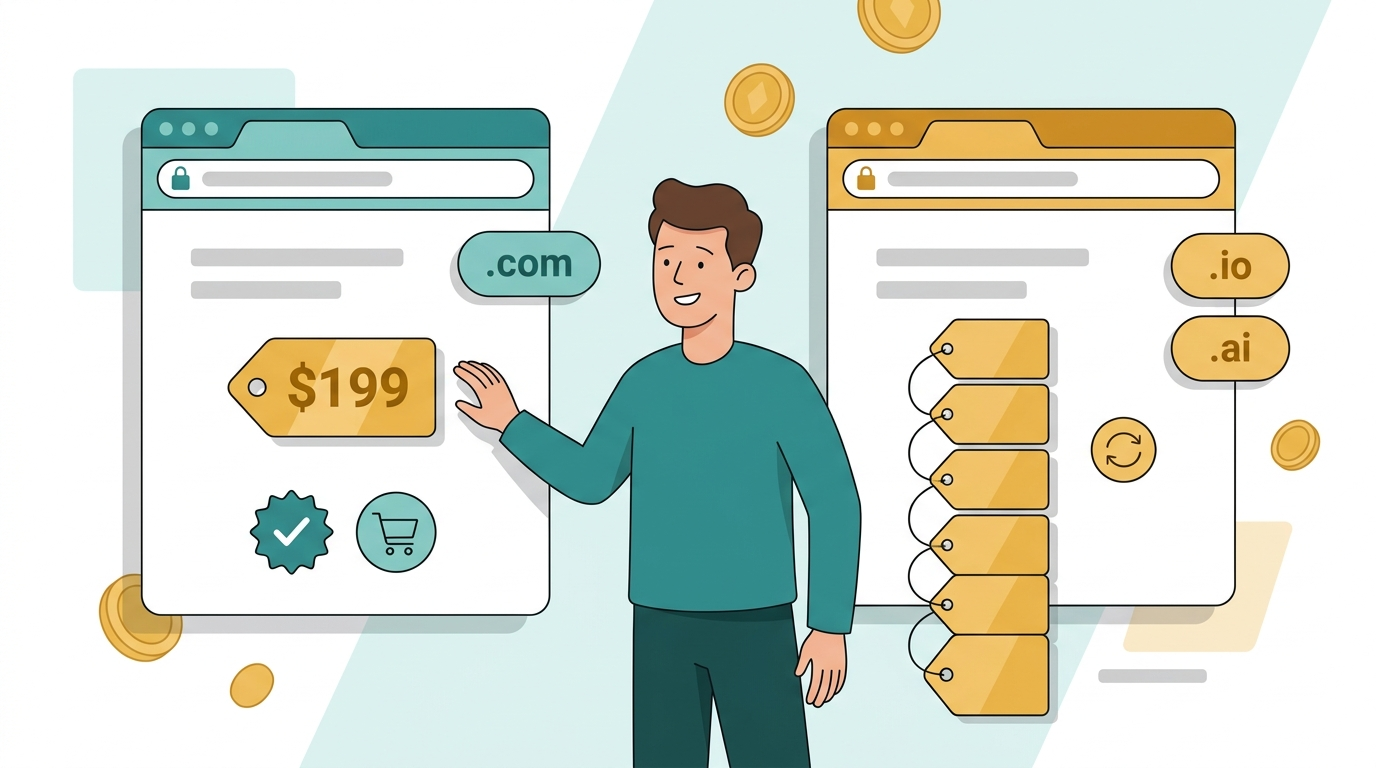
Payment plans exist to make expensive names feel reachable. But a large share of genuinely good names, clean two-word .coms, short brandables, solid keyword names and modern extensions like .ai, .io and .app, are not expensive at all when they are priced to sell instead of priced to negotiate. At that level there is nothing to finance. You pay once, the transfer starts, and the name is yours.
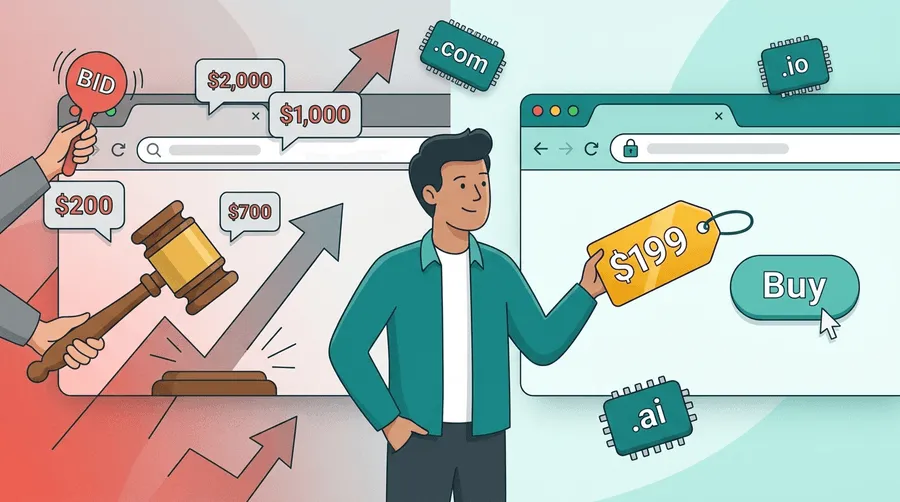
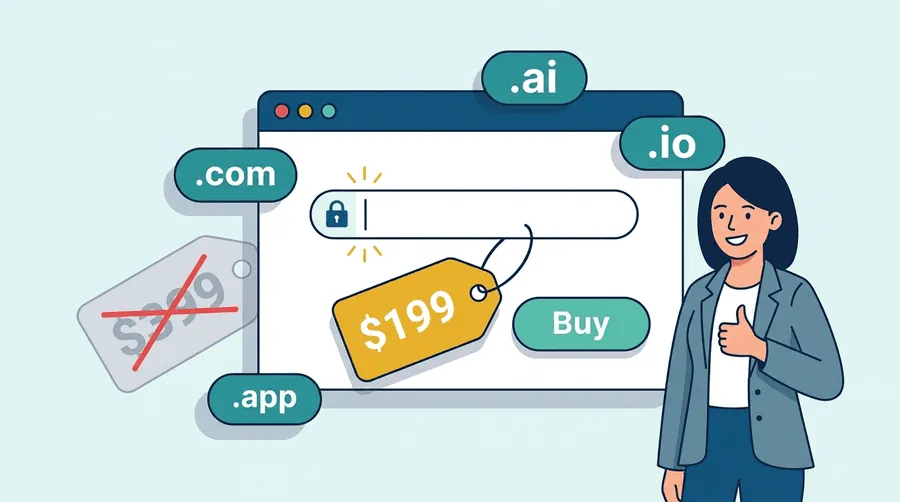
That is the tier 199.domains is built for. Every listing is $199 or less, set by the seller on a ladder from $29 to $199, with the price shown up front. There is no auction, no offer form and no installment schedule, so there is no lock, no grace period and no clause about what happens if you miss a month. Every name is AI quality-vetted and owner-verified by DNS, and the transfer is initiated within 72 hours, with a full refund if it cannot be completed.
A few live names from the catalog right now:
Notice what you are evaluating when there is no monthly figure in the way: whether the name is short, easy to say out loud, easy to spell after hearing it once, and on an extension your customers will trust. Those are the qualities that actually decide a name's value, and you can judge them in a minute.
If you want something in a specific extension, the same no-plan pricing applies across the catalog:
You can also browse the brandable collection for invented and compound names, or one-word domains if you want the shortest names available at this tier. If a two-word name fits your brand, two-word domains explains why that pattern is the value sweet spot.
So: worth it or a trap?
A domain payment plan is worth it when three things are all true: the name is worth its full price to you, you are confident about the cash for the entire term, and you have read exactly what happens if either of those turns out to be wrong.
It becomes a trap when the monthly number is doing the persuading. The lock, the non-refundable installments and the rebrand you would face after a default are all real, and they all land on the buyer.
My rule after years on both sides of these deals is simple. If you would not pay the total today, do not pay it over two years. For a genuinely category-defining name on a funded timeline, spread it and read every clause. For everything else, find a strong name you can own the day you buy it.
When you are ready to skip the plan entirely, browse the full catalog. Every name is $199 or less, paid once, and yours from the moment the transfer completes.