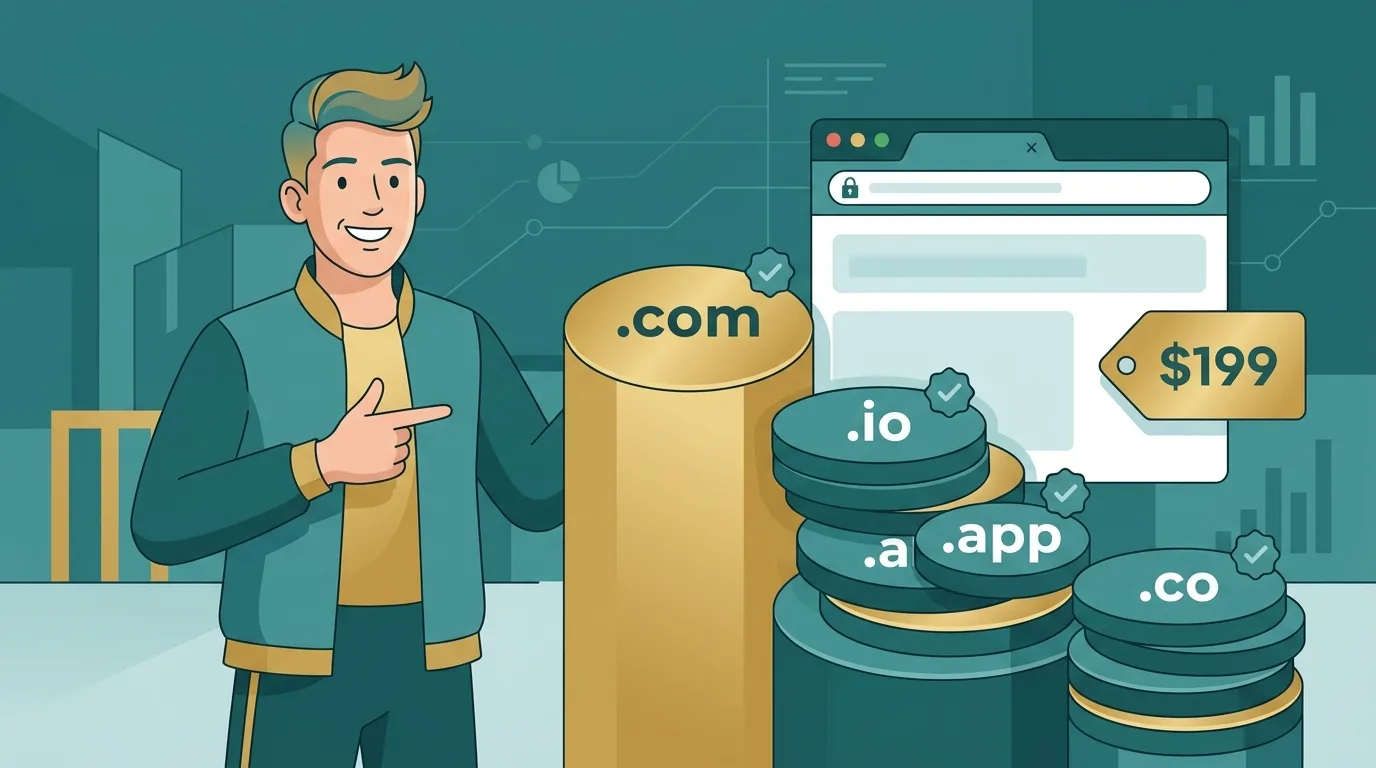
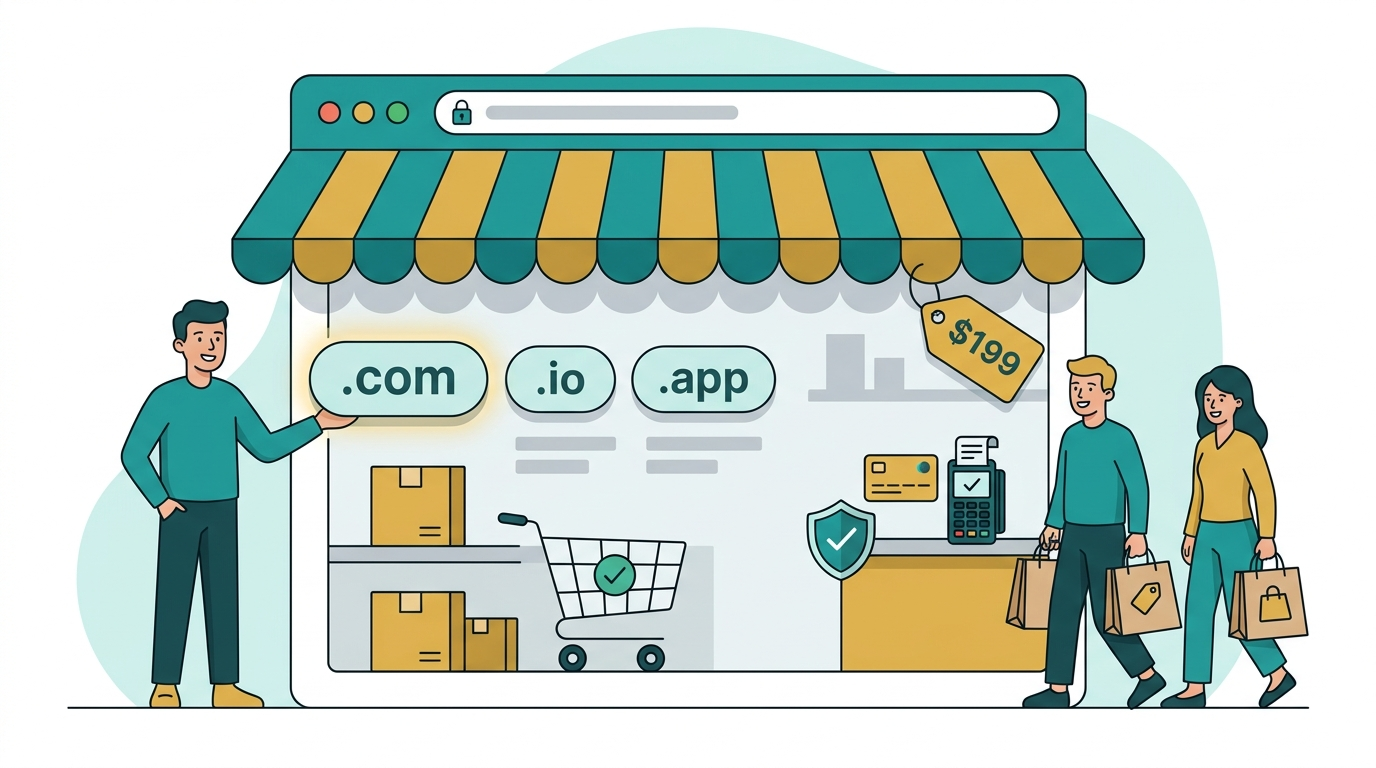
Most founders pick a store domain the way they pick a username: type a few ideas into a registrar, grab whatever is free, and move on to the fun part of building the shop.
That works until the first time someone tells a friend about your store and the friend cannot find it. Or until a shopper gets to the payment step, glances at the address bar, and hesitates.
In ecommerce, the domain is part of the checkout. It is the name printed on the box, the sender on every order confirmation, and the thing a shopper types when they come back to reorder. This guide covers how to choose one that holds up at every one of those moments, which extensions make sense for a store in 2026, and what it costs to get it wrong.
What makes the best domain for ecommerce?
After many years of buying and selling domain names, I judge a store name on two tests. Everything else is secondary.
Test 1: Can a shopper remember it after one hearing?
A lot of ecommerce growth is word of mouth, podcasts, creator shout-outs and unboxing videos. In all of those, your domain is heard, not clicked. If a listener cannot type it correctly from memory later, that sale goes to whoever ranks for your product category instead.
That means short, easy to spell, no hyphens, no numbers that could be written as words, and no clever misspellings. "Kwik" might look fun on a logo. Spoken aloud, it is a customer lost to "quick".
Test 2: Does it look safe at the payment step?
Baymard Institute's cart abandonment research puts the average documented abandonment rate at just over 70%, based on 50 separate studies. Among shoppers who abandoned for checkout-related reasons, 19% said they did not trust the site with their credit card information.
A domain cannot fix a slow checkout or surprise shipping costs. But it is one of the first things a cautious shopper checks. A clean, brand-matching name on HTTPS says "real company". A long string with hyphens, a random extension or a name that does not match the logo says "maybe not".
| Signal at checkout | Builds trust | Erodes trust |
|---|---|---|
| Domain matches the brand | Logo, packaging and address bar all agree | Store is "Luna" but the URL is "best-luna-deals-online" |
| Extension | .com, or a clear store extension used consistently | An obscure extension the shopper has never seen |
| Length and spelling | Short, one obvious spelling | Hyphens, numbers, deliberate misspellings |
| Email sender | Order emails come from the same domain | Confirmations from a different or free email domain |
| HTTPS | Padlock present on every page | Any browser warning at all |
Ecommerce domain name patterns that work
Store names that last tend to follow one of three patterns. Each has a different cost profile and a different ceiling.
1. The invented word
A made-up but pronounceable word that becomes the brand. It gives you the widest trademark room, the best chance at a short .com, and a name you can stretch across product lines as you grow.
The trade-off: an invented word says nothing about what you sell, so your product photography, tagline and first ads have to do that work. Invented names are best for DTC brands planning to expand beyond one product. The brandable collection is full of names built this way.
2. Two clean words
Two short, common words that together suggest a feeling or a benefit. This is the sweet spot for most small stores: easier to remember than an invented word, far cheaper and more available than a one-word .com, and still ownable as a brand. I cover the pattern in depth in two-word domains: the affordable sweet spot.
The rule is that both words must be easy to spell and the combination must not create an accidental third word where they join.
3. Category plus modifier
A product category with a short modifier: a shop word, a place, a quality, or an audience. These names tell shoppers exactly what you sell, which helps paid ads and marketplace listings convert.
The trade-off is ceiling. A name built around "sneakers" is awkward the day you start selling jackets. And a keyword in the name is not the ranking shortcut it once was, as I explain in keyword vs brandable domains for SEO. Choose this pattern when your niche is tight and you intend to stay in it.
| Pattern | Best for | Memorability | Trademark room | Room to grow |
|---|---|---|---|---|
| Invented word | DTC brands planning several product lines | Good once learned | Widest | Widest |
| Two clean words | Most small and mid-size stores | High | Good | Good |
| Category plus modifier | Single-niche stores, ad-driven shops | High | Narrow | Limited |
Whichever pattern you pick, clear the name before you print a single box. A quick check of trademark databases saves you from a forced rename later; the domain trademark clearance guide walks through the process.
.com vs .shop vs .store vs .co: which extension should an online store use?
Here is the part most guides turn into a list of twenty extensions. For an online store, four are worth serious consideration.
First, the search question, because it comes up in every conversation. Google has said its systems treat new generic top-level domains like other gTLDs, so .shop or .store neither helps nor hurts rankings on its own. The choice is about people, not algorithms.
| Extension | Shopper trust | Typing habit | Name availability | Price reality | Best fit |
|---|---|---|---|---|---|
| .com | Highest, the default | People type it without thinking | Tight for short names | Normal renewals; good short names cost more upfront | Any store that wants word of mouth to work |
| .shop | Good, reads as retail in many languages | Needs to be said out loud | Much wider | Check renewal pricing before buying | General retail, international shoppers |
| .store | Good, obvious meaning in English | Needs to be said out loud | Much wider | Check renewal pricing before buying | Product brands, single-category shops |
| .co | Good with younger, startup-savvy buyers | Often mistyped as .com | Moderate | Higher renewals than .com | Modern DTC brands with a design-led audience |
When .com is still the right call
If a short, brand-matching .com is available at a price you can live with, take it. It has no typing penalty, no explanation needed, and it sidesteps the biggest risk of any other extension: shoppers adding .com out of habit and landing on someone else's site, possibly a competitor's.
That leakage matters more for stores than for most businesses, because so much ecommerce discovery is spoken. My TLD trust rankings for 2026 go deeper on how people judge each extension.
When .shop or .store makes sense
Store extensions shine when the .com of your exact brand is taken or priced out of reach, and you are not willing to change the brand. A clean "brand.shop" beats "getbrandnow.com" for many stores. They are also a strong fit when most of your traffic comes from ads, marketplaces or social links that people click rather than type.
Two cautions before you buy either one:
- Check the renewal price, not just year one. Some registrars heavily discount the first year of newer extensions, then renew at a much higher rate. Look up the renewal figure on the checkout page before you commit.
- Own the defensive .com if you can. If "brand.com" is cheap or available, grab it and redirect it to your store so habit-typers still find you.
Where .co fits
.co works for brands with a startup or design-led feel and an audience used to it. Its weakness is that it is one letter away from .com, so it leaks more traffic than any other extension on this list. If you choose .co, printing the full address on packaging and saying ".co" clearly in audio ads helps.
How your domain affects cart abandonment and checkout trust
A shopper who has already put something in the cart is close to buying. Anything that makes them pause at the last step costs you real money. The domain contributes to that pause in four quiet ways.
Consistency across the journey. The ad, the product page, the checkout, the confirmation email and the shipping notification should all show the same domain. If your checkout redirects to a different-looking URL, many shoppers stop to wonder whether they are still in the right place.
Email from your own domain. Order confirmations and shipping updates are the most-opened emails a store sends. When they come from your domain, they reinforce the brand. When they land in spam, customers think the order failed. Set up SPF, DKIM and DMARC before launch; why new domains get flagged by email providers covers the steps.
No lookalike confusion. If your name is one letter away from a better-known brand, some shoppers will suspect a scam, and the better-known brand may suspect the same thing. Distinct beats clever.
Short enough to check at a glance. A cautious shopper often looks at the address bar right before entering card details. A short name they recognise passes that glance in a second.
Investor's note: the stores I have seen struggle with trust rarely had a "bad" extension. They had a mismatch: a brand name on the logo, a different string in the URL, and a third variation in the email sender. Pick one name and use it everywhere.
Store-ready names from the current catalog
Every listing on 199.domains is $199 or less at a price shown up front, AI quality-vetted and owner-verified by DNS before it goes live. Here are some current names with a shop or store flavour, pulled live from the marketplace:
If you want a brand that can outgrow one product category, look at invented and two-word .com names instead. These are brandable .com listings from the catalog right now:
Judge any name in these grids with the two tests from the top of this guide: say it out loud to someone and see if they can type it, then picture it in the address bar next to your payment form. If it passes both, it is a contender. You can also filter the full catalog by keyword names that describe a product category.
The migration warning: why changing your store domain later costs you
The most expensive ecommerce domain is the one you replace after launch.
Google's guidance on site moves with URL changes is direct about it: expect temporary fluctuation in rankings during a move, and expect it to take a few weeks or more for Google to start showing the new URLs instead of the old ones. For a store, that means product pages that took months to rank can dip right when you need the traffic.
And search is only part of the bill. A store domain change also means:
- A 301 redirect for every product, collection and blog URL, kept in place for the long term.
- Updating payment processor, shipping, tax and analytics settings that reference the old domain.
- Re-authenticating your email sending domain and warming up its reputation again.
- Reprinting packaging, inserts and business cards.
- Re-earning reviews and backlinks that point at the old name, or trusting redirects to carry them.
None of this is impossible. Stores rebrand successfully all the time. But the cost is weeks of work and some lost revenue, which is exactly why a few extra days choosing the right name up front is the cheapest decision you will make. If you already suspect your current name is holding you back, seven warning signs it is time to rebrand will help you decide.
A 5-minute checklist before you buy your store domain
- Say it out loud to two people and ask them to type it. Any misspelling is a warning.
- Check the .com of your exact brand even if you plan to use .shop or .store, and buy it defensively if you can.
- Look up the renewal price, not just the first-year price, for any non-.com extension.
- Search trademark databases for the exact name in your product category.
- Check social handles so your brand can match across channels.
- Picture it on the box and in the address bar next to a card form. If it looks like a real company, you are close.
If you are weighing what a store name should cost, how much a premium domain costs explains one-time price versus renewals so you can budget properly.
The bottom line on choosing an ecommerce domain
The best domain for ecommerce is short, easy to spell after one hearing, matches your brand exactly, and looks trustworthy in the address bar at the moment a shopper is about to pay. For most stores that is still a .com. When the .com is out of reach, a clean .shop or .store is a respectable choice, as long as you check the renewal price and own the .com redirect if you can.
Pick it before launch, use it everywhere, and you will not have to think about it again. When you are ready, browse brandable store names: every one is $199 or less, already vetted, and ready to transfer this week.