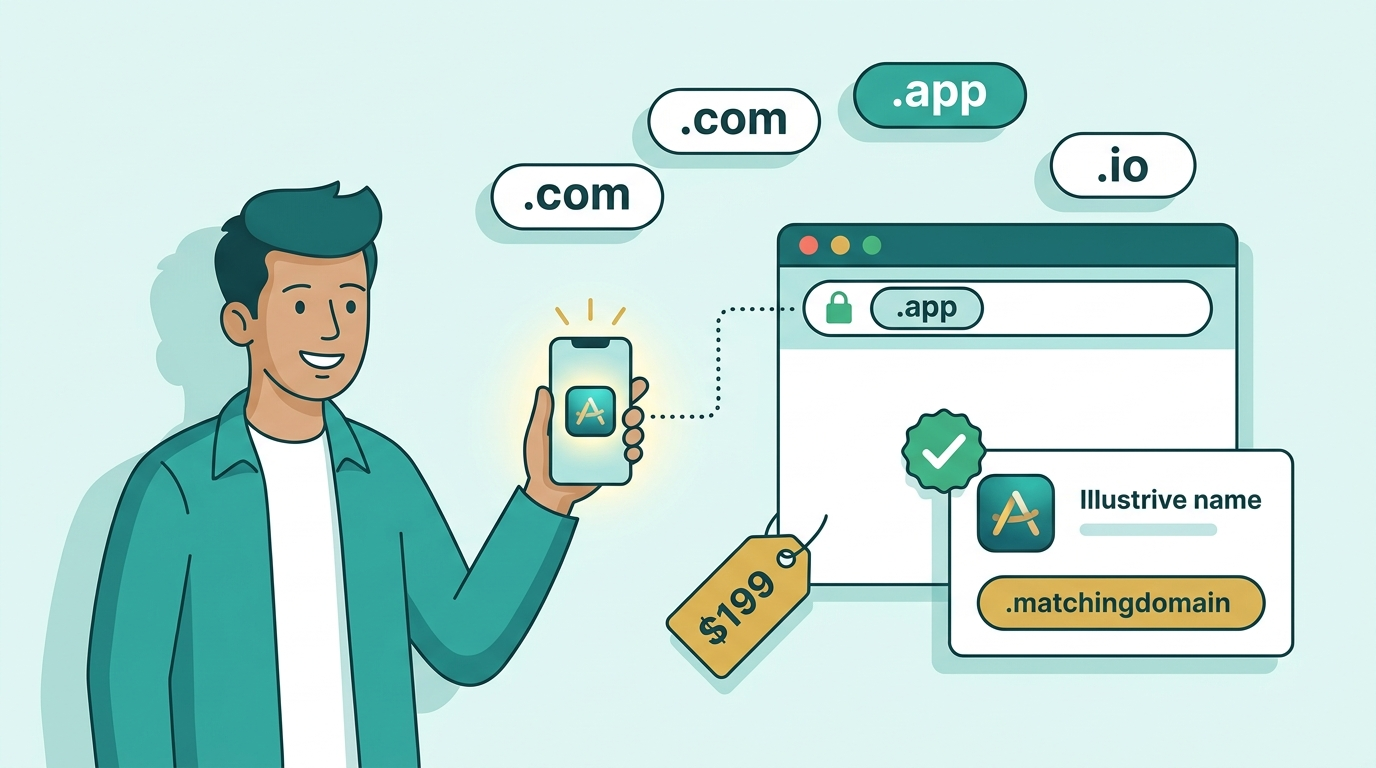
Here's a pattern I've watched play out for 25 years in the domain business, and it has only gotten more common in the AI-build era: the app is finished, the icon is designed, TestFlight is full of happy testers — and the whole launch stalls because the founder can't settle on a name, or discovers the name they settled on has no domain left to buy.
Naming an app is two problems wearing one coat. The first is the App Store problem: a name that ranks in search, fits the character limit, reads well under an icon, and clears store review. The second is the ownership problem: a name you can actually claim across a domain, social handles, and trademark space, so your brand isn't half-yours the day you launch. Almost every naming guide online solves the first and ignores the second — which is exactly why founders get blindsided at the domain-registrar step.
This guide solves both, in order, and ends with a timeline you can run in a single focused afternoon. Every domain featured here is $199 or less.
What makes a good app name in 2026?
Strip away the branding-agency mystique and a strong app name does four concrete jobs:
- It hints at what the app does without being generic. "Notes" tells a user everything and nothing — it's undifferentiated and unownable. A name should carry a spark of function or feeling while still being distinct enough to build a brand around.
- It survives being said out loud. The say-spell-search test is the fastest filter I know: can a stranger say it after hearing it once, spell it without you repeating yourself, and search it without landing on something else? Fail any one and you'll bleed downloads to confusion.
- It fits the frame. Under an icon, in a 30-character store field, in a URL, in a "Download on the App Store" badge. A name that only works as a logo but breaks everywhere else isn't finished.
- It's ownable end-to-end. This is the job the ASO blogs skip. A name you can own as an App Store title and a domain and a handle is worth more than a marginally cleverer name you can only partially claim.
Get those four right and the rest is polish. Get the fourth one wrong and you'll be quietly rebranding within a year — a topic I've written about in the warning signs that it's time to rebrand a startup.
How long can an app name be on the App Store and Google Play?
This is the hard constraint that shapes everything else, and it's identical on both platforms in 2026.
Apple's own App Store product page guidelines state plainly that "an app name can be up to 30 characters long," and only about 26 characters render before search results truncate. Google matches it: the Google Play listing guidelines require that "your app title must be 30 characters or less," with the same warnings against emojis, ALL CAPS, and ranking-claim language.
Thirty characters sounds roomy until you try to fit a brand plus a descriptor. The practical target most successful listings hit is a 10–15 character brand name, leaving room for one short keyword phrase after a separator:
| Element | Character budget | Example shape |
|---|---|---|
| Brand name | 10–15 chars | Lumen |
| Separator | 1–3 chars | – or : |
| Keyword phrase | remainder to 30 | Sleep Tracker |
| Total visible | ≤ 26 before truncation | Lumen – Sleep Tracker |
Keyword-stuffing the title is a mistake in both stores — it reads as spam to users and increasingly to the ranking algorithms. One clear descriptor beats three crammed keywords. If SEO weight is a priority for your web presence too, the keyword-versus-brand trade-off is worth understanding at the domain level as well; I break it down in keyword domains vs. brandable domains for SEO.
Why your app name and domain should match
Here's the moment every founder eventually hits. Someone hears your app name — on a podcast, from a friend, in a review — and does the most natural thing in the world: they open a browser and type the name followed by a guess at the extension. If that address doesn't resolve to you, you've handed a warm lead to a parked page, a competitor, or nothing at all.
Matching your app name to a domain you own closes that gap. It's also the difference between a real brand and a listing that only exists inside a store you don't control. The store can change its rules, reject an update, or bury you in search overnight — your domain is the one piece of the brand that's fully yours.
The trouble is that the clean .com for a good app name is often gone or priced in the thousands. That's where founders reach for the two oldest workarounds — and where most of them quietly weaken their brand.
The get-/-app prefix trap
When the exact-match .com is taken, the reflex is to bolt on a modifier: getlumen.com or lumenapp.com. It works, and plenty of real companies have done it. But it carries three hidden costs:
- Every verbal reference needs a caveat. "It's Lumen — l-u-m-e-n — dot com, but with 'get' in front." Friction on every introduction.
- You're renting attention to the exact match. Type-in traffic and word-of-mouth guesses flow to whoever owns the clean
lumen.com, not to you. - It signals scrappiness. For a weekend project that's fine. For a product you want investors and enterprise buyers to trust, a modifier reads as "couldn't get the real one."
There's a cleaner path, and it's the reason the .app extension exists.
Why .app is built for exactly this
Google Registry created .app as a domain purpose-built for applications. Two things make it the natural match for an app name. First, it reads as an application — lumen.app tells a visitor what they're looking at in a quarter-second. Second, it's on the HSTS preload list, so browsers connect to it only over HTTPS; your marketing site is encrypted by default with no way to accidentally ship an insecure page, which is a real trust signal for anything handling user data. Short, brandable words that disappeared from .com years ago are frequently still available on .app.
If you're weighing .app against .dev and .io for a technical product, I compared all three in depth — security behavior, renewal cost, and audience read — in domain names for indie developers.
Domain-matching strategies compared
When the perfect exact-match .com isn't realistic, these are your real options, ranked roughly by how well they hold up as a brand grows.
| Strategy | Example | Best for | The catch |
|---|---|---|---|
| Exact-match .com | lumen.com |
Consumer brands with budget | Usually taken or four-to-five figures |
| Clean name on .app | lumen.app |
Apps of any kind | Requires HTTPS (free, automatic) |
| Clean name on .io / .co | lumen.io |
Dev tools, B2B, startups | .io renews higher; .co reads as "company" |
| Coined one-word name | lumio.com |
New brands from scratch | Must build meaning from zero |
| Prefix/suffix modifier | getlumen.com |
Quick side projects | Rents traffic to the exact match |
The pattern I steer founders toward: if you can't own the exact match affordably, change the word before you change the extension into a modifier. A clean, coined, or shortened name you fully own on a modern TLD almost always outperforms the "right" word wearing a get or app band-aid. That's a naming decision as much as a domain one — the psychology of why some names stick and others don't is covered in the psychology of naming a startup.
How do I check if an app name is already taken?
Do not fall in love with a name before you've run all four of these. Skipping any one is how founders end up rebranding post-launch.
- App Store + Google Play search. Search the exact name and close variants. Two apps with near-identical names means poor discoverability at best and a rejection at worst.
- Domain availability. Check the name across
.com,.app, and one or two alternates at once. A fixed-price marketplace speeds this up because every listing is already vetted for clean history and trademark conflicts — you're choosing from pre-screened names instead of gambling on the raw aftermarket. - Trademark prescreen. Run the exact name through the USPTO trademark search database for your product's category (and the equivalent registry for your region). This is a prescreen, not legal advice — a same-name mark in an unrelated class may be fine, but a direct conflict in your category is a stop sign. When a name matters, confirm with a trademark attorney before you commit.
- Social handles. Check the handles you'll actually use. Consistency across store, domain, and social is what makes a brand feel real.
If a name clears all four, you have something you can own end-to-end. That's rarer — and far more valuable — than a name that merely sounds good.
A launch-week naming timeline you can actually run
You don't need a month. Here's the sprint I'd run to go from working title to a locked, ownable name in a single focused afternoon.
Step 1 — Write the one-sentence brief (10 minutes)
"It's a ___ for ___ that helps them ___." Underline the two or three words that carry the most meaning. Those are your raw material.
Step 2 — Generate 10–12 candidates (20 minutes)
Mix descriptive words, coined portmanteaus, and short evocative words. Keep every candidate under 12 characters if you can. Don't self-edit yet — volume first. For structured naming patterns that consistently produce brandable results, see the best domain names for SaaS startups and, for pure single-word strength, one-word domains for startups.
Step 3 — Run the say-spell-search filter (15 minutes)
Read each candidate aloud. Cut anything you can't say cleanly, can't spell on the first try, or that collides with an existing brand in search. You'll usually be down to three or four.
Step 4 — Run the four-part availability sweep (20 minutes)
Store, domain, trademark, handles — for each finalist. This is where most candidates die. That's the point: better here than at launch.
Step 5 — Decide and lock everything (15 minutes)
Pick the survivor that scores best on ownability, not just cleverness. Then buy the domain, reserve the app name in App Store Connect and Google Play Console, and grab the handles — in one sitting, so nothing gets sniped in the gap. If your app started life as a weekend build and you want the fast-track version of this sprint, I wrote it up in how vibe coders pick domains.
The bottom line: name it once, own it fully
The competitors ranking for "how to name an app" will tell you to keep it short, make it descriptive, and mind the 30-character limit. That's all true — and it's only half the job. A name that ranks in the App Store but that you can't own as a domain is a brand with a hole in the middle, and you'll pay to patch that hole later with a rebrand, a modifier domain, or a five-figure aftermarket purchase.
Do it in the right order instead. Nail the App Store constraints, then make sure the name is ownable end-to-end before you commit — domain, trademark space, and handles. A clean, brandable word on a .app, .io, or .com that's fully yours will carry your product further than a marginally catchier name you only half-control.
When you've got the name, browse curated build-an-app domains — short, brandable, trademark-screened, and every one $199 or less, ready to transfer within 72 hours. Or start from the extension up with our guides to brandable domains and keyword domains to lock the style of name before you name the app.