Ask a room of founders what stalled their launch longest and a surprising number will give the same answer: not the code, not the funding, not the go-to-market. The name. The build took a weekend; the name took a month. I've watched genuinely capable people ship a working product and then sit on it for three weeks because they couldn't decide what to call it — re-opening the same shortlist every evening, adding two names, removing one, and going to bed no closer than the night before.
The problem almost never is that naming is hard. The problem is that naming has no natural stopping point, so it expands to fill whatever time you give it. Every popular guide tells you to "take your time" and "don't settle," which sounds wise and, in practice, is the exact instruction that produces the paralysis. After 25 years buying, selling, and writing about domains, I've become convinced the opposite advice is more useful for a pre-launch founder: put a clock on it.
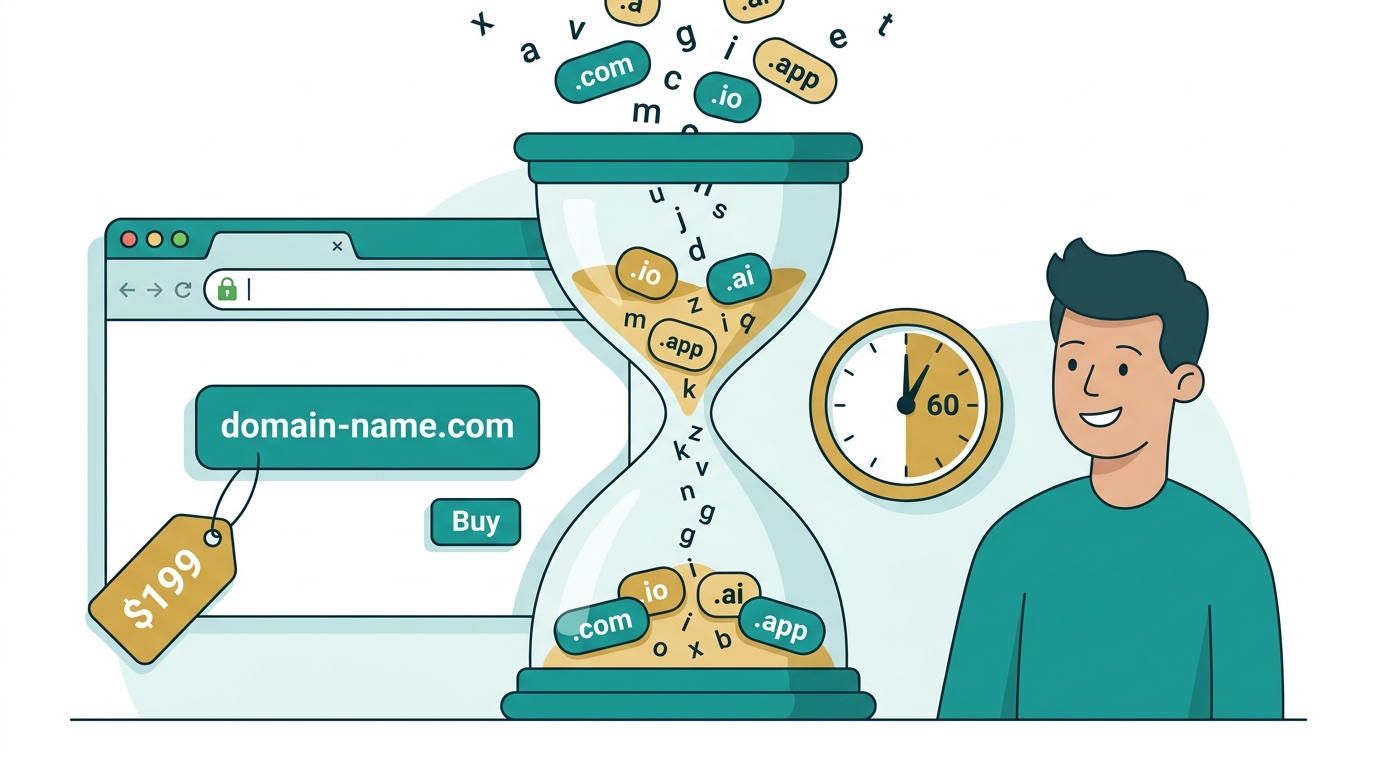
This is that clock. A strict 60-minute naming sprint — four fifteen-minute blocks — that takes you from a blank page to a short, brandable name you actually own, for $199 or less. Not a perfect name. A good name, decided and bought, which beats a perfect name that stays hypothetical every single time.
Why naming a startup takes weeks when it should take an hour
Look at how the standard advice is structured and the paralysis makes sense. The typical startup naming guide walks you through ten open-ended stages — understand naming psychology, define your purpose, build a buyer persona, brainstorm keywords, run generators, validate legally, test with an audience, and so on. Every stage is defensible. Together they describe a process with no timer and no forcing function, which is a recipe for a decision that never resolves.
Here's the uncomfortable truth underneath it: the quality of a naming decision stops improving long before the calendar does. The first hour of focused work surfaces most of your good candidates and kills most of your bad ones. Hour two adds a little. Day three adds almost nothing except doubt — you start second-guessing names you were happy with on day one, not because new information arrived, but because staring at anything long enough makes it look wrong. Extended deliberation doesn't refine the choice; it just corrodes your confidence in a choice you'd already effectively made.
The other hidden cost is what the delay does downstream. While you deliberate, you can't buy the domain, set up email, register social handles, or tell anyone what you're building. The name is a keystone dependency — a dozen small launch tasks are blocked behind it. Every day the name stays undecided, those days multiply. An hour-long sprint isn't about being reckless with an important decision. It's about refusing to let one keystone decision quietly hold the entire launch hostage.
The 1-hour naming sprint at a glance
The sprint is four blocks of fifteen minutes. Each block has one job and a hard handoff — when the timer rings, you move on, even if the block felt unfinished. That constraint is the whole point: it stops any single phase from swallowing the hour.
| Block | Time | The one job | What "done" looks like |
|---|---|---|---|
| 1. Diverge | 0:00–0:15 | List names without judging | 30–50 raw candidates on the page |
| 2. Filter | 0:15–0:30 | Run the say-spell-search test | 3–5 survivors that clear all three |
| 3. Sweep | 0:30–0:45 | Check real availability + price | 1–3 names you can actually get today |
| 4. Decide | 0:45–1:00 | Pick one and buy it | An owned domain, transfer initiated |
Set an actual timer. Not a vague intention to spend "about fifteen minutes" — a real countdown you can see. The visible clock is what converts good intentions into a finished decision. Everything below is just detail on what to do inside each block.
Minutes 0–15: Diverge — fill the board and judge nothing
The first block has exactly one rule: write everything, evaluate nothing. Your only goal is volume. Thirty to fifty raw candidates, dumped onto a page or a whiteboard, no filtering, no "that's dumb," no checking domains yet. The instant you start judging names as you write them, your output collapses to the four safe options you already had in your head — and those are rarely your best ones.
To keep the ideas flowing, rotate through a few angles rather than staring at one blank line:
- Describe what you do, then distort it. Start with the plain description ("scheduling for clinics") and mutate the words — synonyms, root words, Latin, verbs turned into nouns.
- Pair two clean words. The two-word compound is the most reliable brandable pattern going, and it stays affordable when single words don't — I make the full case in two-word domains: the affordable sweet spot. Dropbox, MailChimp, and BlueApron all came from this box.
- Invent a word. Chop, blend, or respell — a coined word is trademark-friendly and often the only way to get a short, clean name in a crowded category.
- Steal structure, not names. Look at brands you admire and copy the shape (verb+noun, one-word category claim, playful misspelling), not the word.
Fire through all four angles fast. Do not open a registrar or a search bar in this block — availability-checking is a different mental mode and it will strangle your idea flow if you let it in early. Just fill the board.
Minutes 15–30: Filter — the say-spell-search test
Now you judge, and you judge hard. This is where a chaotic list of forty names becomes a serious shortlist of three, and the tool is a single three-part filter every candidate has to survive. It's the fastest quality gate in naming, and most founders skip it — which is exactly why so many launched names quietly leak traffic and require constant spelling.
Say: the radio test
Read each name aloud once, the way you'd tell a friend across a loud room. If a listener couldn't repeat it back cleanly, it's out. As the team at Funded.club puts it, if you can't say your domain over the phone without spelling it letter by letter, it's too complicated. A name lives in conversation far more than on a screen — in podcasts, sales calls, and word-of-mouth referrals — and one that stumbles out loud loses momentum every time it's spoken.
Spell: the dictation test
Say the surviving names and ask whether a stranger would type the right spelling without you dictating letters. Silent letters, doubled consonants, "ph" for "f," and c/k/q ambiguity are all disqualifiers — every one sends a share of your hard-won traffic to a URL you don't own. The moment a name needs "no, the other spelling," it fails. A single obvious spelling on first hearing is non-negotiable.
Search: the crowd test
Type each remaining name into a search engine and into a free trademark search. If page one is already dense with an established company in an adjacent industry, cross it off — you'll spend years fighting for oxygen and possibly for the legal right to the name at all. This block is also your trademark prescreen; catching a collision now costs two minutes, catching it after you've printed business cards costs a rebrand.
A name has to clear all three parts. Anything that survives say, spell, and search is a real candidate. You should walk out of this block with three to five of them — no more.
Minutes 30–45: Sweep — check what you can actually get
Here's where the classic process derails, and where the sprint format saves you. You've got three to five strong names. On the open market, checking whether you can have them is its own multi-day ordeal: the clean .com is taken, it's parked on a make-an-offer page, you email the owner, you wait, you get a five-figure number back, and now your name decision is hostage to a negotiation. The Resend founders lived this — a domain that started at "$39,999," took days of back-and-forth, and closed at "$25,000." A great story for a funded company. A sprint-killer for everyone else.
The way to keep the sweep inside fifteen minutes is to check availability on venues that show you a real, fixed price up front instead of an invitation to negotiate. Run your shortlist through a fixed-price marketplace and you get a binary answer in seconds: it's available at a price you can see, or it isn't, and you move to the next name. No offer to draft, no reply to wait for, no anchoring game. If the clean .com of your favorite name is gone or absurd, this is also where you consider the same name on a modern extension — a two-word .io, .ai, or .app frequently reads more current than a compromised .com, especially for a technical audience, as I cover in one-word domains for startups.
Here's a live snapshot of the kind of short, brandable names that pass the say-spell-search filter and are available right now — every one priced up front at $199 or less:
By the end of this block you should have one to three names you can genuinely acquire today, with a known price next to each. Not "probably available." Available, priced, ready.
Minutes 45–60: Decide — pick one and own it
The final block is a decision and a transaction, not another round of debate. You have a tiny set of names that already cleared say-spell-search and are actually available at a fair price. The hard filtering is done. Now you commit.
If you're solo, pick the one you'll be happiest saying out loud a thousand times — the sound and feel matter more than any clever meaning nobody will notice. If you have cofounders, use the rule that keeps a sprint from collapsing back into a committee: everyone had a veto in the filter block, but one person makes the final call here. Consensus narrows; a single decider picks. Group voting at the finish line drifts toward the blandest option no one objects to, which is how startups end up with names nobody loves.
Then buy it. This is the step founders flinch at, and it's the least risky part of the whole sprint. A short, brandable domain bought at a fixed, transparent price is an appreciating, resellable asset — if you pivot later, you're holding something with real value, not eating a sunk cost. The genuine risk runs the other way: naming the company, telling people, and then discovering the domain is a multi-week negotiation. Buying at a fixed $199 or less, transferable within 72 hours, is what actually lets you close the sprint instead of re-opening it tomorrow. For the full case on why a fixed price beats the auction-and-offer game, see how to get a premium domain for under $500 and the psychology of make-an-offer pricing.
The printable 60-minute sprint checklist
Keep this next to your timer. One pass, top to bottom, no backtracking once a block's timer rings.
Block 1 — Diverge (0:00–0:15)
- Timer set, registrar and search bar closed
- Cycle the four angles: describe-and-distort, two-word pairs, invented words, stolen structure
- 30–50 raw names on the page, zero judging
Block 2 — Filter (0:15–0:30)
- Say each aloud once (radio test) — cut the stumbles
- Spell test — cut anything needing dictation
- Search + trademark prescreen — cut the crowded ones
- 3–5 survivors remain
Block 3 — Sweep (0:30–0:45)
- Check each survivor on a fixed-price marketplace (real price, no negotiation)
- Consider a modern extension where the
.comis gone or overpriced - 1–3 names available today, price known
Block 4 — Decide (0:45–1:00)
- Single decider picks one
- Two-minute final trademark glance
- Buy it — transfer initiated
A real 60-minute sprint, start to finish
To make it concrete, here's how the hour actually plays out for a founder building, say, a scheduling tool for independent clinics.
Diverge (0:00–0:15): They dump forty names — literal ones (ClinicClock, SlotWise), distorted ones (Kadence, Bookly, Tendo), two-word pairs (CalmDesk, ClearSlot), and a few invented blends (Schedu, Clivio). Messy on purpose. No domains checked.
Filter (0:15–0:30): The radio test kills the ones that blur out loud. The spell test kills Kadence (is it a c or a k?) and Clivio (nobody spells it right first try). The search test kills two names already owned by established scheduling companies. Five survive: SlotWise, ClearSlot, CalmDesk, Bookly, Tendo.
Sweep (0:30–0:45): On a fixed-price marketplace, they get instant answers. Two survivors are unavailable or over budget; three come back available at a visible price under $199 — one as a clean two-word .com, one on .app, one as a short brandable .co. No emails sent, no offers made.
Decide (0:45–1:00): The founder reads the three aloud one last time, picks the two-word .com because it's the one they'll enjoy saying on every sales call, runs a final trademark glance, and buys it. Transfer initiated. Total elapsed time: under an hour. The name debate is closed — permanently.
Sprint vs. endless deliberation: the honest comparison
| Dimension | The 60-minute sprint | Open-ended deliberation |
|---|---|---|
| Time to a decision | One hour, done | Days to weeks, often reopened |
| Name quality | Good, filtered by say-spell-search | Marginally better at best, usually not |
| Confidence at the end | High — you committed and acted | Erodes the longer it drags |
| Launch tasks unblocked | Immediately (email, socials, site) | Blocked until the name resolves |
| Domain outcome | Owned, fixed price, $199 or less | Often stuck in a make-an-offer negotiation |
| Failure mode | A slightly-imperfect name you own | No name at all after three weeks |
The sprint doesn't win because it produces better names than a careful month-long process. It wins because the month-long process rarely produces meaningfully better names — and it reliably produces delay, eroded confidence, and a stalled launch. Same destination, a fraction of the cost.
When to stop the clock
The sprint is the right default, not an absolute law. There are a few genuine cases where you should deliberately spend more than an hour. If you're naming a funded company mid-scale where a rename would mean re-papering contracts and confusing an existing audience, invest in real brand-strategy work — the stakes now justify it. If your product name has to work across multiple languages and markets at launch, add a pronunciation-and-meaning pass in each. And if you're naming an app where App Store search and icon constraints come into play, layer in those specifics, which I break down in naming an app: from working title to launch.
For the far more common case — a founder or small team trying to launch something and stuck on what to call it — none of those apply, and the sprint is exactly the forcing function you need. If you're naming a side project you built over a weekend, the sprint compresses even further, as I cover in how vibe coders pick domains.
Here's a current snapshot of short, buildable names across extensions — the kind you can decide on and own inside the hour, each $199 or less:
The bottom line: decide in an hour, own it today
Naming stalls launches not because it's hard but because it's unbounded — and the standard "take your time" advice makes the unboundedness worse. Put a real timer on it. Fifteen minutes to fill the board, fifteen to run say-spell-search, fifteen to sweep for what you can actually get, fifteen to pick one and buy it. You'll end the hour with a short, brandable name you own instead of a shortlist you'll reopen tomorrow night, and the night after that.
The last block is the one that makes the sprint stick: a name you've bought at a fixed, transparent price is a decision that's actually closed. Browse the curated brandable catalog or the buildable Vibe collection — short, clean, clean-history names, every one $199 or less and ready to transfer within 72 hours. Before you commit to any of them, the psychology of why founders overthink this decision is worth two more minutes: the psychology of startup domain names. Then set your timer, and go name the thing.