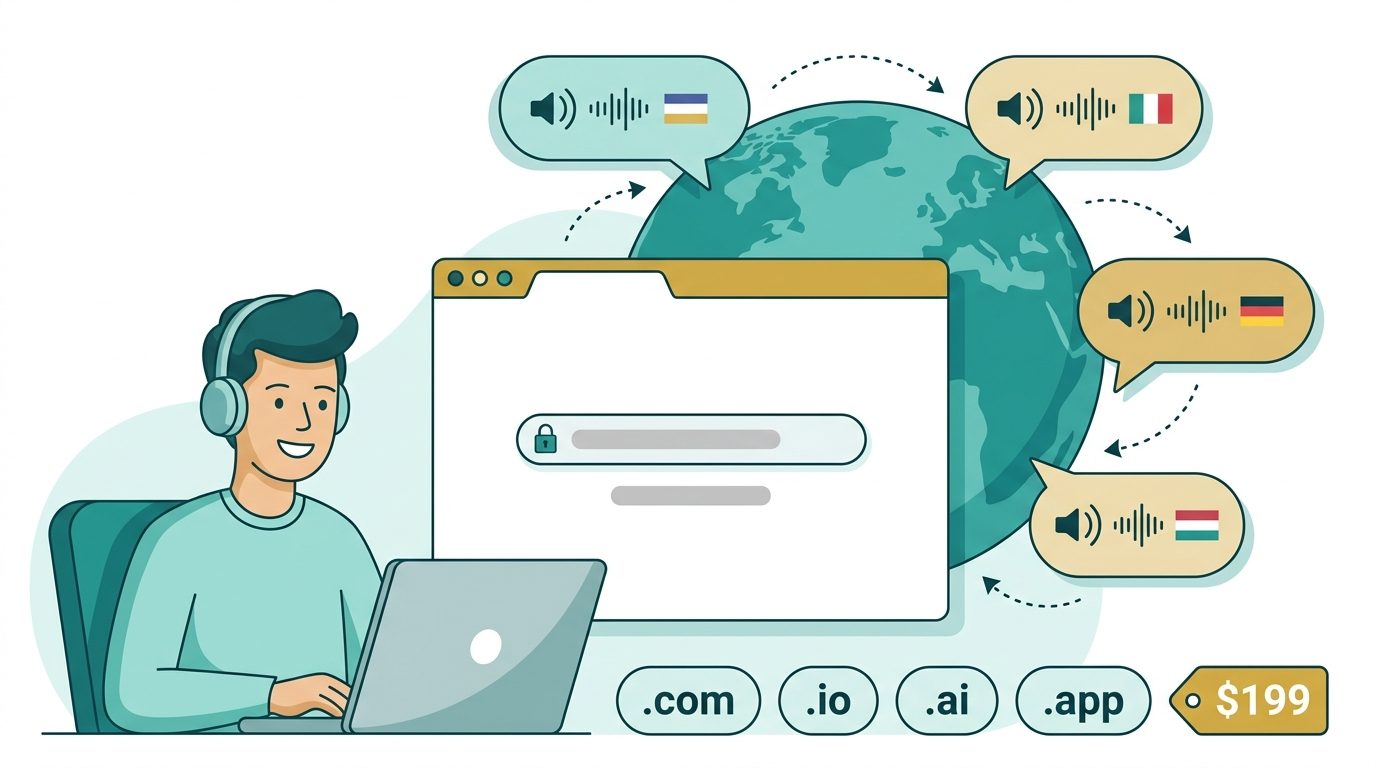
Here is a failure that never shows up in your analytics. A name tests well with an English-speaking team, launches in Germany or Brazil or Korea, and nobody there can remember it.
The cause is almost never the extension. It's that the name was designed for one mouth and one keyboard. It had a sound the local language doesn't make, a letter people spell differently out loud, or a meaning nobody on the original team knew about. The domain was fine on paper and quietly broken in the market that mattered.
International domain strategy usually gets treated as a pure SEO architecture question: ccTLDs, subdomains, or subfolders. That question is real, and it's all here. But it comes second. A global domain name has to survive being said, heard, typed, and understood in languages you don't speak, before the URL structure behind it matters at all. I've spent 25+ years buying, selling, and writing about domains, and names fail the first test far more often than the second.
This guide covers both, in the order that actually saves you money.
What makes a domain name work internationally?
A name that travels has to clear four hurdles in every market you care about:
- It can be said. Every sound in it exists in the listener's language, or a close substitute doesn't change the word.
- It can be spelled from hearing it. Someone who hears it on a call or a podcast can type it correctly on the first try.
- It means nothing bad. It isn't slang, a rude word, or an unfortunate false friend in a target language.
- It can be typed anywhere. It uses characters every keyboard has.
English-speaking founders fail hurdle two most often, because English spelling is unusually irregular and they've stopped noticing. Non-English founders more often fail hurdle three when they expand into English-speaking markets. Everyone underestimates hurdle one.
The pronunciation traps that break a global domain name
These are the patterns that come up again and again. None of them requires a linguist to spot. They just require looking.
- Sounds that don't exist. The English "th" isn't native to French, German, Japanese, or Mandarin, among many others. A name built around it gets said as "z", "s", "t", or "d", and then typed that way. Japanese does not distinguish "l" from "r", so a name that depends on the difference between them is a coin toss.
- Letters that sound different. In German, "w" is said like an English "v", "v" is usually said like "f", and "z" sounds like "ts". In Spanish, "j" is a throaty "h" sound and "h" is silent. A name like "Jolt" or "Havi" changes shape the moment it crosses a border.
- Consonant clusters at the start. Spanish and Portuguese speakers commonly add a short "e" sound before words starting with "s" plus a consonant, which is why "Spain" is "España". A name starting with "st", "sp", or "sk" often gets heard, and searched, with an extra vowel in front.
- Letter names. When people spell a domain aloud, they use their own alphabet names. In most European languages "i" is said "ee" and "e" is said "eh", so an English speaker reading out "dot i o" can produce a typo on the other end of the line. "Y" is "i griega" in Spanish and "ypsilon" in German. Every letter you have to spell out is a chance to lose the visitor.
- Number puns. "4" for "for" and "2" for "to" only work in English. Elsewhere they're just numbers, and in Chinese-speaking markets the number four sounds close to the word for death, which is why many buildings there skip it.
Meaning traps: the false friends
Some words mean something completely different in another language. "Gift" is German for poison. "Mist" is German for manure, and in everyday speech it means rubbish or "damn". Neither would stop a German speaker from reading an English site, but either one would be a strange choice for a brand you want to sell in Germany.
The fix isn't memorizing lists. It's asking a native speaker of each target language two direct questions: "What does this sound like to you?" and "Would you be embarrassed to say it to a client?"
The say-it-in-five-languages test
This is the test I recommend running on any shortlisted name before you buy it. It costs an afternoon and a few favors, and it catches the problems above before they're baked into your logo, your email addresses, and your ad accounts.
- Pick your five. Choose the five languages spoken by your most likely customers over the next three years, not just today. If you're unsure, include at least one Romance language (Spanish, Portuguese, French, or Italian), German, and one Asian language relevant to your market.
- Say it, don't show it. Record yourself saying the domain once, with the extension. Send only the audio to one native speaker per language.
- Ask them to type it. No hints, no corrections. Whatever they type is what their market will type.
- Ask them to say it back. Record their version. If it sounds like a different word, their colleagues will remember it as that different word.
- Ask the meaning questions. "Does this sound like anything?" and "Would you say it in a meeting?"
- Score it. One point per language for a correct spelling, one for a recognizable pronunciation, one for no bad meaning. A name that scores 13 or more out of 15 travels. Under 11, keep looking.
It pairs well with the faster, English-only process in our founder's one-hour naming sprint: run the sprint to get a shortlist, then run this test on the top three.
Short, invented, vowel-balanced names tend to score best, because they avoid difficult clusters and don't carry a meaning anywhere. That's one of the quiet advantages of brandable names over English keyword phrases for international companies. Here are live examples of the category from the marketplace. Every one is AI quality-vetted, owner-verified, and $199 or less:
When you look at names like these, apply the same checks: count the sounds that could shift, count the letters someone would have to spell out, and say each one with a German, Spanish, and Japanese accent in your head. Our guide to two-word domains covers the other common option, and why simple, concrete English words hold up better abroad than clever compound puns.
ccTLD vs gTLD: which one should an international startup choose?
Once the name works, the extension question has a clear structure. There are two families:
- ccTLDs (country-code top-level domains) are two-letter extensions tied to a country or territory: .de for Germany, .fr for France, .jp for Japan. Each is run by an organization in that country and generally subject to local law. CENTR, the association of European country-code registries, notes that some ccTLDs limit registration to people or organizations with a local presence, and that ccTLDs typically use their own dispute resolution policies rather than the global one.
- gTLDs (generic top-level domains) such as .com, .net, .app, and .dev aren't tied to any place. Anyone can register them through an ICANN-accredited registrar, and disputes run under one shared global policy.
How Google reads country domains
Google's documentation on managing multi-regional and multilingual sites is explicit: a ccTLD is a strong signal that a site is meant for one specific country. That's a genuine advantage if the country is your market, and a real constraint if it isn't.
Other signals count too. Hreflang annotations, local addresses and phone numbers, local language and currency, and links from other local sites all help Google work out who a page is for. Server location is weighed but isn't a definitive signal, because so many sites run on global content delivery networks.
The detail founders most often miss is Google's own exception list. Google treats a set of country codes as generic, because people use them that way. As of its latest documentation that list is .ad, .ai, .as, .bz, .cc, .cd, .co, .dj, .fm, .io, .la, .me, .ms, .nu, .sc, .sr, .su, .tv, .tk, and .ws, and Google notes the list may change. It also treats the regional .eu and .asia as generic.
So a .io, .co, or .ai site is not geotargeted to the British Indian Ocean Territory, Colombia, or Anguilla. It can rank anywhere, like a .com. They are still legally country codes, though. The IANA delegation record for .io, for example, lists a manager based in the British Indian Ocean Territory. That means their long-term policy sits with a local operator, which is worth weighing for a brand you plan to hold for decades. Our .app vs .dev vs .io comparison goes into what that means in practice.
| Extension type | Examples | Google geotargeting | Local trust | Registration limits | Best for |
|---|---|---|---|---|---|
| True ccTLD | .de, .fr, .jp, .uk | Strong signal for one country | High in its home market | Sometimes requires local presence | A business rooted in one country |
| Generic-treated ccTLD | .io, .co, .ai, .me | None, treated like a gTLD | Depends on audience | Usually open | Global tech and startup brands |
| Classic gTLD | .com, .net, .org | None | Broadly recognized worldwide | Open | Selling in many countries at once |
| New gTLD | .app, .dev, .shop | None | Growing, varies by audience | Open | Brands that fit the extension's meaning |
| Regional | .eu, .asia | None, treated as generic | Moderate | Varies by extension | Region-wide positioning |
Why ccTLDs still earn trust in Europe
The trust effect is not imaginary, and it's strongest in Europe. According to OpenProvider's analysis of domain trends for 2026, Europe hosts most of the world's large ccTLDs and they show some of the highest renewal rates in the industry, typically around 85%. A domain that owners renew year after year is one that's doing real work for a real business. In markets like Germany, the Netherlands, and Switzerland, a local extension still reads as "this company is here", which matters most for local services, ecommerce with local delivery, and anything involving money.
The same source summarizes an Identity Digital study of more than 4,000 startups in which 54% used a newer extension as their primary domain. Startups have clearly moved past .com-or-nothing. They haven't moved past the need for the extension to make sense to the customer. Our TLD trust rankings break down how each major extension actually reads to users.
Which domain architecture is best for global SEO?
If you serve more than one country or language, you have three ways to structure the site. Google's documentation lays out the trade-offs, and they haven't changed much in years.
| Structure | Example | Geotargeting | Cost and upkeep | Authority | Main drawback |
|---|---|---|---|---|---|
| ccTLD per country | example.de, example.fr | Clearest | Highest: separate domains, sites, and renewals | Split across every domain | Each site starts from zero; some ccTLDs have strict rules |
| Subdomain on a gTLD | de.example.com | Moderate | Moderate | Partly split | Users can't tell if "de" means language or country |
| Subfolder on a gTLD | example.com/de/ | Via hreflang and on-page signals | Lowest: one site, one domain | Consolidated in one property | Harder to separate hosting or teams by market |
For most startups, the answer is one generic domain with subfolders. Everything you publish builds the authority of a single property, links earned in one market help every other market, and you have one certificate, one analytics setup, and one renewal date. It's the same consolidation argument we make in our guide to portfolio thinking for founders, applied to geography.
Separate ccTLD sites make sense when a market is big enough to justify its own team, its own content, and its own link building, or when local law, payments, or buyer expectations effectively require a local presence.
Investor's note: The expensive mistake I see isn't picking the wrong architecture. It's building a ccTLD network before the company has traction in more than one country. Every new country domain starts with no authority, and the founder ends up maintaining five thin sites instead of one strong one. Buy the country codes for your real markets so nobody else takes them, point them at the right subfolder with a permanent redirect, and turn them into full local sites only when a market has earned it.
Hreflang: telling Google which page belongs to which market
Once you have more than one language or regional version, hreflang is how you tell Google which URL to show whom. Google's guide to localized versions of your pages sets out the rules, and most hreflang errors come from breaking one of four:
- Every version lists every version, including itself. The German page lists the German, French, and English pages. So does the French page. So does the English page.
- Links must be reciprocal. If page A points to page B, page B must point back to page A. Missing return links top Google's own list of common hreflang mistakes.
- Use valid codes only. Language codes follow ISO 639-1, and optional region codes follow ISO 3166-1 Alpha 2. So
de,de-CH, andpt-BRare fine, and codes outside those standards, such ases-419for Latin American Spanish, are not supported. - Set an x-default. This names the page for anyone whose language or region you haven't listed, usually a language selector or your main English page.
You can declare hreflang in HTML link tags, HTTP headers, or your XML sitemap. The sitemap is usually easiest to keep consistent as you add markets. And if you ever consolidate country domains into subfolders, the redirect rules in our guide to buying domains for SEO apply directly.
IDN basics: should you use accents or non-Latin scripts in your domain?
An internationalized domain name (IDN) lets a domain use characters beyond the plain a to z. As ICANN explains in its overview of internationalized domain names, that includes Latin letters with accents and marks used across many European languages, as well as entire scripts such as Arabic, Chinese, Cyrillic, and Devanagari.
Under the hood, the domain name system only stores ASCII. So every IDN has two forms: the Unicode form people see, called the U-label, and an encoded ASCII form beginning with xn--, called the A-label. A German company name with an umlaut is stored as a string of seemingly random letters after xn--, and that's the version that can appear when the name is pasted into some apps, email clients, or security tools.
That leads to a practical rule:
- Use an IDN when your audience types in that script every day, you sell mainly in that market, and your customers will reach you by typing or tapping the name in their own language.
- Use an ASCII name when you sell across several markets, when your customers use mixed keyboards, or when your email addresses need to work reliably everywhere.
- If your brand has an accented letter, own both. Register the accented IDN and the plain version. For German, that means the umlaut version and its conventional spelling without it (ü written as "ue"), and possibly the version that simply drops the mark. Redirect the extras to your main domain.
For most international startups, the brand can carry the accent in its logo while the domain stays plain ASCII. That's rarely a compromise anyone notices.
A decision framework by company stage
Here's how the pieces fit together, depending on where the company is today.
Pre-launch, planning to sell globally
Pick one name that passes the five-language test, on a generic extension your buyers trust. Launch in English with subfolders ready for later languages. Don't buy country codes yet: nobody is mistyping a brand they've never heard of. Before you commit, clear the name as a trademark in your first two or three markets, because ccTLD disputes run under local rules and a registered mark is your strongest tool there. Our trademark clearance guide walks through that search.
Rooted in one country, expanding later
If your first market strongly prefers its local extension, use the ccTLD as your main site and secure the matching .com (or another generic extension) now, while it's cheap. When you expand, the generic domain becomes the international hub, with subfolders for each new market.
Selling in several countries with real traction
Keep one generic domain with subfolders and hreflang. Register the ccTLDs for your top markets and 301-redirect each to its matching subfolder, not to your homepage. Build a separate local site only for a market that has its own team and budget.
Extensions like .co sit in a useful middle ground for international startups: short, open to register, and treated by Google as generic, so they don't lock you into one country. If you're weighing an AI-focused name, .ai is on the same generic-treated list, and our guide to affordable .ai domains covers what's still realistic in 2026.
The bottom line
An international domain strategy has an order of operations, and skipping ahead is expensive.
First, make the name itself travel. Check that it can be said, spelled from hearing it, typed on any keyboard, and doesn't mean anything unfortunate. Run the five-language test before you buy, not after the logo is printed. Then choose the extension for where your customers actually are: a true ccTLD when you're rooted in one country, a generic extension (or a generic-treated one like .io, .co, or .ai) when you sell everywhere. Structure the site as one domain with subfolders until a market earns its own site, wire hreflang carefully, and keep IDNs for audiences that live in that script.
The best global domain name is short, easy to say, and means nothing in particular in any language, so it can come to mean your company. Browse curated brandable domains or premium one-word domains, every one $199 or less, owner-verified, with the price visible up front and no negotiation. If you want a deeper look at the category first, start with our guide to brandable domains, or see what it takes to get a genuinely premium domain for under $500.