Nobody gets taught how to name a company. You pick it up in fragments: a brainstorming tip from a founder thread, a registrar blog telling you to grab a .com before someone else does, a lawyer friend mentioning trademarks after you've already printed the stickers. The fragments rarely add up, and the step that burns the most money (everything after checkout) almost never gets covered at all.
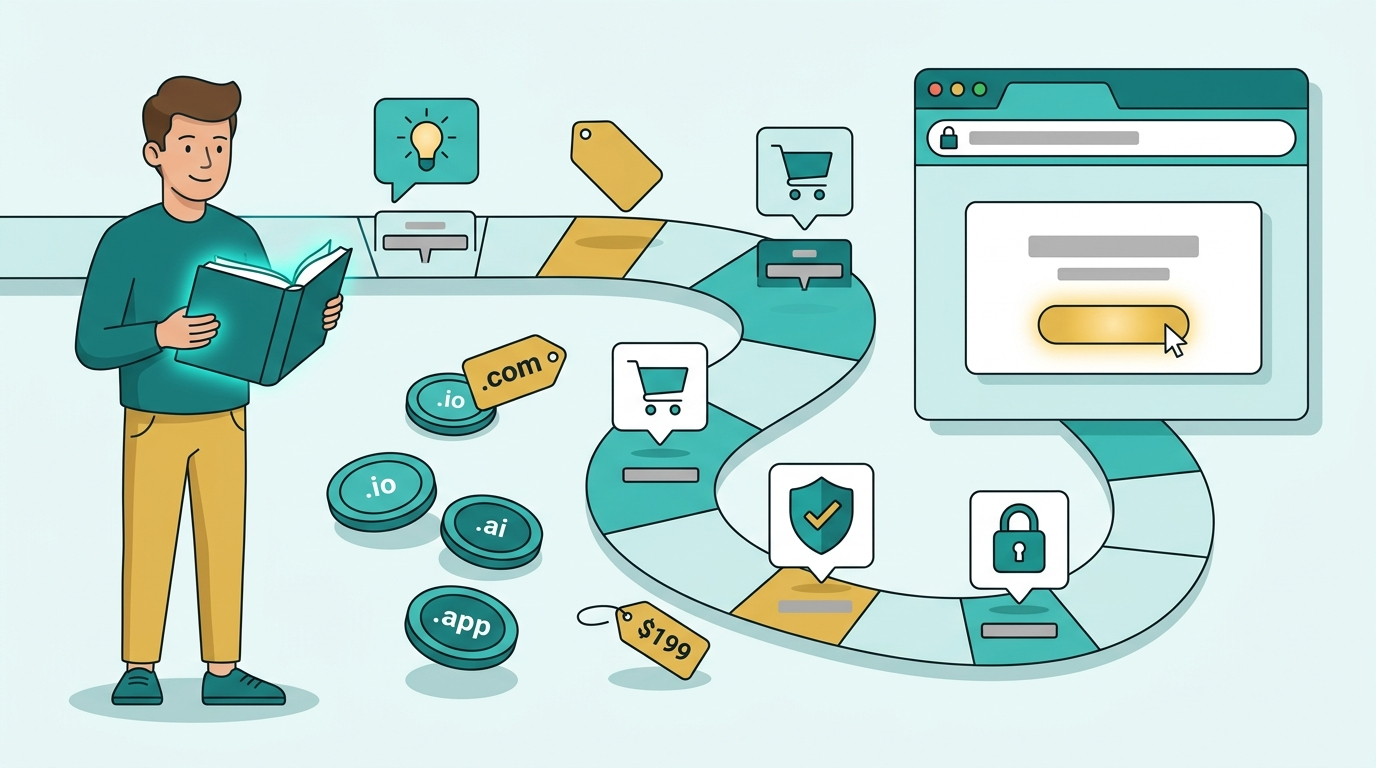
This is the whole job in one place. Over the last three months we've published a deep-dive on nearly every step of naming a startup and securing its domain. This playbook is the map that connects them: the principles, the process, the extension decision, the budget, the purchase, the checks, and the setup work afterwards.
I've spent more than 25 years buying, selling, and writing about domain names, and the founders who get naming right aren't the most creative ones. They're the ones who run the steps in order. Here are the steps.
How to use this startup naming playbook
Read it top to bottom once, for the map. Then go deep only on the phase where you're stuck. Each phase links to the full guide.
| Phase | The question it answers | Realistic time | Deep-dive |
|---|---|---|---|
| 1. Principles | What makes a name good? | 15 minutes to absorb | Naming psychology |
| 2. Generate | Where do candidates come from? | 1 hour | The 1-hour naming sprint |
| 3. Extension | .com, .ai, .io, .app, or something else? | 10 minutes | TLD trust rankings |
| 4. Budget | How much should this cost? | 10 minutes | Domain valuation explained |
| 5. Acquire | How do I actually get it? | Minutes to weeks, by route | Fixed-price vs. auction |
| 6. Clear | Is it safe to build on? | 15 minutes | Trademark clearance |
| 7. Set up | What do I do after buying? | One afternoon | Domain transfer guide |
Seven phases looks like a lot. Phases 1 to 4 take a single focused morning. Phase 5 is where founders lose weeks, and it's almost always because they picked a route that doesn't fit their budget.
What makes a good domain name for a startup?
Five principles do nearly all of the filtering. A candidate that fails any one of them should be cut, however much you like it.
1. It passes the say-and-spell test
Say the name once to someone who hasn't seen it. Ask them to type it. If they get it right on the first try, the name survives word of mouth, podcasts, and sales calls. If they ask "is that with a K?", that question will be asked thousands of times over the life of your company. The science behind why this matters so much is processing fluency, and we cover it in the psychology of domain names.
2. It's short enough to remember, not so short it's unaffordable
Shorter is better, up to a point. A single dictionary word is the most memorable shape there is, and one-word domains carry real category authority. They're also scarce, which is why one-word .com domains under $500 takes some hunting. The shape I'd point most founders to first is two clean words under about 12 characters. Two-word domains are the affordable sweet spot: nearly as memorable, and a fraction of the price.
3. It leaves room to grow
A name that describes your first feature becomes a liability at your third product. Brandable names give you room; keyword names give you instant clarity but box you in. Keyword vs. brandable domains settles the SEO side of that trade, and our two evergreen guides cover each side in depth: brandable domains and keyword domains.
4. It reads as trustworthy in your market
The same name can reassure one buyer and worry another. A fintech name has to do reassurance work before the product gets a chance to, which is why fintech startup domain names lean on trust roots. An agency needs to look bigger than it is (domain names for agencies and freelancers), and a name that has to work across languages carries extra risk (international domain strategy).
5. You can actually own it
Ownership has two halves: the domain, and the trademark. Invented and arbitrary names are far easier to protect than descriptive ones, and a name you can't protect is a name a competitor can crowd. Phase 6 covers the check.
Investor's note: The five principles are ranked. When two of them conflict, the higher one wins. A slightly longer name that everyone can spell beats a shorter one that nobody can.
How do you come up with a startup name?
Don't wait for inspiration. Run a process with a clock on it.
- Write ten nouns from your customer's problem space. The problem, not your product. A scheduling tool might start from: calendar, shift, slot, rota, window, hour, desk, crew, roster, week.
- Write ten endings from proven patterns. Sync, forge, pilot, kit, loop, craft, hive, base, ly, shift. 50 brandable domain ideas for 2026 breaks down the ten patterns that sell fastest, with the formula behind each.
- Cross them. One hundred combinations in a few minutes. Most will be dead. A handful will make you stop.
- Say every survivor out loud to another person. This cuts the list in half, and it's the step founders skip most.
- Timebox the decision. The founder's 1-hour naming sprint runs this as four 15-minute blocks, ending with a purchase instead of another week of debate.
Your product type changes which patterns work. We've written the playbook for several of them:
- SaaS: the best domain names for SaaS startups
- Mobile apps: naming an app, from working title to App Store launch
- Weekend builds: how vibe coders pick domains
- Developer tools: .app vs .dev vs .io for indie developers
If you'd rather start from names that already exist and are already for sale, browse while you brainstorm. A curated shelf shows you the intersection of "good" and "available" that no generator can:
Which domain extension should a startup choose?
Answer these five questions in order. Stop at the first "yes".
- Is your exact-match .com available at a price you can justify? Buy it. It remains the default the internet assumes, and our funded startup domain data roundup found that more than half of the startups in the largest published sample held their exact-match .com.
- Are you building an AI product for a technical audience? A strong .ai is fully credible. Budget for its higher renewals, covered in affordable .ai domains for startups.
- Is your buyer a developer? .io, .dev, and .app all read as native. .app and .dev require HTTPS on every site, which is a security feature you get by default. The trade-offs are in .app vs .dev vs .io compared.
- Are you selling mainly into one country? A local country code can beat a generic extension on trust. International domain strategy covers when, and which country codes Google treats as generic anyway.
- None of the above? Go back to naming. A weaker name on .com usually beats a stronger name on an extension your buyers don't recognize.
| Extension | Reads as | Best for | Watch out for |
|---|---|---|---|
| .com | The default, universally trusted | Almost everyone | Scarcity pushes good names up the price curve |
| .ai | AI-native, current | AI products, technical buyers | Higher renewal costs than most extensions |
| .io | Developer and infrastructure tooling | Dev tools, APIs | Higher renewals, fading slightly as .ai rises |
| .app / .dev | Modern, secure by default | Apps, developer products | HTTPS required, so plan hosting before launch |
| .co | Startup-friendly, compact | Consumer brands, short names | Frequently mistyped as .com |
| Local country code | Local and established | Single-market businesses | Can read as foreign outside that country |
The full tiering, including which extensions hurt email deliverability, is in TLD trust rankings 2026.
How much should a startup spend on a domain name?
Spend according to what you've proven, not what you hope. The biggest domain mistakes I see are almost all budget mistakes: a pre-revenue founder draining runway on a trophy name, or a funded company still hiding behind getbrandname.com years after it could have fixed it.
| Company stage | Sensible budget | What that buys | Read next |
|---|---|---|---|
| Idea or weekend project | Tens of dollars to low hundreds | A clean, buildable name so you can ship | Vibe coder domains |
| Validated, early revenue | Up to a few hundred dollars | A short, brandable name you'll keep for years | Premium domains under $500 |
| Seed or Series A | Low to mid four figures | Upgrading to the exact match you've outgrown | Rebrand warning signs |
| Growth, proven brand | Whatever the leaked traffic is worth | The exact .com, defensive variants, typos | Portfolio thinking |
Two rules keep the numbers honest:
- Price the name, not your attachment to it. Domain valuation explained walks through the six levers that actually set a price, and why three appraisal tools will give you three wildly different answers.
- Count the total, not the sticker. Premiums, escrow fees, commissions, and renewals all sit on top of the listed price. Some registry-premium names renew at premium rates every year, forever. Always check the renewal price before you pay.
How do you buy a domain name that someone already owns?
The route you choose sets your real cost more than the name does. Here are the six routes, from fastest to slowest.
| Route | Typical speed | Price certainty | Hidden costs | Best when |
|---|---|---|---|---|
| Hand-register at a registrar | Minutes | Total | Premium renewals on some names | The name is simply unregistered |
| Fixed-price marketplace | Minutes to buy, transfer within days | Total | Few, if fees are included | You want a vetted name at a known price |
| Make-an-offer listing | Days to weeks | None | Your time, and anchoring upward | Rarely; the blank box favors the seller |
| Auction | Days | Low | Buyer's premiums, bidding fever | You know the true value and can walk away |
| Direct outreach to the owner | Weeks | Low | Escrow, negotiation hours | The name is unlisted and truly essential |
| Hire a broker | Weeks to months | Low | Commission on top of the price | Five-figure names with a hard-to-reach owner |
Each route has its own deep-dive:
- The true total cost of every route: fixed-price vs. auction domains
- Why a blank price box costs you more: the psychology of make-an-offer domains
- How brokers get paid, and when one is worth it: how domain brokers really work
- The four proven routes to a quality name for less: how to get a premium domain for under $500
- Marketplace head-to-heads: 199.domains vs. Atom and 199.domains vs. Brandpa vs. BrandBucket
The fixed-price row is the one this site is built around. Every name in the 199.domains catalog is priced $199 or less on a ladder from $29 to $199, shown up front, with no auction, no negotiation, and no broker in the middle. If you want to know what "vetted" actually means before you trust it, how we curate, vet, and price every listing shows the full pipeline, and introducing 199.domains explains why it exists.
What should you check before buying a domain?
Fifteen minutes here prevents the three expensive surprises: a trademark conflict, an inherited penalty, and a domain whose email lands in spam.
Check the trademark register
Search the name and its close variants on the trademark registers for every market you'll sell into. What matters is likelihood of confusion within your class of goods and services, not whether the word appears anywhere at all. The trademark trap shows how to tell a real conflict from a harmless coexistence, and when a name is a hard stop.
Check the domain's past life
A previously registered domain has a history you didn't see. Look at archived versions of the site, the backlinks pointing at it, and whether it was ever used for spam or thin content. Buying a domain for SEO covers the vetting steps and what Google's expired-domain policy now targets.
Check that it can send email
The extension you choose and the domain's reputation both shape whether your first emails reach an inbox. Email deliverability and your domain covers the buying decisions that keep you out of spam.
What to do after buying a domain: the post-purchase checklist
Checkout is the halfway point. Work through this list the same week.
- Complete the transfer and note the lock. Under ICANN's Transfer Policy, a registrar can refuse to move a domain within 60 days of its creation or a previous transfer. Plan around that window if you intend to consolidate registrars. The step-by-step process, and why most transfers fail, is in the complete domain transfer guide.
- Turn on auto-renew and registrar lock. An expired domain is the most avoidable way to lose a company's front door. Add a second payment method while you're there.
- Authenticate your email before the first send. Gmail's email sender guidelines require every sender to set up SPF or DKIM, and anyone sending more than 5,000 messages a day to Gmail accounts must set up SPF, DKIM, and DMARC. Set up all three from day one, whatever your volume.
- Register only the defensive variants that earn their keep. The matching .com if you launched elsewhere, an obvious misspelling, and not much more. Portfolio thinking for founders gives a four-tier framework, so you don't end up paying renewals on thirty names.
- Point every extra domain at the main one with a permanent redirect. If you're ever moving an existing site, Google's site move guidance says to keep redirects for as long as possible, generally at least a year. The migration checklist is in when to rebrand your startup.
- File the trademark application once the name has cleared, before you spend on brand design.
When should a startup change its domain name?
Sometimes the right playbook move is to name again. The signals are specific: traffic and email leaking to the exact match you don't own, spelling friction on every sales call, a trademark letter, or a get or try prefix you've outgrown. 7 domain name warning signs walks through each one with a cost framework by funding stage.
The cheaper fix is usually preventive. If you're on a compromise name today, the upgrade is often far less expensive now than after another year of links, customers, and printed materials point at the old one.
What should you do with domains you don't use?
Almost every founder who runs this playbook ends up holding names they didn't pick: the runner-up, the old working title, the defensive registration that turned out unnecessary. Don't let them renew in a drawer forever.
Either let the genuinely weak ones lapse, or sell the good ones to the next founder. On 199.domains you can list a domain for free: it passes the same AI quality review as every listing, you verify ownership by DNS, set your price on the $29 to $199 ladder, and keep up to 81% when it sells. Start at the seller page.
The startup naming playbook on one page
Print this. It's the whole guide, compressed.
- Principles: say-and-spell first, then short, then room to grow, then trust, then ownable.
- Generate: ten problem nouns, crossed with ten pattern endings, said out loud, inside one timed hour.
- Extension: exact .com if justifiable; .ai, .io, .app, or .dev for technical buyers; local code for a single market; otherwise rename.
- Budget: match spend to proof. Pre-revenue founders need a great name for $199 or less, not a trophy.
- Acquire: choose the route by price certainty. Avoid blank price boxes unless the name is truly essential.
- Clear: trademark, history, email, in about 15 minutes.
- Set up: transfer, auto-renew and lock, SPF plus DKIM plus DMARC, a few defensive names, permanent redirects, trademark filing.
Investor's note: The founders who regret their domain almost never regret the price. They regret the months they spent deciding, or the shortcut they took at checkout. Run the steps, set a clock, and buy the name.
If you're ready for Phase 5, these are live and available right now, each priced $199 or less:
Browse the full featured domains, the brandable catalog, the premium one-word names, or the Vibe names you can build an app on.
The takeaway
A good startup name isn't found by luck or by staring at a whiteboard. It comes out of a sequence: filter with the principles, generate on a clock, choose the extension deliberately, spend in proportion to what you've proven, buy through a route with a price you can see, clear it, and do the setup work the same week.
Every step has a full guide behind it. Use the map, go deep where you're stuck, and don't let naming become the thing that keeps you from launching.